Table of Contents
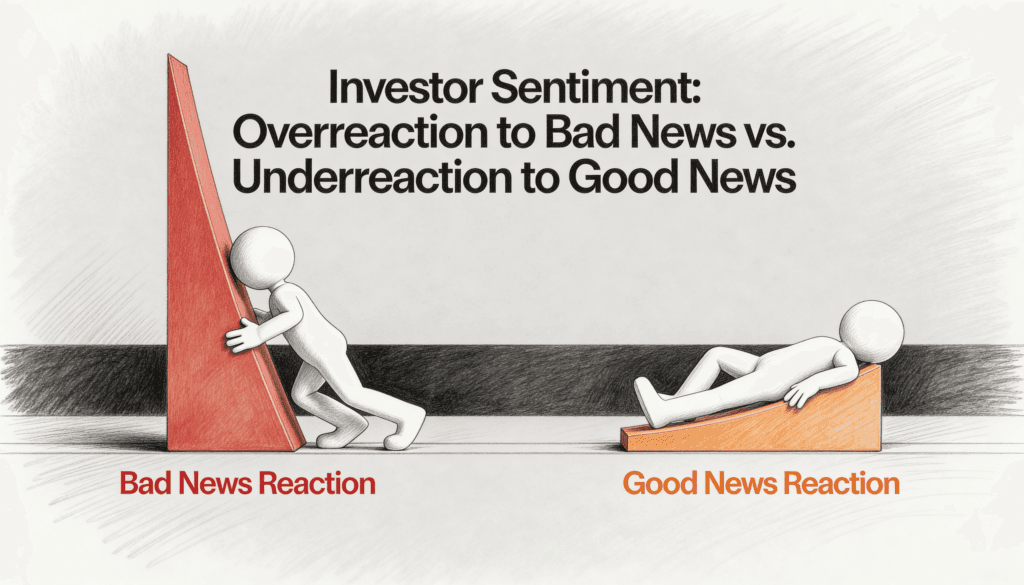
There is a strange asymmetry that lives at the heart of every market. A company can spend ten years building something remarkable, quietly compounding cash flows, improving margins, expanding into new geographies, and the market will reward it with a polite nod and a modest re-rating. Then one Tuesday afternoon, the same company misses earnings by two cents, and the stock falls twelve percent before lunch. Nobody is surprised. Everyone shrugs. This is just how markets behave.
But why?
The standard explanation, the one you will hear in finance classrooms and on financial television, is that investors are irrational. They panic. They are greedy. They are driven by emotion rather than logic. This explanation is true in the way that saying water is wet is true. It describes the surface without saying anything useful about the structure underneath.
The deeper answer has less to do with psychology and more to do with the architecture of how information moves through a market. Bad news and good news are not symmetric goods. They travel at different speeds, they are priced by different participants, and they are interpreted through different mental machinery. Once you understand this, the overreaction to bad news and the underreaction to good news stops looking like a bug. It starts looking like a feature of the system.
Loss is a Sharper Teacher
Begin with the obvious. Humans feel losses more intensely than gains of equal size. This is the famous insight from behavioral economics, and it explains part of the asymmetry. If you lose a hundred dollars, you feel it roughly twice as much as you would feel finding a hundred dollars. Multiply this across millions of investors making thousands of decisions a day, and you get a market that is structurally more sensitive to negative information.
But this is only the first layer, and it is the least interesting one. Loss aversion tells you why people flinch. It does not tell you why the flinch is amplified by the market itself into something violent.
To understand that, you have to think about who is on the other side of the trade when bad news hits.
The Vanishing Buyer
When good news arrives, sellers do not disappear. They simply raise their asking prices. The stock drifts up in an orderly way as buyers and sellers renegotiate. The market behaves like a well lit auction house.
When bad news arrives, buyers vanish. Not because they are scared, though some are, but because they genuinely do not know what the right price is anymore. A profit warning is not just information about earnings. It is information about everything you thought you knew about the company. Maybe management has been hiding problems. Maybe the industry is shifting. Maybe the auditor is about to resign next quarter. Buyers do not refuse to bid because they are emotional. They refuse to bid because they need time to think, and time is the one thing a falling market does not give you.
The market makers, the firms whose job it is to provide liquidity, widen their spreads dramatically. They are not being cruel. They are pricing in the risk that they do not know what they do not know. When uncertainty spikes, the cost of being a buyer goes up. The bid retreats. The price falls until it reaches a level where someone, somewhere, is willing to step in and absorb the shares.
This is why bad news produces what looks like overreaction. It is not that the news is being mispriced. It is that the price has to fall far enough to compensate the brave for the privilege of catching a falling knife. The market is not overreacting. It is paying for liquidity at a moment when liquidity has become expensive.
Good news does not require this discount. A positive surprise might bring new buyers to the market, but it does not make sellers afraid to sell. The supply of shares is still there. The market processes good news through normal channels. The reaction is muted because the machinery is working as designed.
The Story Problem
There is another asymmetry that nobody talks about, and it has to do with narrative. Bad news comes with a story attached. Good news rarely does.
When a company reports a disastrous quarter, the headlines write themselves. There is a villain. There is a betrayal. There is a moment where things went wrong. The story is satisfying because it has structure. The CEO did this. The competitor did that. The regulator changed its mind. Journalists, analysts, and Twitter strategists immediately assemble a coherent narrative, and the narrative spreads faster than the underlying facts.
When a company reports an excellent quarter, the story is boring. They executed well. Margins improved. Demand was strong. There is no villain, no twist, no moment of revelation. The narrative does not travel because there is nothing dramatic to carry it.
This matters because markets are partly priced by attention. A story that grabs attention pulls in more participants, more analysis, more trading volume. Bad news creates a feedback loop where the story attracts attention, the attention attracts selling, the selling validates the story, and the cycle repeats. Good news has no such loop. The stock drifts up quietly, and most people do not notice until it has already happened.
This is why great companies are often discovered slowly. The market is not blind to them. It is simply not interested in stories without conflict.
The Career Risk Distortion
Now consider the people who actually move large pools of money. Fund managers, and institutional investors are not playing the same game as individual investors. They are playing a game where being wrong in an interesting way can end your career, while being wrong in a boring way usually does not.
If you are a fund manager and you hold a stock that collapses on bad news, you have a problem. You will be asked why you did not see it coming. You will be asked why you did not sell. You will be compared to peers who did sell. Your reputation, your bonus, and possibly your job depend on the answer.
But if you fail to buy a stock that quietly doubles over two years, almost no one notices. You did not lose money. You just did not make as much as you could have. This is the kind of mistake that disappears into the noise. Your investors do not call you about the things you did not buy.
So institutional investors are structurally biased toward selling on bad news and waiting on good news. Selling protects them. Waiting protects them. The asymmetry of professional risk gets baked into the asymmetry of price reactions. The market overreacts to bad news partly because the people making the decisions are protecting themselves, not optimizing returns.
This is one of the great open secrets of professional money management. The job is not to be right. The job is to be defensibly wrong.
The Compounding Blindspot
There is also a deeper cognitive issue at work, and it has to do with how human brains process exponential change. We are linear creatures living in a compounding world. We can imagine a company growing twenty percent. We have trouble imagining what twenty percent for ten consecutive years actually looks like.
When a company reports a great quarter, the market prices in the immediate good news. It does not usually price in the implications of what that good news means for the trajectory of the business over the next decade. This is not because investors are stupid. It is because the human mind genuinely struggles to feel the weight of compounding.
This is why great businesses tend to be persistently underpriced for long periods. The market sees the next quarter clearly. It sees the next year reasonably well. Beyond that, the picture gets fuzzy, and the brain defaults to assuming things will revert to average. Most things do revert to average. But the businesses that do not are the ones that produce most of the returns in any market, and they are systematically undervalued by a market that cannot quite believe in their persistence.
Bad news, by contrast, gets priced linearly and then some. A company that misses earnings gets punished not just for the miss but for the implied trajectory. The market assumes the bad news will compound. The good news, it assumes, will not.
What This Means in Practice
If you take all of this seriously, a few things follow.
First, the worst time to sell is usually right after bad news, because that is when the price reflects not just the news but the cost of liquidity in a panicked market. The information has been priced. The liquidity discount has not yet recovered. Selling at that moment means you are paying twice for the same problem.
Second, the best time to pay attention to a company is when nothing interesting is happening to it. Good businesses build value during the boring quarters. The market does not notice. The story is dull. The professional managers are looking elsewhere. This is where the asymmetry can be exploited, not by being clever, but by being patient.
Third, the framing of news matters more than the news itself. A company that beats earnings by five percent and guides down for the next quarter will often be punished harder than a company that misses earnings by five percent and guides up. The market is responding to the narrative, not the numbers. The investor who can separate these two has an edge that does not require any special information.
The market is not a calculator. It is a crowd, and crowds have moods, and moods have a structure. The structure of fear is loud and fast. The structure of confidence is quiet and slow. If you understand which one is operating at any given moment, you understand more about price than most of the people setting it.
And that, in the end, is the real edge. Not predicting the news, but understanding how the machine responds to it.