Table of Contents
Why the Wealthy Are Quietly Trading Cash for Canvas, Cork, and Clockwork
There is a quiet panic happening in the vaults of the very rich, and it does not look like panic at all. It looks like a Basquiat hanging in a Geneva freeport, a case of 2010 Domaine de la Romanee Conti resting in a temperature controlled cellar in London, or a steel Patek Philippe Nautilus, still wrapped in its plastic, sitting in a safe somewhere in Singapore.
To the casual observer, investing in art, wine and watches looks like a hobby. A toy. The expensive taste of people who have already bought every house they could possibly live in. But that reading misses what is actually going on. The wealthy are not collecting these objects because they have run out of things to spend money on. They are collecting them because they have lost faith in money itself.
That is a strange thing to say in an era when central banks publish glossy reports about price stability and politicians talk about cooling inflation as if it were a fever that broke last week. But the people who have the most to lose tend to read the situation differently than the people writing the press releases. And what they have concluded, more or less in unison, is that cash is no longer a safe place to wait.
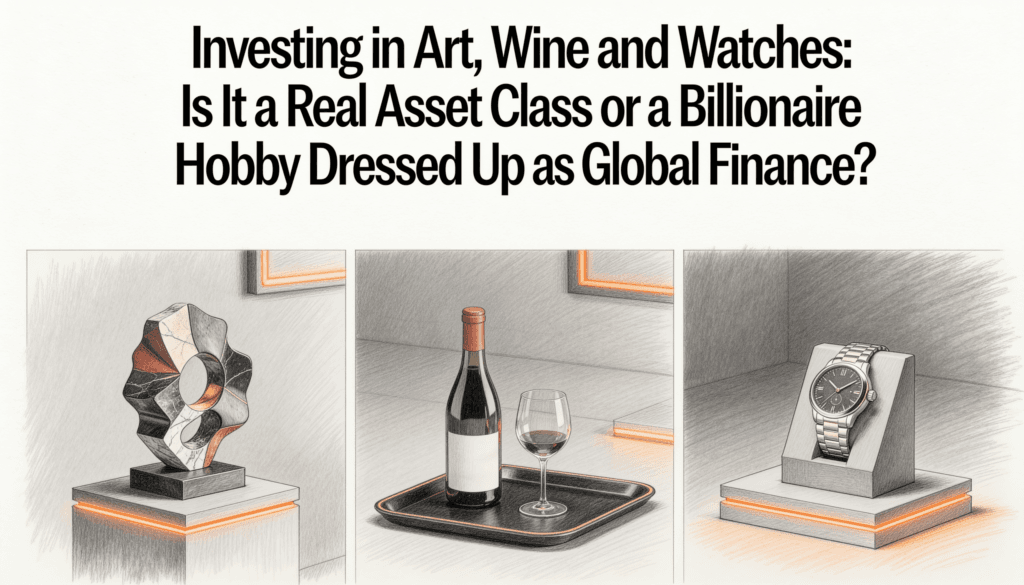
So the question that follows is the one worth sitting with. Are luxury collectibles a genuine alternative asset class, with the same seriousness we give to stocks and bonds, or are they simply a billionaire hobby that has been dressed up in the language of finance to make the spending feel responsible? The honest answer is that they are a little of both, and the difference between the two depends almost entirely on who you are and how much you already have.
The Quiet Insult of Holding Money
There is something almost philosophical about what inflation does to a person. It is not only that your money buys less. It is that your patience gets punished. Every month you hold cash and do nothing with it, you are quietly being told that prudence was the wrong choice. Saving, that old virtue your grandparents preached, has been turned into a slow leak.
For a middle class household, the leak is painful but manageable. You feel it at the grocery store and at the gas pump, and you grumble. For someone with serious money, the leak is catastrophic in a way that is hard to imagine until you do the math. A loss of a few percentage points a year on a fortune large enough to matter is not a rounding error. It is a house. It is a small company. And it happens every year, silently, while you sleep.
For a billionaire, simply keeping pace with inflation is a kind of victory. For an ordinary saver, keeping pace with inflation is merely treading water. The two groups are playing entirely different games on the same board.
So the wealthy are doing what wealthy people have always done when the currency starts to feel suspicious. They are converting paper into things. Things that cannot be printed. Things that do not answer to any central bank. Things that, ideally, somebody else will want even more in ten years than they want now.
The Difference Between Protecting Wealth and Building It
This is the first place where the hobby and the asset class diverge. When a family office allocates a slice of a fortune into tangible assets that hold value, the goal is rarely explosive growth. The goal is preservation. The goal is to own something that survives a banking crisis, a currency devaluation, or a sudden political turn in the country where most of the money happens to sit.
For the rest of us, the priority is reversed. The ordinary investor needs growth, because compounding is the only realistic path from a modest balance to a comfortable retirement. And here is the uncomfortable truth that the auction house brochures will never print: the assets that excel at preservation are frequently terrible at growth, especially for anyone who is not already inside the circle that sets the prices.
Why Art, Wine, and Watches Specifically
You might reasonably ask why these three categories in particular. There is gold, after all. There is real estate, there are commodities and stocks and a hundred other ways to park value. What makes these three quietly dominate the conversation inside private banking offices?
Part of the answer is boring. Art, wine, and watches are portable in ways that buildings are not. A painting can cross a border in a briefcase. A bottle of wine fits in a suitcase. A watch sits on your wrist and walks through customs without anyone blinking. For people who think globally about wealth, and who have always thought globally about wealth, this matters far more than the casual observer realizes.
But there is a deeper reason, and it is the reason this whole phenomenon is worth thinking about. These three categories sit at a strange intersection of scarcity, story, and time.
Scarcity You Cannot Manufacture
A Rothko cannot be reprinted. A 1982 first growth Bordeaux cannot be re fermented. A discontinued Audemars Piguet cannot be unmade. And unlike a share of a company, which is essentially a paper claim on a stream of future profits that may or may not arrive, these objects exist in the physical world. You can touch them. You can show them to your friends. You can even pretend, with some justification, that you bought them purely because you love them, even when your accountant knew exactly what you were doing.
How the Three Markets Actually Behave
It helps to understand that these are not one market but three, each with its own personality:
- Fine art is the most volatile and the most exclusive. A single masterpiece can change hands for tens of millions, but the market is opaque, illiquid, and dominated by a handful of galleries and auction houses that effectively control which names rise and which fade.
- Fine wine is the most accessible of the three. It carries the unusual feature that if your investment thesis fails, you can still drink the evidence. Indices that track top Bordeaux and Burgundy have shown steady, bond like returns over long periods, though storage and provenance are everything.
- Luxury watches sit somewhere in between. Certain steel sports models from Patek Philippe, Rolex, and Audemars Piguet became speculative instruments in recent years, then cooled sharply, reminding everyone that even the smart money can get caught chasing a trend.
The lesson buried in that list is that the headline returns you read about almost always describe the very top of each market. The masterpiece, the legendary vintage, the grail watch. The mass of ordinary collectibles below those peaks behaves far less impressively, and that gap is where most newcomers lose money.
The Status Game in Disguise
Here is where it gets interesting, and where the irony begins to thicken. The reason these objects hold value is not really because they are scarce. Plenty of things are scarce. There is a finite number of empty soda cans from 1973, and nobody is rushing to store them in climate controlled warehouses.
These objects hold value because the right people agree they hold value. That is the entire mechanism. A painting is worth ten million dollars because a small, interconnected, globally distributed community of collectors, museums, dealers, and auction houses has decided it is worth ten million dollars. Take that consensus away, and you are left with a piece of canvas with some dried paint on it.
What the wealthy are really stockpiling is not art or wine or watches. They are stockpiling membership in a club. The object is merely the receipt, and the value is the social agreement printed on it.
This is not a criticism. It is simply the actual structure of the thing. And once you see it, you start to understand why these markets stay so resilient even when conventional assets get hammered. The club does not want its own collectibles to lose value, because the club is the one assigning the value in the first place.
It is one of the few markets in the world where the buyers, the sellers, and the appraisers are essentially the same group of people, passing the hat around the same table. When you are a member of that table, your assets do not really fluctuate based on macroeconomic conditions the way a stock portfolio does. They fluctuate based on whether the table still meets, and the table has been meeting for several centuries now.
The Boredom Premium
There is another reason the rich are drawn to these assets, and it is one you will not find in any financial publication. Cash is boring. Bonds are boring. Even stocks, after the tenth time you check your phone in a single day, become a kind of glowing wallpaper.
But a wine cellar is a room you can walk into. A watch collection is something you can lay out on velvet and rotate through the week. A painting is something that hangs above your dining table and gets admired by everyone who visits.
Wealth, once it passes a certain threshold, stops being about acquiring more and starts being about feeling something. The very rich already understand that the next zero on the bank balance changes nothing meaningful about their day. What they are buying with these collectibles is not really a return. It is texture. It is the experience of stewardship. It is the chance to be a person who knows things about Burgundy, or who can discuss brushwork at a dinner party, or who owns a watch with a story attached to it.
The financial logic is genuine, but it would never be enough on its own. What sustains these markets is that the assets are also authentically interesting to own. Try saying that about a Treasury bond. This emotional dividend is exactly why the hobby and the asset class are so difficult to separate. The pleasure subsidizes the patience, and the patience is what eventually produces the return.
The Counterintuitive Truth About Copying the Rich
Now for the part that should make you pause. If everyone with serious money is moving into these assets, the obvious conclusion is that you should follow them. Buy some wine. Get a watch. Find a small painting. Ride the wave.
This is almost certainly the wrong insight, and understanding why is the single most valuable thing in this entire article.
Their Portfolios Solve Problems You Do Not Have
The wealthy are not making these moves because the assets are about to appreciate dramatically. They are making them because they already own so much that protection matters more than growth. There is a quiet trap in copying the moves of the very rich, because their portfolios are built around problems that have nothing to do with your life.
They are trying to preserve fortunes across generations, shield value from political instability, and maintain their social position inside the small global tribe that matters to them. None of these are your problems. Your problem, if you have a normal amount of money, is growth. And these collectible markets are famously bad at growth for anyone who is not already inside the club.
The art market has spent decades quietly transferring money from outsiders who buy at the top to insiders who sell at exactly the right moment. The wine market follows the same pattern, softened only by the fact that you can at least drink your losses.
The Hidden Costs That Erase the Romance
Even if you found a genuine bargain, the friction in these markets is brutal for a small participant. Consider what stands between you and an actual profit:
- Authentication and provenance. A fake or a poorly documented piece is worth a fraction of the real thing, and verifying authenticity is expensive and specialized.
- Storage and insurance. Wine needs climate control, watches need security, and art needs both, plus insurance premiums that compound year after year.
- Transaction fees. Auction houses regularly take a commission across the buyer and seller premiums combined, a haircut that quietly devours any modest gain.
- Illiquidity. When you need cash quickly, a forced sale almost guarantees a poor price. These are not assets you can liquidate on a Tuesday afternoon.
Stack these costs together and you begin to see why the casual collector so rarely comes out ahead. The insiders absorb these frictions easily because of their scale and their relationships. The outsider pays full retail on every single one of them.
What This Whole Story Is Really Telling You
Strip away the wine cellars, the auction houses, and the watch boutiques, and the underlying message becomes simple. A growing number of people who manage serious wealth have quietly decided that holding cash is no longer the conservative choice. They believe the long arc of currency points downward. They believe the institutions that manage money have problems they cannot fix. And they believe the safest thing to own is something that exists outside the system entirely.
You do not have to agree with them to find that fascinating. Even if they are wrong, the fact that they have collectively shifted their behavior tells you something real about the mood inside the offices where capital actually lives. And mood, in finance, has a way of becoming reality. If enough people decide that paper currency is suspect, then paper currency becomes suspect, regardless of what the official numbers happen to say.
So Is It a Real Asset Class or a Billionaire Hobby?
The cleanest answer is this. For the ultra wealthy, art, wine, and watches function as a real asset class, because they solve a real problem of preservation, portability, and protection from a system they no longer fully trust. The pleasure is a bonus on top of a strategy that makes financial sense for their specific situation.
For nearly everyone else, the same objects behave far more like a hobby that has borrowed the vocabulary of investing. The returns are unreliable, the costs are punishing, and the playing field tilts steeply toward the insiders who set the prices. There is nothing wrong with buying a beautiful watch or a case of wine you intend to enjoy. The error is convincing yourself it is a serious financial plan when it is mostly a pleasure with a resale story attached.
The Honest Lesson for the Rest of Us
What should you actually take from all of this? Not that you need to start bidding at Sotheby’s. The genuine insight is the one underneath the objects themselves. The smart money is signaling a deep distrust of holding pure cash for the long term, and that signal is worth respecting even if you cannot afford a Basquiat.
Your version of a painting, a bottle, or a watch is more likely to be a diversified portfolio of productive assets, ownership of real businesses through index funds, perhaps a measured position in something genuinely scarce like a small allocation to gold. The principle is identical. Own things that cannot simply be printed into oblivion. Own things that compound while you sleep, rather than leak.
There is something almost old fashioned about the whole spectacle. Almost peasant like, in fact. After centuries of building ever more sophisticated financial instruments, the smartest money in the world has decided that the most sophisticated move is to return to basics.
The trick, for those of us watching from outside the velvet rope, is to copy the wisdom of that instinct without copying the specific objects, because the objects were never really the point. The distrust of fragile money was.