Table of Contents
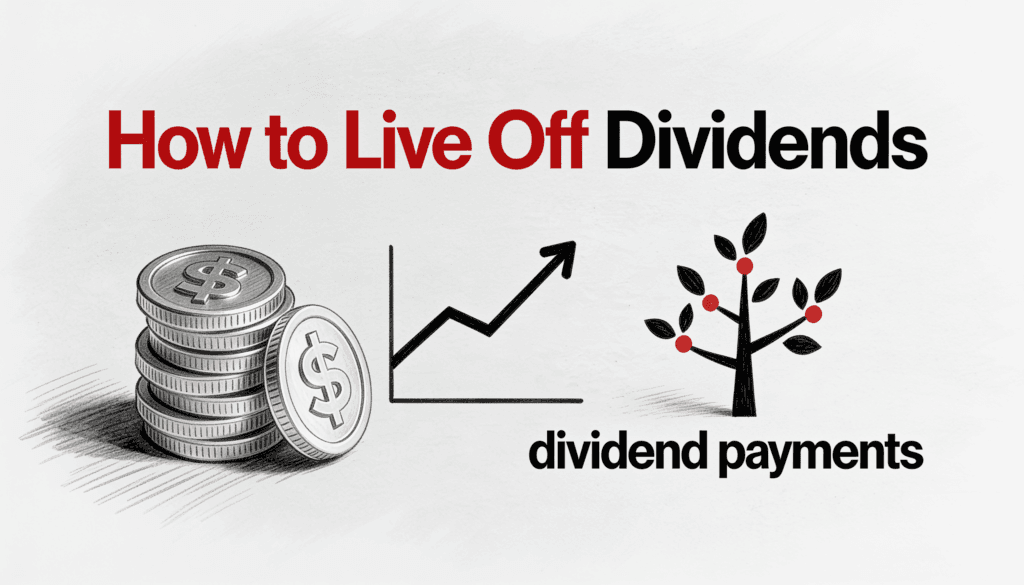
The Employee Who Never Calls in Sick: Understanding How to Live Off Dividends
Somewhere in the world right now, a worker is doing a job for you. This worker did not call in sick this morning. This worker did not ask for a raise during your last performance review, though it often gives itself one anyway. It has no opinions about office politics, no LinkedIn profile it updates suspiciously often, and no surprise resignation letter waiting in your inbox.
This worker is the dividend. And if you have ever managed a team of human beings, you already understand how rare this kind of employee truly is. Learning how to live off dividends is, at its heart, the process of hiring an entire workforce that shows up, does the labor, and quietly deposits money into your account while you sleep, eat, argue with your spouse, or scroll through videos of strangers renovating barns in Portugal.
The strange thing about dividends is that most investors treat them like a side dish. The main course, they believe, is capital appreciation. The thrill of buying something for one hundred dollars and watching it climb to two hundred. The dopamine of green candles on a screen. Dividends, by comparison, feel slow. Boring. Suspiciously unsexy. They are the salad nobody ordered.
But here is the quiet truth that financial history keeps trying to whisper. A meaningful portion of long term stock market returns has come not from prices going up, but from companies sending cash back to their owners year after year. The boring salad, it turns out, has been doing a great deal of the heavy lifting at the table this entire time.
The Philosophy of Getting Paid to Wait
There is a peculiar psychology to investing that most people never confront. When you buy a stock, you are essentially making a bet about the future. You are saying that someone, somewhere, at some point, will agree to buy this thing from you at a higher price. That is the entire mechanism behind capital appreciation. You are waiting for a stranger to validate your decision.
Dividends flip this idea on its head. Instead of waiting for the market to bless your judgment, the company itself pays you for being a partial owner. The validation is built directly into the arrangement. You do not need anyone else to agree with you. You do not need a buyer. You do not need momentum. You simply need the business to keep doing what businesses do, which is making more money than they spend.
This is a subtle but profound shift in how you relate to your investments. A stock that pays no dividend is essentially a promise. A stock that pays a dividend is a relationship. One says, trust me, things will work out. The other says, here, allow me to prove it monthly or quarterly with cash you can verify in your account.
We tend to overvalue the dramatic and undervalue the consistent. The dramatic story is louder. The consistent one is richer.
We admire the person who quits everything to start a company and become a millionaire. We rarely talk about the person who saved fifteen percent of every paycheck for forty years and ended up with a fortune their grandchildren will inherit. The drama gets the headlines. The discipline gets the money.
How Much Do You Actually Need to Live Off Dividends?
Let us address the question most readers came here to answer, because the philosophy means little without the mathematics. To live off dividends, you need to know two numbers: your annual spending and the average yield of your portfolio.
The formula is refreshingly simple. Divide your desired annual income by your expected dividend yield. If you want forty thousand dollars per year in dividend income and your portfolio yields four percent, you need a portfolio worth one million dollars. If your portfolio yields three percent, you need roughly one and a third million dollars. If it yields six percent, you need closer to six hundred sixty seven thousand dollars, though chasing that higher yield often introduces serious risk.
Here are the practical benchmarks most income investors use:
- A two to three percent yield typically comes from high quality dividend growth companies with rising payouts and strong balance sheets.
- A four to five percent yield usually involves dividend focused funds, real estate investment trusts, or more mature businesses.
- A yield above six or seven percent demands serious scrutiny, because it often signals that the market expects the dividend to be cut.
The honest answer is that most people aiming to live entirely off dividends need a portfolio somewhere between eight hundred thousand and two million dollars, depending on their lifestyle, their location, and how much they value safety over yield. That number frightens people. It should not. It is a destination you walk toward over decades, one reinvested dividend at a time.
The Employee Analogy Taken Seriously
Imagine for a moment that you ran a small business and you needed to hire someone. The ideal employee would have certain traits. They would work continuously without supervision. They would not need motivation. They would not be affected by their mood, the weather, their relationship status, or whether their favorite team won last night. They would generate more value over time as they grew into the role. And they would do all of this without ever asking for a single thing in return.
This employee does not exist in human form. But it does exist in financial form. A solid dividend paying business is, in a very real sense, an employee you have hired. You pay an upfront fee, which we call the share price. In exchange, the business sends you a portion of its profits, forever, or at least until the business stops being a business.
What makes this analogy even more interesting is that good dividend payers tend to give themselves raises. Companies that consistently grow their dividends are signaling something about their internal health that no marketing campaign can fake. You cannot pretend to pay shareholders more money. The cash either leaves the company and arrives in your account, or it does not. It is the most honest performance review in the entire financial world.
Consider a company like Coca Cola, which has paid and increased its dividend for over six decades. Think about what that historical record actually means. World wars, recessions, oil crises, the rise and fall of various technologies, multiple pandemics, and an entire generation that decided sugar was the enemy. Through all of it, the checks kept arriving in the mailboxes of shareholders, and they kept getting slightly larger every single year. That is not merely an investment. That is an indestructible employee. Antifragile if you will.
The Dividend Aristocrats and Why They Matter
Investors who are serious about building income gravitate toward a specific group of companies known as the Dividend Aristocrats. These are members of the S&P 500 that have raised their dividends for at least twenty five consecutive years. An even more exclusive club, sometimes called the Dividend Kings, includes companies that have raised payouts for fifty years or longer.
Why does this track record matter so much? Because raising a dividend for twenty five years requires surviving multiple recessions, management changes, and competitive threats while still growing free cash flow. A company that achieves this has demonstrated something that a backtest cannot fake. The streak itself is a measure of durability.
These companies tend to operate in stable, unglamorous industries. Consumer staples. Industrial supplies. Utilities. Healthcare. They sell products people buy whether the economy is booming or collapsing. That is precisely why their dividends survive when flashier companies are slashing theirs.
The Counterintuitive Beauty of Boring
There is a strange snobbery in modern investing culture that treats dividend stocks as the financial equivalent of beige cardigans. They are seen as something your grandfather owned. Something for retirees. Something that lacks the explosive potential of whatever shiny new thing the algorithm is feeding you today. This is, frankly, a hilarious misreading of how wealth actually accumulates.
The counterintuitive reality is that boring tends to win. Not always, not in every decade, not in every individual case. But over long stretches of time, the unglamorous compounding of dividends paid and reinvested has built an enormous amount of generational wealth. The reason this surprises people is that compound growth feels invisible while it is happening. You do not notice it the way you notice a stock doubling in a month. It happens in the background, like hair growing or rust forming.
The snowball does not need encouragement. You receive cash, you buy more shares, those new shares pay dividends, and those new dividends buy still more shares. It just rolls.
The Power of Dividend Reinvestment
The single most important decision a young dividend investor makes is whether to reinvest. When you are still accumulating wealth and do not yet need the income, automatically reinvesting every dividend turns a modest portfolio into a formidable one over time.
Consider a simple illustration. A portfolio that yields three percent with dividends growing at six percent annually, fully reinvested, can roughly double your income stream every twelve years without you adding a single additional dollar. The shares you bought with last year’s dividends are now generating dividends of their own, which buy more shares, which generate more dividends.
The Psychological Gift of Cash Flow
Here is something they do not teach in finance class. The biggest enemy of long term investors is not the market. It is themselves. Specifically, it is the urge to sell when things look ugly.
When the market drops thirty percent in a few months, the average investor does not calmly review their thesis. They panic. They check their phone every ten minutes. They start asking strangers on the internet for advice. They sell at the bottom, swear off investing forever, and then watch in dismay as the market recovers and climbs to new highs while their money sits in a savings account earning less than inflation.
Dividends offer a quiet antidote to this madness. When a company you own keeps paying you while its stock price falls, something psychological shifts. You start to see the holding less as a number on a screen and more as a productive asset. The stock price might be down, but the rent is still being paid. The employee is still showing up. The relationship is still functioning.
This is not a small thing. In fact, for the person who hopes to live off dividends in retirement, this psychological stability may matter more than any single percentage point of yield. A person who can sleep through a market crash because the checks keep arriving is a person who stays invested long enough to actually win.
Building a Portfolio Designed to Pay You Forever
If you want a portfolio that pays you for the rest of your life, a few principles separate the people who succeed from the people who chase yield off a cliff.
- Prioritize dividend growth over dividend size. A company growing its payout at seven percent annually will eventually out pay a stagnant high yielder, and it signals far greater financial health.
- Diversify across sectors. Owning thirty companies across consumer staples, healthcare, utilities, industrials, and technology protects your income when any one industry stumbles.
- Watch the payout ratio. A company paying out more than it earns is borrowing against its own future. A sustainable payout ratio, often below seventy percent, leaves room for the dividend to survive a rough year.
- Reinvest until you need the income, then flip the switch. Accumulate aggressively while working, then turn the dividends into your paycheck once you retire.
- Be patient with the timeline. Nobody builds a livable dividend income overnight. This is the work of years, sometimes decades, and that slowness is a feature rather than a flaw.
What Dividends Cannot Do
In the spirit of honesty, dividends are not magic. They cannot rescue a bad business. A dying company can pay a beautiful dividend right up until the moment it cannot, and the high yield you were chasing turns out to be a warning sign rather than an opportunity. The market is full of value traps that wear dividends like a costume.
Dividends also do not guarantee anything. A company can cut, suspend, or eliminate them entirely if conditions deteriorate. The promise is only as strong as the business standing behind it. This is why the quality of the underlying company matters far more than the size of the yield. A modest dividend from an excellent business will almost always serve you better than a fat dividend from a fragile one.
And dividends are not the right tool for every investor at every stage. Younger people with long time horizons and small portfolios may benefit more from growth oriented companies that reinvest every dollar back into expansion. The mathematics there can be genuinely compelling. The point is not that dividends are universally superior. The point is that dividends are profoundly underrated, and the discipline they teach pays off long before the income does.
A modest dividend from an excellent business will almost always serve you better than a fat dividend from a fragile one. Quality is the moat. Yield is merely the bridge.
The Quiet Wealth Builder
In the end, the dividend is a financial expression of something philosophical. It is the recognition that real wealth is built less through brilliance and more through ownership. You do not need to time the market. You do not need to predict the next big thing. You do not need to outsmart anyone. You simply need to own pieces of good businesses, let them do what they do, and let the cash flow in.
The world keeps trying to convince you that investing is a contest of intelligence, speed, or insight. The reality is gentler and more democratic. It is a contest of patience, temperament, and the willingness to let boring things compound. The dividend is the embodiment of that philosophy. It is the patient money. The unglamorous money. The money that does not need you to be a genius.
Your dividend paying companies will work tonight while you sleep. They will work tomorrow while you commute. They will work next year while you take a vacation. They will work in good economies and bad, in calm markets and chaotic ones. They will not call you. They will not need you. They will simply send you a small fraction of the money that the rest of the world is paying them to do what they do.
And that, more than any chart or forecast or hot tip, is what quietly turns small fortunes into large ones over time. The best employee you will ever have is the one you do not have to manage. The dividend has been doing that job for over a century. It is simply waiting for you to put it on the payroll.