Table of Contents
Two Income Streams That Look Identical and Could Not Be More Different
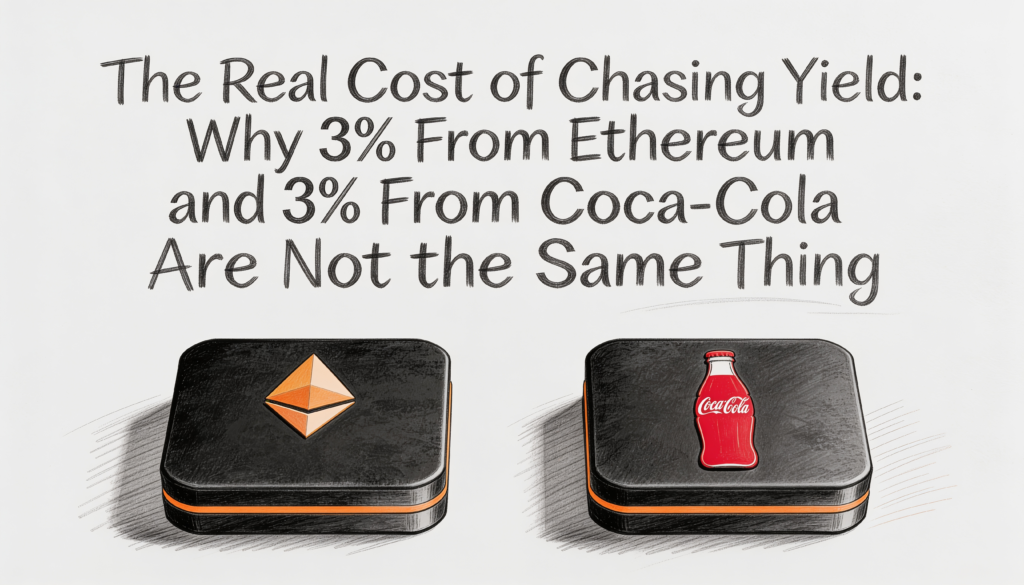
Rounding approximately to the nicer number, a three percent dividend from Coca-Cola and a three percent yield from Ethereum staking will appear on your screen as the same number, glowing with the same false promise of equivalence. They are not equivalent. They are barely even cousins. One arrives from a company that has been paying shareholders for over a century to sell flavored sugar water to the planet. The other arrives from locking up digital tokens on a network that did not exist fifteen years ago, helping to validate transactions that most people still cannot fully explain.
Both make the same seductive promise: your money works so that you do not have to. The resemblance ends precisely there. This is not a tidy comparison between two investments. It is a confrontation between two entirely different ideas about what it means to own something, what income actually is, and whether the future has any obligation whatsoever to resemble the past. When you understand the real cost of chasing yield, you stop reading the percentage and start reading the structure underneath it.
Most income investors never perform this second reading. They see two numbers that match, assume the assets producing them are interchangeable, and allocate accordingly. That assumption is where fortunes quietly leak away. The number on the page tells you what you might earn. It tells you almost nothing about what you are risking to earn it.
The Church of Predictability Versus the Temple of Possibility
Coca-Cola is, in the financial world, what a golden retriever is in the dog world. Reliable. Friendly. Boring in exactly the way you want boring to be. The company has raised its dividend every single year for more than six decades. It has survived world wars, recessions, pandemics, and the invention of diet culture. People who own Coca-Cola stock do not check the price every morning, because they do not need to. The dividend arrives like clockwork, the way rent appears from a tenant who has never once been late.
Ethereum staking belongs to a completely different congregation. You lock up your ETH, the network uses it to verify transactions, and you earn a yield in return. The concept sounds simple enough. The experience of actually earning that yield resembles collecting a Coca-Cola dividend in no meaningful way. The yield fluctuates. The underlying asset fluctuates far more. The regulatory environment shifts depending on which government woke up irritated that particular morning. And the entire mechanism depends on technology that is being actively rewritten while people are using it.
Imagine rebuilding a plane’s engine mid flight and asking the passengers to relax because the in flight snacks are still on schedule. That is staking, more or less. Yet millions of people deliberately choose this second option, and they are not foolish. They simply attend a different church, one that prizes possibility over predictability.
A dividend rewards you for owning a piece of the past that keeps working. A staking yield rewards you for helping to build a future that has not arrived yet. Confusing the two is the most expensive mistake an income investor can make.
What Income Actually Means in Each World
Here is where the comparison becomes genuinely interesting. Both Coca-Cola dividends and Ethereum staking rewards produce income. Both appear in your account without you lifting a finger. Both can be reinvested to compound over time. But the philosophical foundations beneath them could not be more different.
A Coca-Cola dividend is a share of profit. The company sold billions of drinks, collected the revenue, paid its employees and its suppliers, and then chose to hand some of what remained to the people who own fractions of it. This is capitalism in its most traditional form. You own a sliver of a real business that manufactures a real product that real human beings consume. The dividend is evidence that the machine is functioning.
An Ethereum staking yield is compensation for participation. You are not sharing in the profits of a company. You are being paid for contributing to the security and functionality of a decentralized network. There is no chief executive deciding your reward. There is no board meeting. The protocol itself sets the figure, governed by mathematics rather than management. It feels less like collecting rent and more like being paid by the building itself for agreeing to serve as a load bearing beam.
This distinction matters far more than most people realize. Coca-Cola’s dividend tells you something about a business. Ethereum’s staking yield tells you something about a network. One is a statement of corporate health. The other is a statement of network architecture. Treating them as the same thing is like comparing a paycheck to a reward you earn inside a video game. Both place value in your pocket. The systems generating them operate on entirely separate logic.
Risk-Adjusted Return: The Number You Are Not Looking At
Now we arrive at the heart of the matter, the place where surface comparisons go to die. The most important question for an income investor is not how much yield an asset produces. It is how much risk you absorbed to capture that yield. This is the foundation of risk-adjusted return, and it is the single most overlooked concept in income investing.
The cleanest way to think about this is through the lens of the Sharpe ratio. The Sharpe ratio asks a deceptively simple question: how much excess return are you earning for each unit of volatility you endure? You take the return of your asset, subtract the return of a genuinely risk free asset such as a short term government bond, and then divide that figure by the volatility of the asset. A high Sharpe ratio means you are being paid generously compared to the turbulence you tolerate. A low Sharpe ratio means you are accepting a great deal of stomach churning movement for relatively little reward.
Apply this thinking to our two yields and the illusion of equivalence collapses immediately. Coca-Cola produces roughly three percent in dividend income on top of a stock that moves slowly. Its annualized volatility tends to sit in the modest range typical of a mature consumer staple. The income is denominated in dollars, so its purchasing power remains relatively stable. The brokerage account holding it carries insurance. When you calculate the return per unit of risk, the dividend looks like what it is: a steady reward sitting on bedrock.
Ethereum staking also produces a yield in a similar numerical range, sometimes higher. But that yield sits on top of an asset whose annualized volatility can run several times that of a blue chip equity. You might earn four percent in staking rewards while the underlying token drops forty percent in a single quarter. Or you might earn that same four percent while the token triples. When you divide the income by the violence of the price movement, the risk-adjusted picture looks nothing like Coca-Cola, even though the headline yields appear nearly identical.
A three percent yield on bedrock and a three percent yield on a trampoline are arithmetically equal and financially unrelated. The number tells you the reward. Only the volatility tells you the price you paid for it.
Why Nominal Yield Is a Liar
Nominal yield is the figure marketers love, because it is clean, simple, and comparable across anything. It is also, on its own, almost meaningless. A nominal yield strips out every dimension that actually determines whether you will keep the money you appear to be earning.
Consider the denomination problem alone. Coca-Cola pays you in dollars, a currency whose value you can reasonably forecast over a normal investing horizon. Ethereum staking pays you in ETH, which means the real value of your reward depends entirely on what ETH is worth at the moment you eventually need to spend it. You can earn a flawless staking yield for two years and still end up poorer in dollar terms if the token sank during that period. The yield was real. The wealth was not.
Then consider the tail risk. Coca-Cola can cut its dividend, certainly, but a six decade record of increases suggests an organization deeply committed to avoiding that outcome. Ethereum staking carries categories of risk that simply do not exist in a dividend stock. There is smart contract risk if you stake through a protocol. There is slashing risk, where the network penalizes validators for misbehavior or downtime. There is custody risk, because the wallet holding your assets is secured by a string of characters that, if lost, means everything vanishes forever with no help desk to call. None of these risks reduce the nominal yield by a single basis point, yet every one of them can erase your principal entirely.
This is the central insight that the matching percentages conceal. Two assets can advertise the same nominal yield while occupying opposite ends of the risk spectrum. The investor who compares only the headline figure is performing the financial equivalent of choosing a vehicle by reading the speedometer and ignoring whether it has brakes.
Building a Risk-Adjusted Lens for Income
So how should a serious income investor actually evaluate competing yields? Begin by refusing to take any yield figure at face value. For every income stream you consider, ask three questions before you ask about the percentage. First, what is the volatility of the underlying asset over a full market cycle? Second, in what currency or unit is the income paid, and how stable is that unit? Third, what are the catastrophic failure modes, the events that could take not just your income but your capital?
Only after answering those questions should the yield enter the conversation. When you mentally divide the reward by the risk, Coca-Cola and Ethereum staking separate cleanly into different categories of asset that happen to share a coincidental number. The dividend offers a modest, dependable return per unit of risk. The staking yield offers a potentially larger return attached to a volatility profile that can swallow that return many times over.
This does not condemn staking. Risk-adjusted thinking is not a recommendation to avoid volatility. It is a discipline for understanding what you are being paid to endure, so that you can decide whether the compensation is fair for you. A higher risk yield can be a perfectly rational choice for an investor with a long horizon, genuine technical understanding, and capital they can afford to watch swing violently. The point is to choose it with open eyes rather than to back into it because two numbers happened to rhyme.
The Illusion of Safety and the Illusion of Progress
Dividend investors love to talk about safety, and they have earned the right to. A company that has paid rising dividends for more than sixty years possesses a track record louder than any analyst report. But there is a subtle trap inside this comfort. The safety of Coca-Cola’s dividend is ultimately the safety of the status quo. It assumes people will keep drinking soda, that the brand will stay relevant, that the global distribution network will remain intact, and that the economic system rewarding shareholders will keep operating as it always has. These are reasonable assumptions. They are not guarantees.
Crypto staking advocates love to talk about progress. They frame their yields as the income of the future, generated by networks that will eventually replace the aging financial infrastructure. There is a trap here too. Progress does not move in a straight line, and being early often looks identical to being wrong. For every transformative technology that reshaped the world, dozens looked equally promising and ended as footnotes. The people who invested in early radio companies during the 1920s were entirely correct about the technology. Most of them still lost their money.
Both camps are placing a bet on a narrative. The dividend investor wagers that the old story keeps working. The staker wagers that a new story takes over. Neither is making a purely rational financial decision, regardless of how many spreadsheets they produce to justify it.
The Identity Problem Hiding Inside Your Portfolio
This is where things grow uncomfortable for everyone. Financial decisions are identity decisions wearing the costume of mathematics. The person who buys Coca-Cola for the dividend is not only buying income. They are buying membership in a community that prizes patience, tradition, and compounding. They are signaling that they are the kind of person who thinks in decades, who refuses to chase trends, who would rather be boring and wealthy than thrilling and broke.
The person who stakes Ethereum is also buying more than yield. They are buying membership in a community that prizes innovation, disruption, and technological optimism. They are signaling that they grasp something most people do not, that they sit ahead of the curve, that they are constructing the future while everyone else clings to the past.
Both identities feel good. Both manufacture blind spots. The dividend investor can grow so attached to tradition that they miss a genuine paradigm shift unfolding in front of them. The staker can grow so addicted to novelty that they mistake volatility for excitement and confusion for sophistication. The most dangerous asset in any portfolio is the one you hold for reasons of self image rather than analysis.
The real risk in income investing is rarely the asset itself. It is the gap between what you own and what you actually understand. That gap, unlike any yield, does not pay you for waiting.
The Real Question Behind Every Yield
The Coca-Cola dividend investor and the Ethereum staker are both trying to solve the identical problem: how to make money generate more money without active effort. They merely disagree about which engine to use. But the more important question is one that neither side spends enough time confronting.
The question is not which yield is larger. It is not even which yield is safer, though risk-adjusted thinking gets you far closer to a useful answer than nominal figures ever will. The deepest question is whether you are choosing an investment because you genuinely understand its mechanics and its risks, or because owning it makes you feel like the kind of person you wish to be.
A Coca-Cola dividend held by someone who does not understand consumer staples offers no real protection. ETH staked by someone who cannot explain a consensus mechanism offers no real opportunity. In both cases, the genuine risk is not the asset and not the volatility. It is comprehension, or the lack of it.
So when you next encounter two yields that appear to match, resist the pull of the matching number. Pull them apart. Examine the volatility, the denomination, the failure modes, the Sharpe ratio lurking behind the headline. Ask what you are truly being paid to endure. A yield is a promise, and the cost of that promise is written in the risk you accept to receive it. Read the risk first, and the right choice for your particular life and temperament will reveal itself far more honestly than any percentage ever could.