Table of Contents
There is a particular kind of guilt that comes with investing. You hand your money to a brokerage, it flows into companies you have never visited, and somewhere a factory hums a little louder. ESG funds were supposed to fix that. They promised a world where your portfolio could grow and your conscience could rest. The pitch was elegant. The reality is messier.
ESG stands for Environmental, Social, and Governance. It is a framework that scores companies on how responsibly they behave. High scores get into the fund. Low scores get excluded. In theory, this filters out the bad actors and rewards the good ones. In practice, it has become one of the most confusing, contradictory, and quietly expensive corners of modern finance.
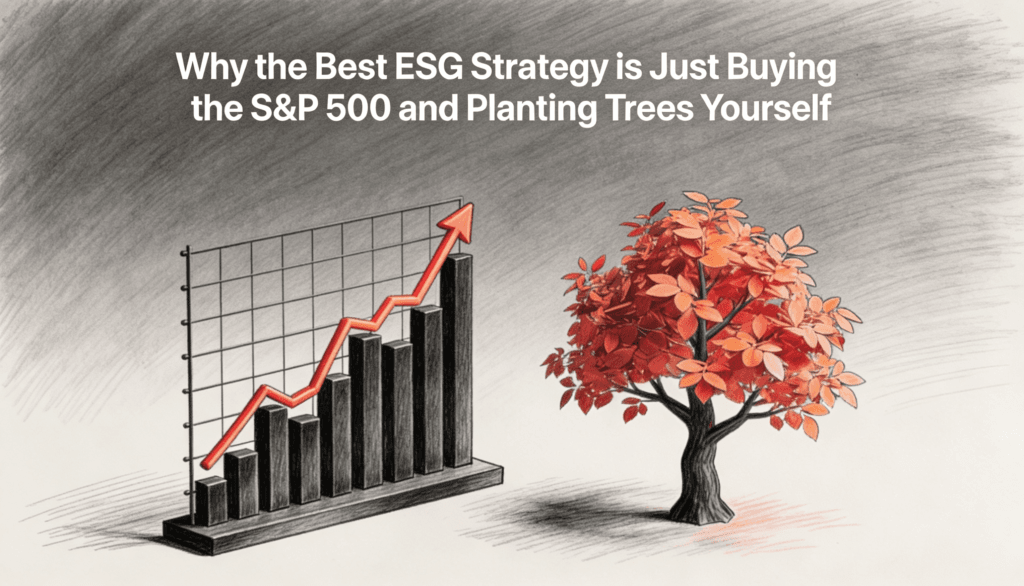
So here is a thought experiment that sounds absurd until you actually run the logic: what if the most effective ESG strategy is to skip ESG funds entirely, buy the S&P 500, and plant trees with the money you save?
Let us walk through why this is less ridiculous than it sounds.
The Rating Problem Nobody Talks About
The foundation of any ESG fund is its rating system. And the foundation is cracked.
Unlike credit ratings, where agencies largely agree on whether a company can pay its debts, ESG ratings are wildly inconsistent. One agency might give a company a top score for its environmental policies. Another might rank the same company near the bottom for the same category. Research from MIT found that the correlation between major ESG rating providers is remarkably low. In credit ratings, agencies agree most of the time. In ESG ratings, they frequently disagree.
This is not a minor technical problem. It is the entire premise collapsing. If the experts cannot agree on who is good and who is bad, then the filter you are paying extra for is not really filtering anything with confidence. You are paying for a label, not a guarantee.
Think of it this way. Imagine hiring a personal trainer who cannot agree with themselves on whether squats are good for you. Monday they say squats are essential. Wednesday they say squats will destroy your knees. You would find a new trainer. But in ESG investing, we collectively shrug and keep paying the membership fee.
The Fee Question
Speaking of fees, let us talk about what ESG funds actually cost.
A standard S&P 500 index fund charges almost nothing. Some of the largest ones charge a few basis points, meaning for every ten thousand dollars invested, you pay a few dollars per year. ESG funds charge more. Sometimes significantly more. The premium varies, but over decades of compounding, even a small difference in fees creates a meaningful gap in returns.
This matters because the purpose of investing is to grow wealth over time. Every dollar lost to fees is a dollar that does not compound. It does not grow. It does not work for you at all. It works for the fund manager.
Now here is where the arithmetic gets interesting. If you took the fee difference between an ESG fund and a plain index fund and redirected that money toward direct environmental action, like planting trees, funding carbon capture, or supporting conservation, you could measure the impact. You could see it. You could visit it. You could watch it grow, literally.
The ESG fund gives you a vague sense of alignment. The trees give you oxygen.
What ESG Funds Actually Hold
One of the most revealing exercises you can do is to look at what sits inside a popular ESG fund and compare it to what sits inside the S&P 500. The overlap is staggering.
Many ESG funds hold the same giant technology companies, the same financial institutions, the same healthcare conglomerates. They exclude a handful of obvious offenders, usually tobacco, weapons manufacturers, and thermal coal producers. But the core of the portfolio looks remarkably similar to the index it claims to improve upon.
This creates a strange situation. You are paying more for a product that is roughly 90 percent identical to the cheaper version. The 10 percent difference is mostly the exclusion of companies that represent a small fraction of the index anyway.
It is like ordering a salad at a restaurant, paying double, and then discovering it is the same salad from the regular menu with one crouton removed.
The Divestment Paradox
There is a deeper philosophical issue with ESG investing that rarely gets discussed at dinner parties, which is a shame because it is genuinely fascinating.
When an ESG fund excludes a company, it sells that stock. But selling a stock does not make the company disappear. It does not shut down the factory. It does not clean the river. All it does is transfer ownership to someone else, usually someone who does not care about ESG at all.
In fact, divestment can make things worse by a certain logic. When socially conscious investors sell shares of a problematic company, the stock price might dip slightly. This makes the shares cheaper for investors who have no interest in corporate responsibility. They buy in at a discount, gain more voting power, and have zero intention of pushing for change.
So the act of divesting, which feels like protest, can function more like surrender. You leave the room where the decisions are made and hand your seat to someone who will not ask uncomfortable questions.
This is one of the great ironies of modern ethical investing. The desire to distance yourself from a problem can actually reduce your ability to solve it.
The Engagement Alternative
Some of the most sophisticated institutional investors have figured this out. They do not divest. They engage. They buy shares in companies with poor environmental records and then use their position as owners to push for change from the inside.
This is harder. It is slower. It does not look as clean on a marketing brochure. But it works. Shareholder resolutions on climate disclosure, executive compensation tied to sustainability targets, board appointments that bring environmental expertise: these are the mechanisms that actually shift corporate behavior.
A retail investor buying an S&P 500 index fund is, in a small way, participating in this process. The largest index fund providers have enormous voting power. They engage with thousands of companies on governance and environmental issues. Your money in a basic index fund is already part of that conversation.
You do not need to pay extra for the privilege.
The Tree Argument
Now let us return to the trees, because they deserve more than a punchline.
The cost of planting a tree varies by region, species, and method. But the general principle holds: it is remarkably cheap to put a tree in the ground compared to the fees you pay over a lifetime of ESG investing.
A single tree absorbs carbon, supports biodiversity, prevents soil erosion, filters water, and produces oxygen. It does these things every day, for decades, without a management fee. It does not need to be rebalanced. It does not issue a quarterly report. It just grows.
If you invested in a standard index fund and redirected the fee savings toward tree planting, reforestation projects, or other direct environmental initiatives, you would accomplish two things simultaneously. Your portfolio would perform in line with the broad market. And your environmental contribution would be tangible, measurable, and probably larger than what the ESG fund delivers on your behalf.
This is not a hypothetical argument made to be clever. It is a practical framework that more people should take seriously.
A Simpler Path
The investing world has a long history of overcomplicating things. Active managers once convinced millions of people that stock picking justified high fees. Then index funds proved that simplicity won. ESG funds are, in some ways, the latest version of this same story. A more expensive product wrapped in a compelling narrative, competing against a simpler alternative that quietly does the job.
Buy the index. Keep your fees low. Let your money compound without friction. Then take the savings and do something with your own hands. Plant trees. Fund a local conservation project. Donate to organizations that fight for clean water or renewable energy. Support the causes you care about directly, where you can see the impact and verify it for yourself.
This approach will not earn you a badge on a brokerage app. It will not come with a sleek PDF report about your portfolio’s alignment with the United Nations Sustainable Development Goals. But it will likely leave you with more money and more real world impact than the alternative.
Sometimes the most sophisticated strategy is the simplest one. And sometimes the best way to save the planet with your portfolio is to stop trying to save the planet with your portfolio, and just go outside with a shovel.