Table of Contents
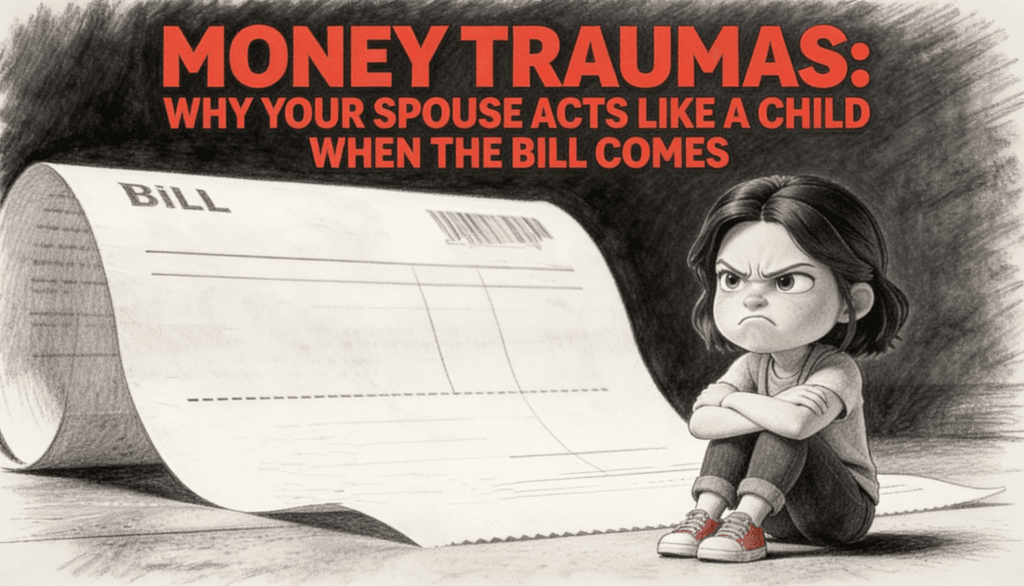
There is a moment in every relationship that reveals more than any therapy session ever could. It is not the first fight. It is not meeting the parents. It is the moment the restaurant bill arrives and lands on the table like a grenade nobody wants to touch.
One of you reaches for it casually. The other freezes, or deflects, or makes a joke, or suddenly needs to use the restroom. And in that tiny choreography of avoidance and action, an entire childhood plays itself out at a table for two.
We like to think money disagreements are about money. They almost never are.
The Suitcase Nobody Unpacks
Every person who enters a relationship brings an invisible suitcase. Inside it are not clothes or toiletries but financial memories. The way their father sighed when the electricity bill arrived. The Christmas their mother said “we will see” and they learned that meant no. The overheard argument at 2 AM about a credit card statement that was never supposed to be seen.
These are not nostalgic anecdotes. They are instructions. They become the operating software that runs silently in the background every time a financial decision appears. And the tricky part is that most people do not know their software is running. They just feel the output: the anxiety, the rigidity, the recklessness, the shame.
A person who grew up watching scarcity does not simply “get over it” because they now earn six figures. The adult brain understands the bank balance. The inner child still hears the pantry door open and counts what is left. These two realities coexist, and they do not always agree on what to do when the waiter asks if anyone wants dessert.
The Four Money Ghosts
If you watch couples long enough, you start to notice patterns. Not in how much they spend, but in the emotional posture they take toward money. Most people are haunted by one of four ghosts.
The Hoarder Ghost. This one whispers that safety means accumulation. People carrying this ghost save compulsively, not because they have a plan, but because spending feels like bleeding. They will clip coupons while sitting on a quarter million in savings. The math does not matter. The feeling does. They watched someone run out of money once, and they decided, consciously or not, that they would rather run out of joy.
The Spender Ghost. This is the opposite wound wearing opposite clothes. People with this ghost learned early that money disappears no matter what you do, so you might as well enjoy it now. Or they learned that love was expressed through purchases. Or they discovered that buying things was the only reliable way to feel something in a home where emotions were rationed more carefully than dollars. They are not irresponsible. They are medicated.
The Avoider Ghost. These people do not overspend or oversave. They simply refuse to look. Bills sit unopened. Bank apps go unchecked. The retirement account exists in the same way the smoke detector exists: somewhere in the background, presumably working, definitely not something they want to think about. Avoidance is not laziness. It is a trauma response dressed in procrastination. Looking at money means feeling something about money, and that feeling was never safe.
The Controller Ghost. This one shows up as the person who needs to manage every dollar, not just their own but everyone else’s in the household. They build spreadsheets the way some people build walls. Every line item is a brick. The budget is not a tool. It is a fortress. Inside the fortress, nothing unexpected can happen. And the unexpected is what hurt them before.
Now put two of these ghosts in a marriage and watch them try to buy a couch together.
Why Logic Fails at the Dinner Table
Here is where it gets interesting, and where most financial advice falls apart completely.
The standard guidance says to sit down, make a budget, communicate openly, and compromise. This is excellent advice for two rational adults. It is useless advice for two wounded children pretending to be rational adults.
When a Hoarder and a Spender argue about a vacation budget, they are not arguing about the vacation. The Hoarder is arguing against the feeling of vulnerability that comes from watching the account drop. The Spender is arguing against the feeling of deprivation that comes from saying no to something beautiful. Both of them are right. Both of them are six years old. And the spreadsheet cannot fix that.
This is why couples who earn plenty of money still fight about money. It was never about the amount. It was always about the meaning. And meaning is set in childhood like concrete. You can paint over it, but it does not move.
There is a concept in psychology called “emotional reasoning,” where people treat their feelings as evidence. I feel afraid, therefore the situation is dangerous. I feel deprived, therefore we are not spending enough. I feel out of control, therefore someone is being reckless. In financial arguments, emotional reasoning runs the show while both parties insist they are being logical. It is a courtroom where both lawyers are crying and neither will admit it.
The Inheritance Nobody Talks About
We spend a lot of cultural energy discussing financial inheritance. Who gets the house. Who gets the portfolio. What the estate plan says.
But the more powerful inheritance is the emotional one. The beliefs about money that pass from parent to child without a single document being signed.
A father who flinches at the price of groceries teaches his daughter that abundance is a threat. A mother who hides shopping bags in the trunk teaches her son that desire must be concealed. A household where money was discussed openly and calmly, without panic or shame, produces adults who can do the same. But those households are surprisingly rare.
The fascinating thing is that siblings raised in the same house often develop opposite money ghosts. One child watches the family financial stress and becomes a Hoarder. The other watches the same stress and becomes a Spender. Same data, different conclusions. The psyche does not process trauma uniformly. It improvises a survival strategy, and that strategy becomes identity.
This is why “just talk about money” is advice that misunderstands the problem. Talking about money requires feeling safe while talking about money. And for many people, money was the least safe topic in the house where they learned what safety meant.
The Biology of the Bill
There is a physical dimension to this that deserves attention. Neuroscience has shown that financial stress activates the same regions of the brain that process physical pain. This is not a metaphor. So when your partner “overreacts” to an unexpected expense, their brain is not being dramatic. It is processing a genuine pain signal. Telling them to calm down is roughly as effective as telling someone with a burned hand to calm down. The information is technically correct and practically useless.
This also explains why financial disagreements escalate so quickly. Two people in pain do not negotiate well. They defend. They attack. They retreat. The bill sitting between them on the table might as well be a small fire, because both nervous systems are responding as if it is.
What Actually Helps
If logic and spreadsheets are not enough, what is?
The first step is identification. Not identifying the problem, but identifying the ghost. Each person needs to understand which money trauma they are carrying and where it came from. This is not about blame. Nobody’s parents set out to install defective financial software in their children. But the software got installed anyway, and pretending it did not exist is how couples end up screaming about a $47 impulse purchase at Target.
The second step is narration. There is strong evidence that simply naming an emotional pattern reduces its power. When someone can say “I know I am being a Hoarder right now because this reminds me of the time we almost lost the house,” the reaction loses some of its grip. It moves from the amygdala to the prefrontal cortex, from reflex to reflection. The feeling does not vanish. But it stops driving the car.
The third step is perhaps the most counterintuitive. It is to stop trying to fix your partner’s money ghost. You did not create it. You cannot exorcise it. What you can do is stop triggering it accidentally and start recognizing when it is talking instead of your actual partner. When the Controller starts building another spreadsheet at 11 PM, that is not your spouse. That is their ghost. When the Avoider refuses to open the retirement statement for the third month in a row, that is not laziness. That is armor.
The goal is not to eliminate these patterns. It is to create enough awareness that two people can say, “Our ghosts are arguing again. Can we pause and let the adults talk?”
The Money Conversation You Actually Need to Have
Every financial advisor will tell couples to discuss their goals. Few will tell them to discuss their wounds.
But the wound conversation is the one that changes everything. It sounds like this: “When I was growing up, money meant _______.” Fill in the blank honestly and you will learn more about your partner in five minutes than a year of budgeting sessions could teach you.
Money meant fear. Money meant power. Money meant love. Money meant silence. Money meant fighting. Money meant freedom. Money meant control.
Whatever fills that blank is the lens through which your partner sees every single financial decision you will ever make together. And until you both know what lens the other person is wearing, you will keep wondering why you cannot seem to see the same thing when you look at the same number.
The couples who thrive financially are not the ones who earn the most or budget the best. They are the ones who figured out that when the bill arrives, two histories arrive with it. And they learned to be gentle with both.