Table of Contents
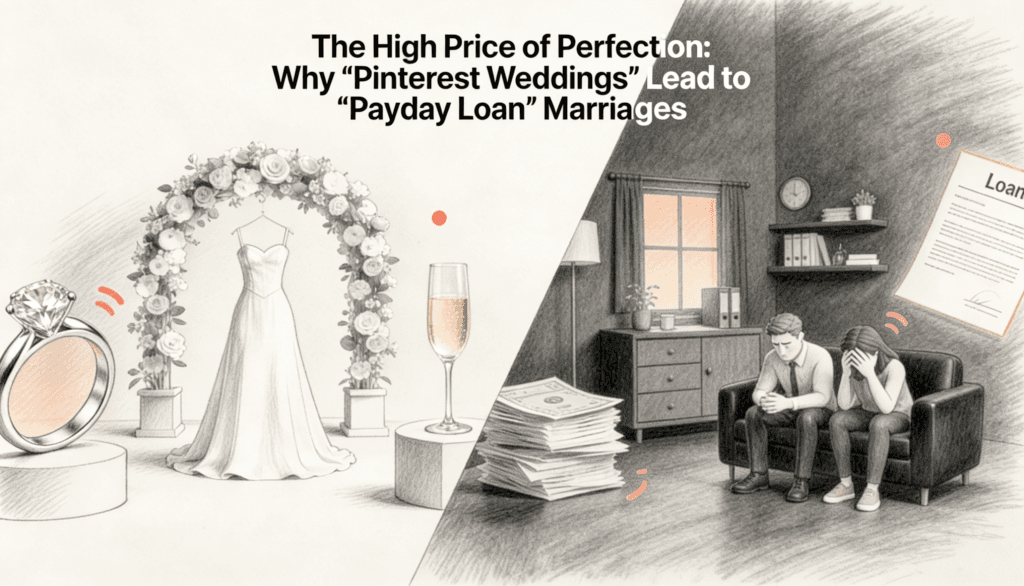
There is a particular kind of silence that fills a room when a couple sits down with their credit card statements three months after the wedding. The flowers are dead. The photographer has delivered the album. The custom monogrammed napkins are in a box somewhere in the garage. And the bill is very much alive.
The average American wedding now costs somewhere north of $35,000. But the exact number matters less than what it represents: a generation of couples who are willing to spend the equivalent of a down payment on a house for a single Saturday afternoon.
This is not an article about how weddings cost too much. Everyone knows that. This is about something more interesting. It is about how the psychology that drives wedding overspending is the same psychology that keeps people broke long after the last guest has gone home.
The Rehearsal Dinner for Financial Ruin
Think of a wedding not as an event but as a financial stress test. How a couple handles the pressure of wedding planning reveals almost everything about how they will handle money for the rest of their lives.
Couples who cannot say no to a $12 per slice cake are unlikely to say no to a car they cannot afford two years later. The muscle that controls spending is the same muscle whether you are choosing between fondant and buttercream or between a sensible sedan and a financed SUV.
This is not a moral judgment. It is a pattern. And patterns, unlike wedding vows, do not lie.
The wedding industry understands this better than anyone. It has built an entire economy around a single insight: people in love are terrible negotiators. When a vendor says “but it is your special day,” what they are really saying is “your emotions have disabled your prefrontal cortex, and I would like to take advantage of that.”
And it works. Beautifully.
The Instagram Trap
Pinterest and Instagram did not invent wedding excess, but they did something arguably worse. They democratized the aesthetic of wealth without democratizing the wealth itself.
A generation ago, if you wanted a wedding with cascading orchids, a twelve piece band, and a venue that looked like a Tuscan villa, you needed Tuscan villa money. Now you just need a Pinterest board and a willingness to finance the gap between your taste and your bank account.
This is the same dynamic that drives consumer debt. Social media shows you the lifestyle. Credit makes it feel accessible. And the bill arrives later, long after the dopamine has faded.
There is an uncomfortable parallel here with the 2008 housing crisis. Banks gave mortgages to people who could not afford them because the prevailing wisdom was that everyone deserved to own a home. The wedding industry operates on a similar fiction: everyone deserves their dream wedding. The word “deserves” is doing a lot of heavy lifting in that sentence. It is carrying about $35,000 worth of debt on its back.
The Sunk Cost Veil
Once a couple begins planning an expensive wedding, something fascinating happens. Each decision becomes harder to reverse because of all the decisions that came before it.
You book an expensive venue. Now you need decorations that match the venue. Now you need a photographer who has shot at that venue before. Now you need a caterer the venue recommends. Each choice narrows the next one, and each one costs more because the previous one set a higher floor.
Behavioral economists call this a commitment escalation. Normal people call it “we have already spent this much, we might as well keep going.” It is the same logic that keeps gamblers at the blackjack table and investors in bad stocks. The money you have already spent should be irrelevant to your next decision, but it never is. Human beings are not wired to walk away from sunk costs. We are wired to chase them.
A wedding planning spiral is essentially a six to twelve month course in all the financial mistakes a person can make. And the final exam is a stack of bills that arrives right when you are supposed to be starting your life together.
What You Are Actually Buying
Here is the part no one wants to hear. The research on wedding spending and marital satisfaction tells a story that should make every engaged couple deeply uncomfortable.
Studies have consistently shown an inverse relationship between wedding cost and marriage duration. Couples who spend more on their weddings are statistically more likely to divorce. Couples who spend less tend to stay together longer.
Let that sink in. The more you spend on the wedding, the worse your odds of staying married.
Now, correlation is not causation. Expensive weddings do not cause divorce. But they are a symptom of something that does: a misalignment between financial reality and emotional aspiration. Couples who overspend on weddings often share a set of traits. They prioritize appearance over substance. They struggle to make joint financial decisions. They use spending as a way to manage anxiety or prove worth.
These are not traits that age well in a marriage.
The Registry of Regret
Consider the wedding registry, which is perhaps the most honest artifact of the entire process. A couple walks into a store and scans everything they want for their new life together. A $400 stand mixer. A $200 set of wine glasses. Towels that cost more than some people’s car payments.
The registry is a wishlist dressed up as a tradition. And like most wishlists, it reveals more about the wisher than they might like.
What nobody registers for is an emergency fund. No one puts “three months of rent in a savings account” on their Crate and Barrel list. No one asks for a contribution to their index fund. The things that would actually make a new marriage more stable are invisible to the wedding industrial complex because they are not photogenic.
You cannot put a picture of compound interest on Instagram. But it will do more for your marriage than a KitchenAid mixer ever will.
The Opportunity Cost of Flowers
Every dollar spent on a wedding is a dollar not spent on something else. This is obvious. What is less obvious is how dramatically those alternative uses could change a couple’s financial future.
Take $30,000 and put it into a broad market index fund at the start of a marriage. Leave it alone for thirty years. With average historical returns, that single investment could grow to well over $300,000. Possibly more.
That is the real cost of the wedding. Not the number on the invoice. The number that never appears because the money was spent on a party instead of a future.
In finance, this is called opportunity cost. In life, it is called the thing you did not build because you were too busy decorating.
The cruelest irony of wedding overspending is that it often creates the exact financial stress that damages the marriage it was supposed to celebrate. Couples report that money is the number one source of conflict in their relationships. And nothing accelerates money conflict like starting a marriage in debt for a party you threw to celebrate starting the marriage.
It is a perfect circle of self defeat.
The Vendor Theory of Love
The wedding industry has accomplished something remarkable from a business perspective. It has created a product category where the customer is emotionally incapable of rational comparison shopping.
Try telling a bride that her $3,000 photographer produces images virtually indistinguishable from a $1,200 photographer. Try telling a groom that no guest in the history of weddings has ever remembered the thread count of the table linens. Try telling either of them that the $8,000 difference between their first choice venue and their third choice venue will be invisible in their memories within five years.
You will lose every one of these arguments. Not because you are wrong. Because being right is irrelevant when emotion is making the decisions.
This is the same reason people overpay for brand name products, choose expensive actively managed funds over cheap index funds, and lease cars they could buy for less. Rationality does not stand a chance against identity. And weddings are identity purchases at their most concentrated.
A Modest Counter Argument
Some will say that a wedding is not an investment. It is an experience. And experiences, unlike things, are worth paying for because they create memories and bring people together.
This is a fair point. There is real value in gathering the people you love in one place and celebrating something meaningful. Anyone who says otherwise is being unnecessarily cynical.
But there is a difference between paying for an experience and financing a performance. A backyard wedding with good food and the right people is an experience. A $50,000 production designed to look good on social media is a performance. And performances require an audience to have value. Experiences do not.
The question is not whether your wedding should be meaningful. It is whether meaning requires a payment plan.
The First Investment You Make Together
If you reframe the wedding as the first major financial decision of a marriage rather than the last act of a courtship, everything changes.
Suddenly the question is not “how do we make this the best day of our lives” but “how do we make a decision together that reflects our actual values and resources.” One of those questions leads to a Pinterest board. The other leads to a conversation. And conversations, unlike centerpieces, actually strengthen relationships.
The couples who navigate wedding planning well tend to be the same couples who navigate financial life well. They set a budget and stick to it. They distinguish between what they want and what they need. They recognize that the opinions of others should inform but not determine their choices. And they understand that the wedding is not the marriage. It is just the opening ceremony.
The After Party
The honeymoon ends. The thank you notes get written. The dress goes into storage. And then the real work begins.
Two people, possibly in debt, definitely exhausted, trying to build a financial life together. If they spent their planning months practicing discipline and communication, they have a head start. If they spent those months hemorrhaging money to keep up with an aesthetic standard set by strangers on the internet, they have a handicap.
The wedding does not predict the marriage. But the spending habits that shaped the wedding will absolutely show up again. In the house they buy. The cars they drive. The vacations they take. The retirement they either build or do not.
Every financial decision is a rehearsal for the next one. And the wedding is the first rehearsal of the marriage.
Make it a good one. Not an expensive one.