Table of Contents
For fifty years, the world has run on a quiet handshake. Oil gets priced in dollars, dollars get recycled into US Treasuries, and the United States gets to borrow at rates that would make any other country blush. We call it the petrodollar system, and most people treat it like the weather. It is just there. You do not question it any more than you question gravity or the fact that airport coffee costs nine dollars.
But handshakes can be broken. And lately, a strange idea has been creeping out of the fringes of finance. What if the next layer of global energy trade settles, at least partly, in Bitcoin?
Go ahead and laugh. I will wait.
Done? Good. Because the people quietly running the numbers on this are not laughing anymore.
The Original Deal Was Also Insane
It helps to remember that the petrodollar itself sounded ridiculous when it was new. In 1974, Henry Kissinger essentially walked into Saudi Arabia and proposed a trade. Sell your oil only in dollars, park your surplus in American debt, and in return you get military protection and a permanent seat at the grown ups table. The Saudis agreed. OPEC followed. And just like that, a desert kingdom became the silent partner of the American financial empire.
If you had pitched that arrangement in 1970, you would have been told it was geopolitically naive, economically unstable, and probably a violation of three different treaties. Yet it worked for half a century because it solved a real problem. Oil producers had cash they could not spend at home. America had debt nobody else wanted to hold. The dollar became the bridge between those two awkward facts.
Every monetary regime looks crazy until the moment it becomes obvious. Then it looks crazy again on the way out.
The Cracks Nobody Wants to Name
The petrodollar is not collapsing. That would be too cinematic. It is doing something more interesting. It is becoming optional.
China now buys a meaningful share of its oil in yuan. Russia, after being kicked out of the dollar system in 2022, learned to live without it faster than anyone expected. India pays for Russian crude in dirhams. The United Arab Emirates is running pilot programs to settle commodity trades in digital currencies. None of this kills the dollar. But it does something arguably worse for Washington. It proves the dollar is not the only option.
Once an empire stops being the only option, it has to start competing on price. And competing on price is not what reserve currencies do. It is what losers do.
This is where Bitcoin enters the conversation, not as a replacement, but as something stranger. A neutral settlement layer that no government controls and no government can freeze.
The Awkward Appeal of a Stateless Asset
Imagine you are the finance minister of a midsized oil exporter. You are not pro American or anti American. You just want to sell barrels and get paid without somebody in Washington or Brussels deciding one Tuesday morning that your accounts are now frozen because of a war you have no opinion on.
Holding dollars means trusting the United States. Holding yuan means trusting China. Holding euros means trusting whichever European bureaucracy is having a personality crisis that quarter. Every traditional reserve asset comes with a landlord, and every landlord eventually wants something.
Bitcoin has no landlord. That is its entire pitch. You may find that pitch laughable, dangerous, or visionary, but you cannot deny it solves a problem that did not really exist twenty years ago and now exists very loudly. The problem is not inflation. It is not even monetary policy. The problem is that money has become a weapon, and the people getting shot at are starting to want body armor.
A Strange Mirror From History
Here is a connection that rarely gets made. The closest historical analogue to what Bitcoin might become in global trade is not gold. It is the bill of exchange used by medieval merchants in the Mediterranean.
These merchants traded across hostile kingdoms, rival religions, and constantly shifting alliances. They needed a way to settle accounts without trusting any single ruler. So they invented a paper instrument that any reputable merchant house would honor, regardless of which king happened to be winning that decade. It was not backed by a government. It was backed by the collective self interest of people who needed to keep trading no matter what the politicians were doing.
Sound familiar? The world is fragmenting again. Trade is happening across blocs that increasingly distrust each other. And once again, merchants and ministers are quietly looking for a settlement layer that does not pick sides.
Bitcoin, for all its volatility and meme energy, fits that role surprisingly well. Not because it is stable, but because it is neutral. In a world where neutrality is becoming the rarest commodity of all, that matters more than people realize.
Why Oil Producers Specifically
Of all the actors in the global economy, oil producers have the most peculiar relationship with money. They sell something the world genuinely needs in exchange for paper that is worth whatever the issuing government says it is worth. For decades that trade was fine because the paper was reliably valuable and the alternative was worse.
But oil producers also have a unique problem. They generate enormous surpluses that have to go somewhere. Historically, those surpluses went into US Treasuries, real estate, sovereign wealth funds, and the occasional questionable football club. The first option, Treasuries, is now politically risky. The second is illiquid. The third is already saturated. The fourth, well, ask anyone who bought a Premier League team recently.
Allocating even a small percentage of those surpluses into Bitcoin starts to look less like a moonshot and more like basic risk management. Not because Bitcoin will definitely succeed, but because the cost of being wrong about it is now smaller than the cost of being wrong about the dollar.
This is the part that sounds contrarian but really is not. Owning a little Bitcoin is no longer the bold move. Owning zero is.
The Counterintuitive Part
Here is what the Bitcoin maximalists get wrong, and what the Bitcoin skeptics also get wrong, at the same time.
The maximalists think Bitcoin will replace the dollar. It will not. The dollar has too much inertia, too much infrastructure, and too many people whose jobs depend on it continuing to exist. Empires do not get replaced. They get diluted.
The skeptics think Bitcoin is irrelevant to serious finance. They are about to be very surprised. Because the question was never whether Bitcoin becomes the new global reserve. The question is whether it becomes a useful sidecar. A small, weird, neutral asset that sits next to the dollar, the yuan, and gold in the reserves of countries that no longer want to bet everything on one horse.
A petro Bitcoin world does not look like the end of the dollar. It looks like the end of dollar exclusivity. Which, if you are an American policymaker, is almost the same thing, but slower and harder to explain to voters.
The Cultural Layer Everyone Misses
There is something else going on that pure financial analysis tends to miss. Money is not just a tool. It is a story a society tells about itself. The dollar carried the story of American power, American innovation, and American reliability. For a long time, that story was largely true, which is why people believed it.
The story is fraying now, not because America is collapsing, but because the world has more stories to choose from. China has one. Europe has a struggling one. The Gulf states are writing new ones. And Bitcoin, improbably, has its own story. It is the story of a money that nobody owns, that no government can debase, that exists because enough people agreed it should exist.
You do not have to find that story compelling. You only have to notice that other people do, and that those people increasingly include the kind of serious institutional players who used to laugh at the idea.
When stories shift, capital follows. Usually slowly, then suddenly.
So What Actually Happens
Nobody is going to wake up one morning and read a headline saying oil is now priced in Bitcoin. That is not how monetary regimes change. They change at the edges first. A pilot program here. A bilateral agreement there. A sovereign wealth fund quietly rebalancing. A mining operation that conveniently sits next to a stranded gas field. A central bank that adds a small Bitcoin allocation and does not put out a press release about it.
Then one day, somebody runs the numbers and realizes that ten percent of global energy trade is settling outside the dollar system, and a meaningful slice of that is using Bitcoin as a bridge asset. By then it will be too late to argue about whether it should have happened.
The petrodollar will not die. It will just stop being the only show in town. And the petro Bitcoin idea, which sounds so ridiculous today, will look in hindsight like one of those moves that was obvious all along, the way the petrodollar itself looked obvious by 1990 even though it would have sounded insane in 1970.
The Lens Worth Keeping
Here is the bigger point, and it is worth holding onto regardless of what you think about Bitcoin specifically. Every monetary system reflects the political reality of its era. The gold standard reflected an age of empires that trusted each other just enough. The dollar system reflected a unipolar world where one country could credibly underwrite everything.
We do not live in either of those worlds anymore. We live in a fragmented, suspicious, multipolar world where countries want to trade with each other but not depend on each other. That world needs a different kind of money. Maybe it is Bitcoin. Maybe it is something not yet invented.
The ones who keep insisting the old handshake will hold forever will look like the people who, in 1971, were still confidently predicting the gold standard would last another hundred years.
It did not. And neither will the world we have gotten used to.
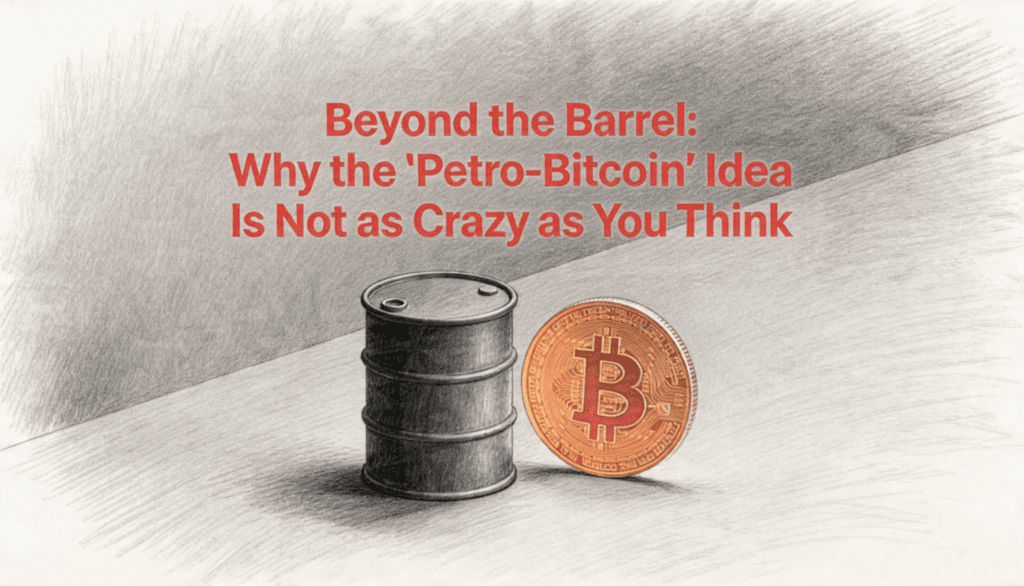
The barrel is changing. The question is whether you are paying attention to what it might be filled with next.