Table of Contents
There is a certain kind of financial thinker who believes that if you just get the money right, everything else follows. Hard currency. Gold backing. No funny business with the printing press. Get the money “sound” and prosperity becomes inevitable.
The Spanish Empire would like a word.
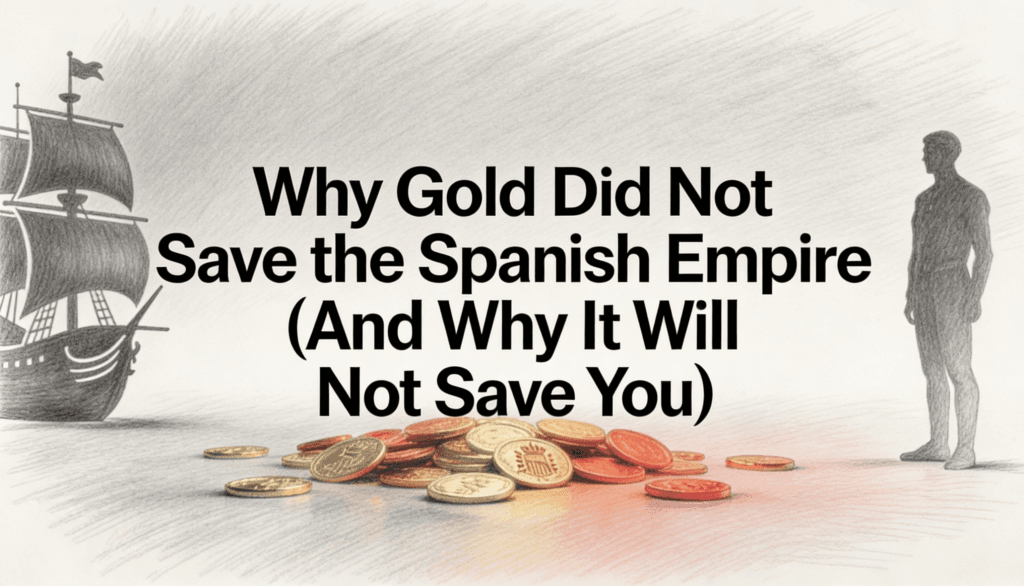
For nearly two centuries, Spain controlled the largest precious metal supply the world had ever seen. Silver poured out of Potosí and gold flowed from the Americas in quantities that would make a modern central banker weep with envy. If sound money theory worked the way its loudest advocates claim, Spain should have become the permanent economic hegemon of the Western world. It had the hardest money imaginable. Not a gold standard. Actual gold.
Instead, Spain became one of history’s most spectacular examples of economic decline. And the reasons why should matter to anyone who thinks the quality of money alone determines the quality of an economy.
The Richest Empire That Kept Going Broke
Here is the part that breaks the brains of monetary purists. Spain did not debase its currency in the early years of its empire. It did not need to. It had a firehose of silver and gold pointing directly at Seville. The coins were real. The metal was pure. The money was, by any reasonable definition, “sound.”
And yet, Spain declared sovereign bankruptcy nine times between 1557 and 1666. Nine times. With the best money on the planet.
The problem was never the composition of the coins. The problem was everything that happened around the coins. Spain used its metallic windfall to finance wars across Europe, maintain a bloated imperial bureaucracy, and import nearly everything its population consumed. The money was excellent. The economy underneath it was a hollow shell.
This is the part that modern sound money advocates tend to skip past rather quickly. Money is a tool. A measuring stick. A medium of exchange. It is not an economy. Confusing the instrument for the thing it measures is like believing a thermometer controls the weather.
What Actually Happens When You Flood an Economy With Hard Money
The Spanish experience gave early economists one of their first real world laboratories for studying inflation. And the results were not subtle.
As American silver flooded into Spain and then across Europe, prices rose dramatically. Historians call this the Price Revolution. Over the course of the sixteenth and seventeenth centuries, prices across Western Europe increased six fourfold. In Spain, which received the metal first, the effects were even more pronounced.
This should not have been possible according to a simplistic view of sound money. Gold and silver are supposed to be inflation proof. That is the whole pitch. But what actually happened was straightforward. The supply of money increased faster than the supply of goods. More coins chasing the same amount of bread, wool, and timber meant higher prices. The metal content of the coins was irrelevant. What mattered was how much of it existed relative to what people actually wanted to buy.
This is an uncomfortable truth for anyone who thinks returning to commodity money would eliminate inflation. It would not. It would simply change who controls the money supply from central bankers to whoever happens to find the next big deposit of whatever metal backs the currency. Trading one form of arbitrary supply expansion for another is not the revolution some people think it is.
The Dutch Puzzle
While Spain was drowning in silver and going bankrupt, the tiny Dutch Republic was becoming the richest society in Europe per person. The Dutch had almost no precious metal resources of their own. What they had instead was something more valuable: productive capacity and sophisticated financial institutions.
The Dutch built banks, insurance markets, a stock exchange, and a trading network that spanned the globe. Their money was not backed by mountains of silver sitting in a vault. It was backed by ships full of spices, warehouses full of goods, and a legal system that reliably enforced contracts.
This is a pattern that repeats throughout economic history with an almost comic consistency. The societies that obsess over the purity of their money tend to lose out to the societies that obsess over the productivity of their people. Venice beat the Byzantine Empire at commerce despite having no gold mines. Britain overtook Spain despite adopting a gold standard much later. The quality of the economy kept outrunning the quality of the coins.
The lesson is not that money does not matter. It does. The lesson is that money is downstream of institutional quality, productive capacity, and the social trust that makes complex economic activity possible. Getting those things right matters more than what your coins are made of.
The Institutional Blind Spot
Spain had something else going for it that should have guaranteed success by the standards of conventional thinking: a strong central state with clear property rights for the nobility and the crown. On paper, this looks like a recipe for economic development.
In practice, Spain developed what economists sometimes call extractive institutions. The crown taxed productive activity heavily while exempting the aristocracy. The Mesta, a powerful guild of sheep ranchers, was given legal priority over farmers, which suppressed agricultural innovation for centuries. Expelling the Jewish and Moorish populations removed some of the most commercially skilled groups in the kingdom. And the Inquisition created an atmosphere where intellectual and commercial risk taking could get you investigated for heresy.
No amount of sound money compensates for an institutional environment that punishes enterprise. You can have the purest gold coins in the world, but if the system surrounding them treats productive work as suspect and financial innovation as dangerous, the gold will simply flow somewhere else. Which is exactly what happened. Spanish silver ended up in the Netherlands, in England, in China. It passed through Spain like water through a sieve.
There is a modern parallel here worth noting. Some of the most resource rich nations today are also among the most economically dysfunctional. Economists call this the Dutch Disease. Having valuable stuff in the ground is not the same as having a functioning economy. The Spanish Empire was arguably the first large scale demonstration of this principle.
What Pre Industrial Money Actually Teaches Us
If you study how money actually worked in pre industrial societies, rather than how monetary theorists imagine it worked, you find something interesting. The most successful economies were rarely the ones with the most rigid monetary systems. They were the ones with the most adaptive ones.
Medieval China experimented with paper money centuries before Europe. It worked brilliantly under the Song Dynasty, when it was managed competently, and collapsed disastrously under later dynasties when it was not. The money itself was neither good nor bad. The governance around it was what mattered.
The Knights Templar essentially invented international banking in the twelfth century, creating a system where you could deposit money in London and withdraw it in Jerusalem without physically moving any gold across thousands of miles of bandit infested territory. This was, if you squint, a very early version of the kind of monetary abstraction that sound money advocates find so threatening. It was also enormously useful and contributed to the expansion of trade across medieval Europe.
Even within Europe, the most commercially vibrant cities were the ones that developed creative monetary instruments. Bills of exchange, letters of credit, early forms of fractional reserve banking. These were all “unsound” by purist standards. They were also the financial technologies that built the modern world.
The fixation on what money is made of misses the more important question of what money allows people to do. A gold coin that sits in a chest does nothing for an economy. A letter of credit that enables a merchant to buy goods in Bruges and sell them in Constantinople generates real wealth. The form matters less than the function.
The Real Lesson for Modern Investors
None of this is an argument against holding gold or against being skeptical of monetary policy. Healthy skepticism about how governments manage currencies is warranted by centuries of evidence. Governments do debase currencies. They do inflate money supplies for short term political reasons. This is real and documented and worth worrying about.
But the Spanish example should give pause to anyone who thinks the answer is simply to return to “real” money and watch prosperity follow. Spain had the most real money in human history. What it did not have was the institutional framework, the productive economy, or the commercial culture to turn that money into lasting wealth.
For modern investors, the implication is that monetary policy is only one variable among many. A country can have a perfectly managed currency and still decline if its institutions rot. A company can have a fortress balance sheet and still fail if it stops innovating. An individual can hold gold and still lose purchasing power if the rest of their financial life is poorly structured.
The Spanish Empire teaches us that wealth is not a thing you possess. It is a process you sustain. The mines of Potosí gave Spain a thing. The Dutch Republic, with its banks and its trading companies and its tolerance for commercial risk, built a process. The process won.
Sound money is a fine idea in principle. But it is not a substitute for sound institutions, sound productivity, or sound thinking. If the largest silver windfall in human history could not save an empire that got everything else wrong, it is probably wise to be suspicious of anyone selling monetary purity as a complete economic philosophy.
The coins were never the problem. The empire was.