Table of Contents
What a Spite Spend Actually Is
Money fights predict divorce more reliably than infidelity, incompatibility, or that thing your partner does with the bathroom towels. Yet almost every piece of financial advice for couples obsesses over budgets, joint accounts, and retirement projections, while ignoring the single most corrosive transaction in any household: the purchase that was never really about the purchase.
Welcome to the spite spend, the financial act disguised as a consumer decision. It looks like shopping. It feels like shopping. The credit card statement reads like shopping. The motivation underneath, however, has nothing to do with wanting the item. It has everything to do with wanting to be heard, wanting to punish, or wanting to reclaim power in a relationship where one person feels they have lost it.
Think of a spite spend as emotional laundering. The raw input is anger, resentment, or helplessness. The polished output is a new handbag, a surprise boat deposit, or an inexplicable four hundred dollar bar tab on a random Tuesday. The transaction sanitizes a difficult feeling into something that looks rational, because people buy things every day. Nothing to see here. Except there is a great deal to see here, and once you learn to spot the pattern, you cannot unsee it.
A spite spend is a communication failure wearing a shopping bag. The receipt is just the part you can hold in your hand.
This article sits at the intersection of personal finance and relationship psychology, because spite spending lives in exactly that overlap. You cannot fix it with a spreadsheet alone, and you cannot fix it with feelings alone. Understanding it requires both lenses at once.
The Psychology Behind Shopping as Warfare
Behavioral economists have long understood that humans are not rational with money. Daniel Kahneman won a Nobel Prize essentially proving that people are emotional disasters when financial decisions are involved. Most of that research, however, focuses on the individual and their private biases. The interesting question is what happens when you place two irrational people inside one shared financial arrangement and then stir in years of accumulated resentment.
You get something I would call strategic irrationality. A spite spend is not impulsive in the way a late night online shopping binge is impulsive. It is calculated, even when the person doing it would recoil at that word. There is a target. There is a desired reaction. The purchase functions as the medium, while the real message travels underneath it.
This borrows from game theory in a way that is worth sitting with. In the classic Prisoner’s Dilemma, two people may either cooperate or betray each other. The collectively rational move is cooperation. Once trust erodes, however, both players begin choosing betrayal, even though doing so leaves them worse off together. A spite spend is the financial equivalent of choosing betrayal. The person knows the purchase damages the household. That damage is precisely the point.
What makes this dynamic so durable is that it provides a release valve without the terror of vulnerability. Swiping a card is enormously easier than saying the words “I feel powerless in this marriage.” The spending lets a person express a difficult emotion while never having to admit, even to themselves, that the emotion exists.
The Five Flavors of Spite Spending
Spite spends do not all wear the same outfit. Recognizing the behavior requires understanding the distinct forms it takes, because each one targets a different nerve and demands a different response.
The Retaliation Purchase
This is the most transparent version. One partner buys something the other disapproves of, specifically because they disapprove of it. You vetoed the golf clubs on Monday? Watch a full set materialize in the garage by Friday. The surface logic is playground simple: you do not get to tell me what to do. The emotional architecture beneath it runs deeper. This purchase is almost always about autonomy rather than golf. The clubs are a flag planted on contested territory.
The Visibility Spend
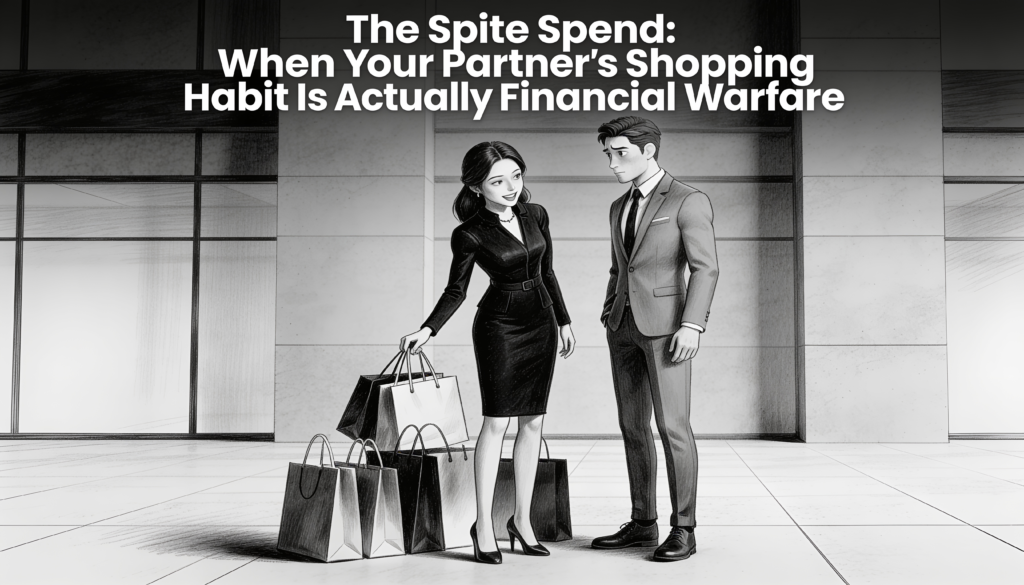
This flavor is quieter and more sophisticated. The purchase itself might be entirely reasonable. What matters is that it is made in a way that guarantees maximum visibility. Receipts left fanned across the kitchen counter. Shopping bags positioned where they cannot possibly be missed. A bank notification that pings both phones at once. The item is secondary. The performance is primary. This person does not particularly want the thing. They want their partner to know they got the thing.
The Slow Bleed
Perhaps the most damaging version, because it is the hardest to detect. The slow bleed consists of small, frequent, unnecessary purchases that gradually drain shared resources. No single transaction trips an alarm. Over the course of months, however, the cumulative effect becomes enormous. This is the financial equivalent of a cold war: no dramatic explosions, just a steady and deliberate erosion that becomes obvious only when you finally tally the year.
The Preemptive Strike
This pattern emerges when one partner senses that financial restrictions are coming. Maybe a conversation about cutting back looms on the horizon. Maybe someone just got laid off. The spite spender accelerates their purchasing before the window slams shut. It is hoarding dressed up as ordinary shopping, a frantic grab at the buffet before the lights come on.
The Martyr Spend
This is the counterintuitive one, and the most difficult to confront. Rather than spending on themselves, the martyr spends lavishly on others: the children, extended family, a charity. The generosity is conspicuous and carefully chosen to make the other partner appear cheap or controlling if they dare to object. Try telling your spouse that they should not have donated to the children’s hospital. You will lose that argument every single time, and the martyr spender knows you will. The kindness is real on the surface and weaponized underneath.
How It Connects to Power Dynamics Rather Than Money
Here is the part that surprises people. A spite spend is almost never genuinely about money. It is about control, and money simply happens to be the most accessible lever in most relationships. Whoever controls the money controls the options. When one partner feels that control slipping away, or feels they never possessed it to begin with, spending becomes a form of resistance.
This mirrors a concept from political science that deserves attention here. In occupied territories and authoritarian regimes, citizens often engage in what the anthropologist James Scott called the weapons of the weak. These are small, everyday acts of resistance that individually seem trivial but collectively amount to a refusal to submit. Dragging your feet at work. Pretending not to understand instructions. Misplacing the paperwork that someone needs.
When direct confrontation feels impossible or unsafe, indirect financial resistance becomes the only protest a person believes they can safely stage.
A spite spend operates by the same logic inside the home. The person may not even fully grasp what they are doing. They only know that buying that thing felt necessary in a way they cannot quite put into words. The purchase becomes a coded letter, written in the only language they feel free to use.
The Warning Signs You Are on the Receiving End
Recognizing a spite spend requires paying attention to context rather than content. The item purchased matters far less than the circumstances wrapped around it. Here are the signals worth watching.
- Watch the timing. Does spending spike after arguments, after you say no to something, or during stretches of unspoken tension? Financial behavior that reliably tracks emotional conflict is rarely a coincidence.
- Watch for defensiveness that outsizes the situation. If you casually mention a purchase and the response erupts like a volcano, you have probably brushed against the real nerve buried beneath the transaction. People who buy things for ordinary reasons do not react to gentle questions as though they have been accused of a felony.
- Watch for financial secrecy that is brand new. Everyone deserves a degree of financial privacy. A sudden lurch toward hidden accounts, unexplained cash withdrawals, and quietly deleted purchase notifications is concealment, and concealment serves a purpose.
- Watch the pattern rather than the incident. Anyone can make one questionable purchase. That is simply being human. The spite spend reveals itself through repetition. The rhythm gives it away, not any single beat.
If you find yourself building a mental case file, documenting purchases and rehearsing confrontations, that itself is a sign the financial dynamic has already poisoned the trust between you. The detective work is a symptom too.
Why Budgets Will Not Fix This
Most financial advice for couples defaults to the mechanical. Set a budget. Agree on spending limits. Install an app that tracks every expense in tidy color coded categories. These are perfectly fine tools for managing money. They are nearly useless for managing the emotional dynamics that manufacture spite spending in the first place.
Imposing a budget on a spite spender resembles posting a speed limit for someone who is driving while furious. The sign was never the problem. The rage is the problem. The driver might ease off the accelerator for a week, yet the underlying energy has to travel somewhere, and it will find a new exit.
This explains why couples therapy tends to outperform financial planning for these situations. The money is the symptom showing on the surface. The actual condition lives somewhere deeper in the relationship: an imbalance of power, a communication breakdown, or resentment that has been quietly composting for years into something rich and dark and toxic. You cannot spreadsheet your way out of resentment. You can only talk your way out of it, slowly and with help.
Moving Forward Without the Receipt
If you have recognized the spite spend in your own relationship, from either side of it, the path forward begins with naming the thing accurately. Not the purchase itself, but the feeling that lives underneath the purchase. “I bought that because I was angry” is a more useful sentence than any budget meeting could ever produce.
It is also one of the hardest sentences a person can say out loud, which is exactly why the spite spend persists. The behavior endures because it allows people to discharge difficult emotions while skipping the vulnerability of actually voicing them. Swiping a credit card is easier. Clicking add to cart is simpler than confessing “I resent that you make every financial decision in this house and I am tired of asking permission for my own life.”
Practical steps help once the emotional truth is on the table. A few that genuinely move the needle:
- Separate the symptom from the disease. Treat the spending as data about the relationship rather than as the central crime to be litigated.
- Build a shared language for money decisions. Agree on a threshold above which purchases get discussed, and frame it as transparency rather than permission.
- Address the power imbalance directly. If one partner controls all financial decisions, redistribute some of that authority before resentment hardens further.
- Bring in a third party when needed. A couples therapist, a financial therapist, or a neutral mediator can hold a conversation that the two of you cannot hold alone.
None of this is quick, and none of it fits neatly into an app. The credit card statement, however, always arrives at the end of the month, predictable and unforgiving. And in a relationship where spite has taken the wheel, the balance due is never just financial. It is paid in trust, and trust is the one debt no purchase can ever settle.