Table of Contents
Most people read Sun Tzu for the warfare. The battles, the tactics, the ancient glamour of generals outsmarting each other across misty valleys. But the real genius of The Art of War has almost nothing to do with fighting. It is a book about when not to fight. About patience. About terrain. About knowing yourself so well that you do not need to prove it to anyone.
Which makes it, oddly enough, one of the best investing books ever written. It just does not know it yet.
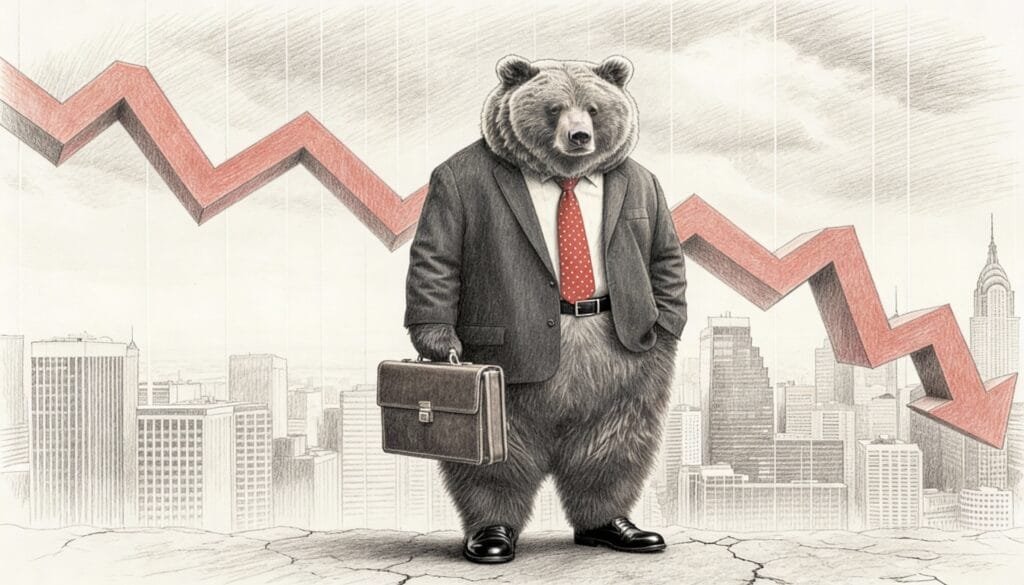
Bear markets have a way of exposing what bull markets so carefully concealed. When prices only go up, everyone is a strategist. Everyone has conviction. Everyone has a thesis. But when the tide pulls out, as the saying goes, you find out who was swimming without shorts. Sun Tzu would have appreciated that metaphor. He understood that the conditions which reveal truth are rarely the comfortable ones.
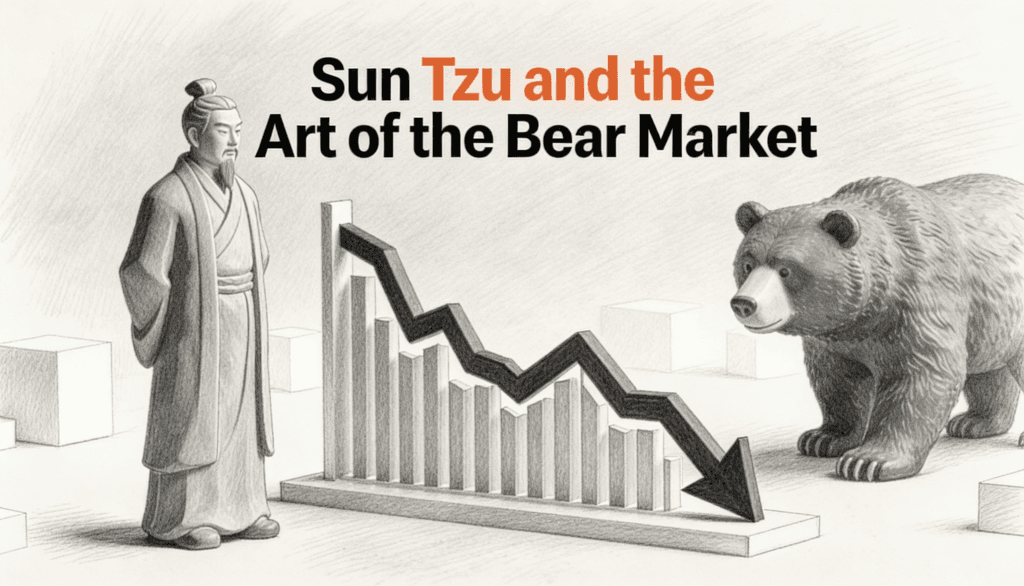
So let us do something unusual. Let us read a 2,500 year old military treatise as a guide to surviving, and even thriving, in the worst markets imaginable.
The War You Do Not Fight
Sun Tzu opens with a line that most people skip past too quickly: “War is a matter of vital importance to the state. It is a matter of life and death, a road to safety or to ruin.”
Replace “war” with “investing” and the sentence loses none of its weight. Capital allocation is not a game. It is not a hobby. It is a decision that determines futures. And yet, the modern investment culture treats it with all the seriousness of a fantasy football league. Apps gamify it. Social media turns it into entertainment. People take positions in things they cannot explain to their own mother.
Sun Tzu would find this horrifying.
His entire framework rests on the idea that conflict should be the last resort, not the first impulse. The best general wins without fighting. The best investor profits without panic. Both require something that modern culture actively discourages: restraint.
In a bear market, the pressure to act is enormous. Prices are falling. The news is catastrophic. Your portfolio is bleeding. Every instinct screams at you to do something. Sell. Buy. Hedge. Rotate. Anything but sit still.
But sitting still is often the entire strategy.
There is a reason that the most successful long term investors sound boring when they talk about process. They are not trying to entertain you. They are trying to survive. Sun Tzu would have approved. He reserved his highest praise not for the general who won spectacular battles, but for the one who won without needing to fight them at all.
Know the Terrain Before You Know the Enemy
One of the most quoted lines from The Art of War is “know your enemy and know yourself.” But people routinely forget what comes before it. Sun Tzu spends an enormous amount of time on terrain. On conditions. On the environment in which conflict takes place.
Translated to markets, this means something specific and often ignored. Before you worry about which stock to pick or which sector is undervalued, you need to understand the landscape you are operating in. What is the interest rate environment? Where are we in the credit cycle? Is liquidity expanding or contracting? These are not exciting questions. Nobody gets followers on social media for discussing the yield curve. But the yield curve does not care about your follower count.
Bear markets are a type of terrain. They have characteristics. They behave in patterns, not identical ones, but recognizable ones. They begin with denial, accelerate through fear, and end in exhaustion. Sun Tzu would call this reading the ground. You do not charge cavalry across a swamp. You do not buy aggressively into a market that has not finished capitulating.
The mistake most people make is confusing the enemy with the terrain. The enemy is not the bear market. The bear market is the terrain. The enemy, as Sun Tzu would be quick to point out, is almost always yourself.
The Psychology of the Losing Army
There is a passage in The Art of War about the morale of troops that reads like it was written about retail investors in a downturn. Sun Tzu describes how an army that has lost its spirit will make increasingly desperate moves. Soldiers abandon formation. Officers second guess their own orders. The chain of command dissolves into noise.
This is precisely what happens in a portfolio during sustained losses. The plan you wrote when markets were calm suddenly looks naive. The allocation you chose with a clear head now feels reckless. You start listening to people you would never have consulted during good times. You make trades based on feelings you would have laughed at six months ago.
Sun Tzu had a word for this kind of behavior. He called it disorder. And he considered it the primary cause of defeat, more dangerous than any external enemy.
The parallel to behavioral finance is striking. Daniel Kahneman, who won a Nobel Prize for studying how people make decisions under uncertainty, arrived at remarkably similar conclusions to a Chinese military philosopher who lived more than two millennia before him. Both understood that human judgment deteriorates in direct proportion to emotional pressure. Both concluded that systems and discipline matter more than intelligence.
This is, incidentally, one of the great ironies of investing. The smartest people in the room are often the worst investors. Not because their analysis is wrong, but because they trust their own cleverness enough to override their own rules. Sun Tzu warned about this too. He called it the fault of the general who believes himself beyond the principles he teaches.
Deception and the Market of Mirrors
Sun Tzu is famous for his emphasis on deception. “All warfare is based on deception,” he wrote, and it remains one of the most referenced lines in strategic thinking.
Markets are theaters of deception, though not always in the way people imagine. The deception is not necessarily some conspiracy. It is not always manipulation, though that certainly exists. The deeper deception is structural. Prices tell you what happened, not what will happen. Earnings reports describe the past. Analyst forecasts are dressed up guesses with decimal points added for confidence.
In a bear market, the deception intensifies. Rallies appear that look like recoveries. These are sometimes called bear market rallies, and they are among the cruelest features of a downturn. They offer hope at precisely the moment when hope is most dangerous. Investors pile back in, convinced the worst is over, only to watch prices resume their descent.
Sun Tzu would have recognized this pattern immediately. It is the feigned retreat. One of the oldest tricks in military history. You pretend to flee, your enemy pursues in excitement, and you turn on them when they are overextended and exposed.
The defense against deception, in both war and markets, is not to become more clever. It is to become more patient. You do not need to identify every trap if you simply refuse to chase.
The Cost of Prolonged War
There is a chapter in The Art of War that modern investors would benefit from reading once a quarter. It concerns the cost of prolonged conflict. Sun Tzu warns that even a victorious army suffers if the campaign drags on. Resources deplete. Morale erodes. The winner inherits exhaustion.
This is the hidden cost of a bear market that nobody talks about at the beginning. It is not just about the money you lose. It is about the psychological capital you spend. The energy. The attention. The sleep. The relationships that strain because you are anxious about something your partner cannot see or touch.
Investors who survive bear markets do not just preserve financial capital. They preserve emotional capital. They do this by accepting something deeply counterintuitive: that not knowing is an acceptable position. That uncertainty is not a problem to be solved but a condition to be endured.
This is where Sun Tzu parts ways with most financial advice. The modern industry sells certainty. Forecasts, targets, probabilities, all presented with the authority of science. But markets are not physics. They are human behavior dressed up in mathematics. Sun Tzu never pretended to know the future. He prepared for multiple outcomes and conserved his resources until the right moment revealed itself.
The Empty Fort
One of the most famous stories associated with Sun Tzu’s philosophy, though it actually comes from a later strategist named Zhuge Liang, is the Empty Fort Strategy. Facing a vastly superior force, Zhuge Liang opened the gates of his city, sat on the wall playing a lute, and waited. The invading general, convinced it must be a trap, retreated.
The lesson is not about bluffing. It is about composure. The signal you send when you refuse to panic is itself a form of strategy. In markets, this looks like the investor who does not sell at the bottom. Not because they are certain prices will recover, but because they have already accounted for the possibility that they might not. Their calm is not ignorance. It is preparation.
This is the philosophical core of risk management. Risk is not something you avoid. It is something you understand so thoroughly that it loses its power to dictate your behavior.
Winning by Not Losing
Sun Tzu makes a distinction that most people miss entirely. He separates the concept of “making yourself invincible” from “waiting for the enemy to become vulnerable.” The first is within your control. The second is not.
In investing terms: you can control your position sizing, your diversification, your cash reserves, your time horizon, and your emotional responses. You cannot control the Federal Reserve, geopolitics, earnings surprises, or the collective mood of millions of other market participants.
Bear markets punish people who confuse these categories. They reward those who focus relentlessly on what is within their control and release everything else.
This sounds simple. It is not. Releasing the need to control outcomes goes against every instinct that makes someone ambitious enough to invest in the first place. But Sun Tzu was never in the business of telling people what they wanted to hear. He was in the business of telling them what would keep them alive.
The Battle After the Battle
Here is where most articles about bear markets end. They tell you to stay disciplined, keep your head, and wait for the recovery. And that is fine advice, as far as it goes.
But Sun Tzu goes further. He talks about what happens after the conflict. About the transition from war to peace. About the dangers of victory itself.
The end of a bear market is its own kind of trap. When prices start to genuinely recover, the temptation is to become aggressive. To make up for lost time. To swing bigger because you feel you have earned it. This is precisely the moment where the lessons of the downturn evaporate and the cycle begins again.
The philosophy of risk is not a bear market survival guide that you put back on the shelf when things improve. It is a permanent orientation. Sun Tzu did not advise being cautious only when losing. He advised being cautious always. Especially when winning.
That might be the most counterintuitive lesson of all. The moment you feel most confident is the moment you are most exposed. The army celebrating its victory is at its most vulnerable. The investor who just rode a recovery to new highs is the one most likely to forget everything the bear market taught them.
Sun Tzu would suggest remembering. Not out of fear. Out of respect for a game that never truly ends.