Table of Contents
There is a quiet violence to being cut off from the global financial system. No missiles are fired. No borders are crossed by soldiers. One day a country can buy wheat, pay for medicine, and settle its debts. The next day it cannot. The wires go dead. The money stops moving. And the effect, for ordinary people standing in line at banks that suddenly have nothing to offer them, is not so different from a siege.
This is financial warfare. And its weapon of choice is not new technology or secret intelligence. It is plumbing. Specifically, the plumbing that moves money between nations.
The Pipes Beneath Global Commerce
SWIFT, the Society for Worldwide Interbank Financial Telecommunication, is not a bank. It does not hold money. It does not transfer money. What it does is far more powerful than either of those things. It carries messages. When a bank in Tokyo needs to send dollars to a bank in London, SWIFT is the messenger that tells both sides what is happening. Think of it as the postal service of global finance, except the letters it carries are worth trillions of dollars a day.
Founded in 1973 and based in Belgium, SWIFT connects more than 11,000 financial institutions across roughly 200 countries. For decades, it operated in the background, invisible to anyone who was not a banker or a compliance officer. Most people had never heard of it. That changed.
The moment SWIFT became a household name was the moment it stopped being infrastructure and started being a weapon.
From Neutral Pipes to Political Levers
The logic of weaponizing SWIFT is elegant in its brutality. If nearly every international transaction passes through a single messaging network, then controlling access to that network gives you control over who can participate in the global economy. You do not need to invade. You do not need to blockade ports. You just need to flip a switch.
Iran learned this first. In 2012, under pressure from the United States and the European Union, SWIFT disconnected Iranian banks from its network. The consequences were immediate and severe. Iran could not easily sell oil, its primary source of revenue. It could not pay for imports through normal channels. Its currency lost roughly 40 percent of its value. The country did not collapse, but it buckled.
Then came Russia. After the invasion of Ukraine in 2022, Western nations cut major Russian banks from SWIFT. The symbolism was loud. The message to the world was clear: the financial system that everyone relies on is not neutral. It has owners. And those owners have preferences.
Here is where it gets interesting. The weapon worked. And it did not.
The Paradox of the Perfect Weapon
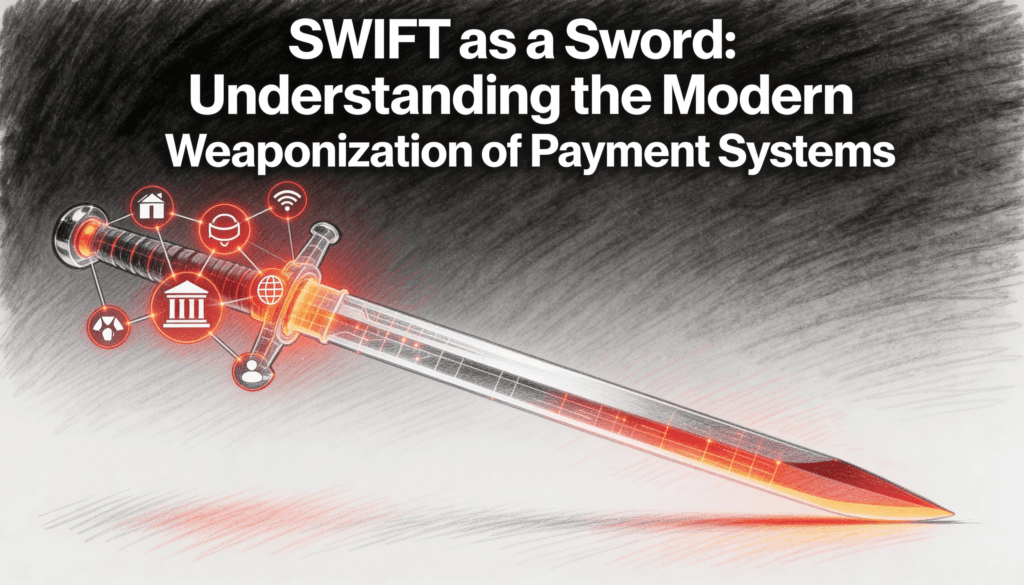
Financial sanctions through SWIFT disconnection are devastating in the short term. They cause chaos, disrupt trade, and punish economies. But they carry a strange, almost poetic flaw. The more effective the weapon is, the more urgently it motivates its targets to build alternatives. Every time you use the sword, you teach your enemy to forge shields.
After being cut from SWIFT, Russia accelerated the development of its own messaging system, SPFS. China had already been building CIPS, its Cross Border Interbank Payment System, since 2015. India developed its own structures. These systems are not yet rivals to SWIFT in scale or reach, but their existence tells a story that should make Western policymakers uncomfortable.
The weaponization of financial infrastructure creates the very conditions for its own obsolescence. This is the paradox. The United States and Europe used SWIFT as leverage precisely because there was no alternative. But every use of that leverage is a marketing pitch for alternatives. It is like a landlord who keeps changing the locks. Eventually, the tenants stop renting and build their own house.
Currency as Ammunition
SWIFT is only part of the story. The broader arena is currency warfare, and the dollar sits at the center of it.
The US dollar is the world’s reserve currency. This means that most international trade, most central bank reserves, and most commodity pricing is denominated in dollars. This gives the United States an extraordinary privilege. It can borrow cheaply. It can run deficits that would sink other nations. And it can use the dollar itself as a tool of coercion, because anyone who needs dollars, which is nearly everyone, must play by American rules.
When the US imposes sanctions, it is not just blocking access to American banks. It is threatening to cut off access to the dollar clearing system. Since most global trade touches dollars at some point, this threat reaches far beyond American borders. A European company doing business with Iran, for example, could find itself locked out of the US financial system even though no American is involved in the transaction.
This is extraterritorial power in its purest form. The dollar does not just facilitate trade. It disciplines it.
But here is the counterintuitive part. This power depends on the dollar being indispensable. The more aggressively the US wields the dollar as a weapon, the more other nations start asking a dangerous question: what if we did not need dollars at all?
The De-dollarization Conversation
De-dollarization is one of those ideas that is simultaneously overhyped and underappreciated. On one hand, the dollar is not going anywhere soon. No other currency has the depth, liquidity, and institutional trust to replace it. The euro is fragmented by the politics of 20 different governments. The yuan is constrained by China’s capital controls. Cryptocurrencies are volatile, speculative, and not remotely ready for prime time.
On the other hand, the direction of travel matters more than the current position. Saudi Arabia has discussed pricing oil in yuan. Brazil and China have arranged to settle trade in their own currencies, bypassing dollars entirely. Central banks around the world have been gradually diversifying their reserves away from dollars. None of these shifts is revolutionary on its own. Together, they suggest a slow migration, not a sudden earthquake, but the kind of ground movement that eventually redraws the map.
There is a tendency in discussions of financial warfare to stay abstract. We talk about systems and currencies and institutions as if they exist in a vacuum. They do not. When a country is cut off from global payments, the first people to suffer are not politicians or generals. They are patients who cannot get imported medication. They are families whose savings evaporate with the exchange rate. They are small business owners who watch their supply chains dissolve overnight.
This is the moral complexity of financial warfare. Its proponents argue that it is more humane than military action. No one dies from a SWIFT disconnection, at least not directly. But the suffering is real, widespread, and often borne by people who have no influence over the decisions that triggered the sanctions in the first place.
The Game Theory of Mutually Assured Financial Destruction
What happens when the targets of financial warfare are not small, isolated economies but major global players?
Cutting Iran from SWIFT was painful for Iran but manageable for the global economy. Cutting Russia was harder. Russia is a major energy exporter, and disrupting its financial flows sent shockwaves through commodity markets worldwide. Europe paid for its own sanctions in the form of an energy crisis that fueled inflation and political instability.
Now imagine a scenario involving China. China is the world’s second largest economy and the largest trading partner for most of the world’s nations. Cutting China from SWIFT, or even threatening to, would not be a targeted strike. It would be a global financial earthquake. Supply chains would fracture. Markets would panic. The cure would be indistinguishable from the disease.
This creates a version of mutually assured destruction, except with bank accounts instead of nuclear warheads. The weapon exists. Everyone knows it exists. But using it against a sufficiently large adversary would cause as much damage to the attacker as to the target. So it sits there, a sword that is too heavy to swing.
What Comes Next
The future of financial warfare is not about whether these tools will continue to be used. They will. The question is whether the infrastructure that makes them possible will remain under Western control.
Three forces are reshaping the landscape. First, alternative payment systems are growing, slowly but steadily. They are clunky, limited, and nowhere near replacing SWIFT today. But technology improves, and necessity is a powerful motivator. Second, digital currencies issued by central banks could eventually enable direct bilateral settlement between nations, cutting out the existing infrastructure entirely. China’s digital yuan is the most advanced of these projects, and its design is explicitly aimed at reducing dependence on the dollar system. Third, and most fundamentally, the geopolitical alignment that sustained the current system is fraying.
None of this means the dollar is finished or SWIFT is obsolete. It means that the weapon is losing its edge, not because it is less sharp, but because the battlefield is changing.
The Deeper Lesson
Financial warfare reveals something important about power in the modern world. The most effective forms of control are the ones that look like services. SWIFT did not become powerful because it sought power. It became powerful because it was useful. The dollar did not dominate because of military force alone. It dominated because it was convenient, liquid, and trusted.
The genius of the system was that it made dependence feel like choice. Countries used dollars because dollars worked. Banks used SWIFT because SWIFT worked. The coercion was invisible until the moment it was not.
A system that depends on voluntary participation cannot survive the moment when participation starts to feel involuntary. The sword works only as long as the people it threatens believe they have no alternative. The moment they start building one, the countdown begins.
Not with a bang. Just with a wire transfer routed through a different network, to a different bank, in a different currency.
Quiet as a message. Loud as a revolution.