Table of Contents
Your portfolio does not care about your feelings. But your feelings care deeply about your portfolio. And that is the entire problem.
We spend enormous energy learning to read candlestick patterns, moving averages, and earnings reports. We study markets as if they were machines. Clean inputs, clean outputs. But the person sitting at the keyboard, the one making the actual decisions, is running on 200,000 year old neurochemistry that evolved to find berries and avoid lions. Nobody in the history of evolution was selected for their ability to hold a losing position through a quarterly drawdown.
This is the case for biology first investing. Not a strategy. A lens. One that might explain why you keep doing the exact thing you swore you would never do again.
The Dopamine Problem You Did Not Know You Had
Dopamine is the most misunderstood molecule in popular culture. People call it the “pleasure chemical.” It is not. Dopamine is the anticipation chemical. It does not reward you for getting what you want. It rewards you for expecting to get what you want. The distinction matters enormously when money is involved.
Wolfram Schultz, a neuroscientist at Cambridge, ran a famous set of experiments with monkeys. When a monkey received an unexpected reward, dopamine spiked. But once the monkey learned to predict the reward, the spike moved. It no longer fired at the reward itself. It fired at the cue that predicted the reward. The juice was the same. The brain had already moved on to the trailer.
Now apply this to your brokerage account. That little rush you feel when a stock you are watching starts climbing before you buy it? That is dopamine doing exactly what it was designed to do. It is not telling you this is a good investment. It is telling you this looks like a pattern that previously led to reward. Your brain is running a prediction algorithm, not a valuation model.
This is why the moment after you buy feels slightly hollow. You expected the purchase to feel like the anticipation. It almost never does. The neurochemistry of wanting and the neurochemistry of having are two completely different systems. The market figured this out long before neuroscience did. It is called “buy the rumor, sell the news.” Wall Street accidentally described a dopamine curve.
Why Losses Hit Harder (And It Is Not Because You Are Weak)
Daniel Kahneman and Amos Tversky showed that losses feel roughly twice as painful as equivalent gains feel good. Lose a hundred dollars and the sting is about double the pleasure of finding a hundred dollars. This is loss aversion, and it is not a character flaw. It is architecture.
From a survival standpoint, this asymmetry makes perfect sense. Missing a meal was more dangerous than finding an extra one. The ancestors who treated threats as more urgent than opportunities were the ones who stuck around long enough to become ancestors. You inherited their nervous system, and now you are using it to decide whether to rebalance your 401k.
Here is where it gets interesting. Loss aversion does not just make you afraid to sell losers. It makes you afraid to sell winners too early because the potential future gain you might miss feels like a loss. You are not holding that stock because of conviction. You are holding it because your amygdala cannot distinguish between a saber toothed tiger and a red number on a screen.
The result is a bizarre behavioral cocktail. Investors hold losing positions too long (because selling crystallizes the loss, making it real) and sell winning positions too soon (because the unrealized gain feels fragile, and locking it in reduces anxiety). This pattern is so universal that behavioral economists gave it a name: the disposition effect. It is not a market phenomenon. It is a biological one.
The Cortisol Calendar
Dopamine gets all the attention, but cortisol might be the more dangerous molecule for investors. Cortisol is your stress hormone. In short bursts, it sharpens focus. In sustained doses, it narrows your thinking, biases you toward familiar options, and makes you catastrophize.
John Coates, a former Wall Street trader turned neuroscientist, measured cortisol levels in London traders over several weeks. He found that during periods of market volatility, traders’ cortisol levels rose by as much as 68 percent. More critically, high cortisol did not just make them feel bad. It changed how they processed risk. Traders with elevated cortisol became significantly more risk averse, often at the precise moment when the best opportunities were appearing.
This is the cruel irony of market biology. The moments that demand the most rational thinking are the exact moments your body is least equipped to provide it. Market crashes do not just destroy capital. They flood your system with a hormone that makes you want to sell everything and hide. The people who buy during panics are not necessarily smarter. They might just have different cortisol baselines.
The Illusion of Rational Conviction
Here is a thought that might be uncomfortable. That deep sense of conviction you feel about a stock? The one that feels like insight, like you have figured something out that the rest of the market has not? There is a decent chance that is also neurochemistry.
When our beliefs align with incoming information, the brain releases a small dopamine reward. Confirmation feels good at a chemical level. This is why confirmation bias is so difficult to overcome. You are not just intellectually lazy when you seek out information that supports your position. You are chasing a micro dose of neurological validation.
Combine this with the endowment effect (we overvalue things simply because we own them) and you get a portrait of the average investor that is not flattering. You bought a stock. You now value it more because you own it. You seek out information that confirms your thesis because finding it feels good. You avoid contradictory evidence because it triggers a small stress response. And through all of this, you believe you are being objective.
The market is full of people with deep conviction and shallow analysis. Biology makes it very difficult to tell the difference from the inside.
What Actually Helps
If the problem is biological, the solutions need to be at least partially biological too.
Time distance from decisions. The simplest intervention is also the most effective. Build a gap between the impulse and the action. Write down your trade thesis before executing it. Wait 24 hours. This is not about discipline. It is about letting cortisol and dopamine return to baseline so your prefrontal cortex can do its job. The prefrontal cortex handles long term planning, but it is slower and quieter than the limbic system. It needs time to get a word in.
Reduce sensory noise. Fewer screens, fewer notifications, fewer real time feeds. Every data point is a potential trigger for a neurochemical response. The most successful long term investors tend to check their portfolios infrequently. It is neurological hygiene.
Pre commitment. Decide your entry and exit points before you are emotionally involved. Homer tied himself to the mast before the Sirens started singing, not during. The same principle applies to stop losses. Set them when you are calm and trust them when you are not.
The Meta Lesson
Finance loves to present itself as a discipline of numbers. And it is. But the person interpreting those numbers is not a spreadsheet. They are a biological organism with reward circuits shaped by millions of years of selection pressure that had absolutely nothing to do with equity markets.
The best investors are not the ones who eliminate emotion. That is impossible and probably undesirable. The best investors are the ones who recognize the biological signals for what they are: data about their internal state, not data about the market.
Your pulse racing before a trade is not conviction. It is arousal. Your calm certainty about a position is not analysis. It might be the absence of contradictory information. Your panic during a downturn is not cowardice. It is cortisol doing its job in a context it was never designed for.
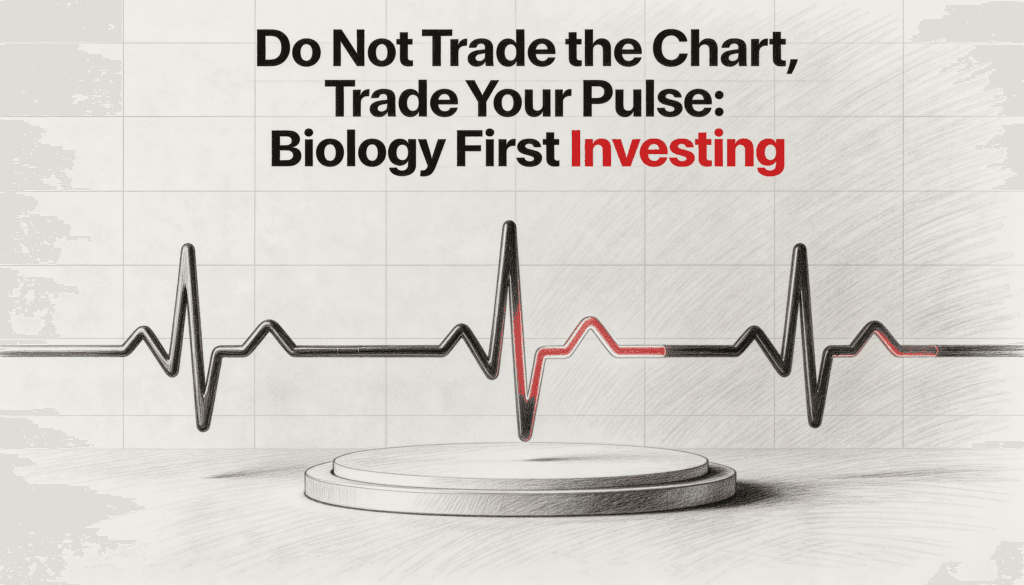
Do not trade the chart. Trade your pulse. Because until you understand what your body is doing to your decisions, your decisions are not really yours.
They belong to a nervous system that is still, on some level, looking for berries and watching for lions.