Table of Contents
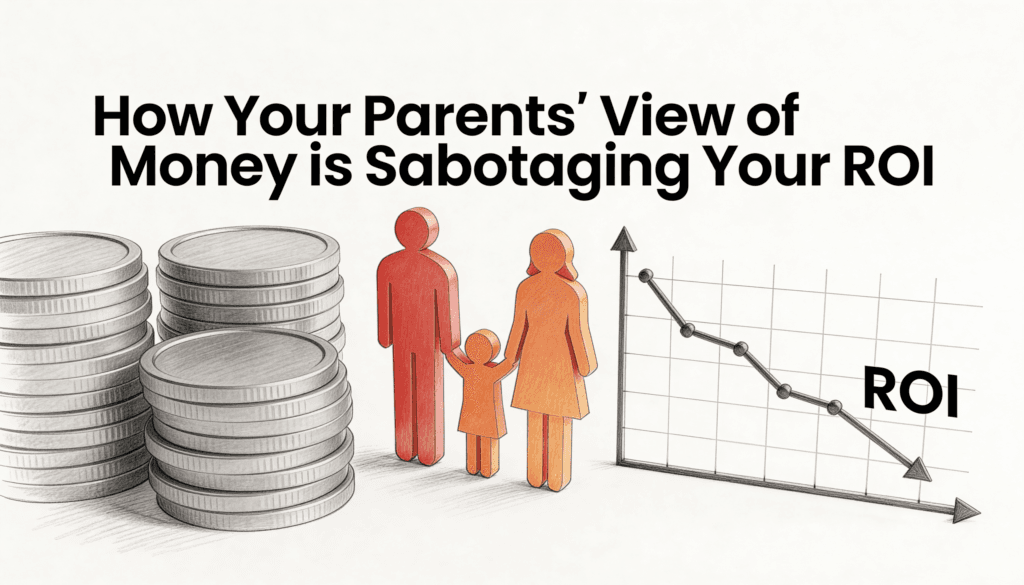
You did not inherit just eye color and a tendency to sneeze in sunlight. You inherited a entire financial operating system, and it was installed before you could even count to ten.
Every investor eventually learns about compound interest, diversification, and risk tolerance. But almost nobody examines the thing that sits underneath all of those decisions: the emotional blueprint around money that was handed to you at the dinner table, in whispered arguments behind closed doors, and in the things your parents never said about money at all.
This is the invisible portfolio. And for most people, it is performing terribly.
The Software You Did Not Choose
Psychologists have a term for the mental frameworks we absorb in childhood. They call them schemas. Think of them as default settings for how you interpret the world. When it comes to money, these schemas get wired early and they get wired deep.
If your mother treated every purchase over twenty dollars like a funeral, you probably carry a scarcity schema. If your father threw money around to signal success, you might carry an association between spending and self worth. If your parents simply never discussed money, congratulations. You were handed the schema of financial silence, which is its own quiet disaster.
Here is the counterintuitive part. These inherited beliefs do not just shape how you feel about money. They shape how you invest it. And feelings, despite what the finance world pretends, are where most portfolio damage actually happens.
The Scarcity Trap and Its Expensive Consequences
Let us start with the most common inherited money belief: there is never enough.
Children who grow up watching parents stress over bills, clip coupons with visible anxiety, or repeat phrases like “we cannot afford that” often develop a relationship with money built entirely on fear. Money becomes a threat rather than a tool.
This sounds like it would produce cautious, disciplined investors. Sometimes it does. But more often it produces something else entirely: people who are so terrified of losing money that they cannot deploy it effectively.
They hoard cash in savings accounts that lose value to inflation every year. They refuse to invest at all because the stock market feels like gambling. Or they do invest, but sell at the first sign of a downturn because the emotional pain of watching numbers go down triggers something much older than any market cycle. It triggers the feeling of sitting at that kitchen table, watching a parent’s face fall while opening an envelope.
The irony is sharp. The very behavior designed to protect money ends up costing the most. Playing it too safe is one of the most expensive financial strategies that exists, but it never feels expensive because the losses are invisible. You do not see the returns you never earned.
The Other Side: Money as Performance
Then there is the opposite inheritance. Some people grew up in households where money was loud. It was the scorecard, the proof of worth, the thing that made you matter in the room.
These investors tend to take on too much risk. Not because they have done the analysis, but because playing it safe feels like admitting you are not good enough. They chase high return investments the way their parents chased the visible markers of success. The big house. The new car. The vacation everyone would hear about.
This schema produces a different kind of portfolio damage. It leads to concentration risk, overleveraging, and a dangerous inability to sit still. Every flat quarter feels like failure. Every friend’s stock tip feels like something you should have found first.
The Silence Tax
Perhaps the most underestimated inheritance is the one built from absence. Many families simply do not talk about money. Not because they are hiding something dramatic, but because they absorbed the cultural message that money is private, even taboo.
The children of financial silence grow into adults who do not know what they do not know. They have no framework for evaluating financial decisions because they never watched someone make one openly. They are more likely to avoid financial planning entirely, more likely to feel shame when they do not understand something, and more likely to defer decisions to whoever sounds the most confident.
Financial silence also creates a specific vulnerability to bad advice. When you have no internal compass for money decisions, you become dependent on external ones. And the financial industry is more than happy to provide a compass.
The Stress Loop Nobody Draws on a Whiteboard
Here is where financial psychology and mental health crash into each other in ways that the personal finance industry mostly ignores.
Financial stress does not just make you feel bad. It changes how your brain processes decisions. Chronic stress around money activates the same threat response systems that evolved to help you escape predators. Useful for running from danger. Terrible for evaluating a 401k allocation.
Under stress, the brain narrows its focus. It prioritizes short term survival over long term planning. It becomes more reactive and less analytical. This means that the people who need the best financial decision making, those under the most financial pressure, are neurologically set up to make the worst decisions. That is not a moral failure. It is biology.
What the Financial Industry Gets Wrong
Most financial advice treats investors as rational agents who simply need better information. Read more books. Learn about index funds. Understand the tax code. And sure, financial literacy matters.
But telling someone with deep inherited money anxiety to “just invest consistently and ignore the market” is like telling someone with a fear of heights to just enjoy the view. The advice is technically correct and practically useless because it does not address the operating system running beneath the behavior.
The financial planning industry has started to acknowledge this. The rise of financial therapy as a field is a sign that the gap between knowing what to do and actually doing it has become too large to ignore. But most people will never see a financial therapist. They will just keep making the same decisions their parents made, dressed up in slightly more modern language.
Recognizing the Pattern
The first step in changing any inherited behavior is seeing it clearly. And this is harder than it sounds because these patterns feel like truth. They do not feel like programming. They feel like reality.
A few questions worth sitting with honestly. What did your parents fight about regarding money? What did they never say? When you think about a large financial decision, what physical sensation shows up? Is it excitement, dread, numbness? What is the financial behavior you keep repeating even though you know it is not working?
That last question is usually where the inherited pattern lives. The thing you keep doing despite evidence it is not serving you. That is not stupidity. It is loyalty to an old program.
Rewriting the Code
Here is the genuinely good news. Neural pathways are not permanent. The brain’s capacity to rewire itself is not just motivational poster language. It is documented science. But rewiring requires more than just knowing a better strategy. It requires interrupting the emotional pattern at the moment it fires.
This means building a space between the trigger and the response. You see your portfolio drop ten percent and instead of immediately selling, you notice the feeling, name it, and pause before acting. That pause is where the old program gets interrupted and the new one starts to load.
Some practical approaches that actually work. First, automate as much of your investing as possible. Automation removes the emotional decision point entirely. You cannot panic sell on a Tuesday afternoon if the money was already invested on Monday morning without your input.
Second, write down your investment rules when you are calm. Decide in advance what you will do if the market drops by certain amounts. Then follow the rules, not your feelings. It is about building a structure that protects you from acting on inherited patterns during the moments they scream the loudest.
Third, talk about money openly with people you trust. This directly counteracts the silence schema and starts to normalize financial conversation. You will be surprised how many people are operating from the same inherited playbook and how much relief comes from simply naming it.
The Real ROI
Your parents did the best they could with what they had. Their money behaviors were inherited too, from their parents, from their economic circumstances, from a culture that has always been deeply confused about what money means and what it is for.
You are not breaking a cycle to prove them wrong. You are breaking it because every decision you make is exhausting, expensive, and unnecessary.
The best investment you will ever make is not in any asset class. It is in understanding why you make the choices you make. Everything else, the strategy, the allocation, the returns, flows downstream from there.
And unlike most investments, this one pays dividends in every area of your life.