Table of Contents
There is a particular kind of misery reserved for people who have everything and feel nothing. You would think that sentence describes a character in a Russian novel. It does not. It describes a surprising number of people earning six figures in cities across the world, staring at bank balances that should make them smile and feeling only a dull, persistent anxiety instead.
We have been sold a very specific story about wealth. The story says: hit the number, feel the feeling. Get to a million, exhale. Get to five million, relax. Get to ten, transcend. But the people who actually arrive at these milestones report something strange. The exhale never comes. The number moves. The finish line was painted on a treadmill.
This is not a motivational essay about gratitude. This is about something more uncomfortable. The possibility that our entire framework for understanding wealth is broken, and that the break is doing real, measurable damage to our mental health.
The Thermostat Problem
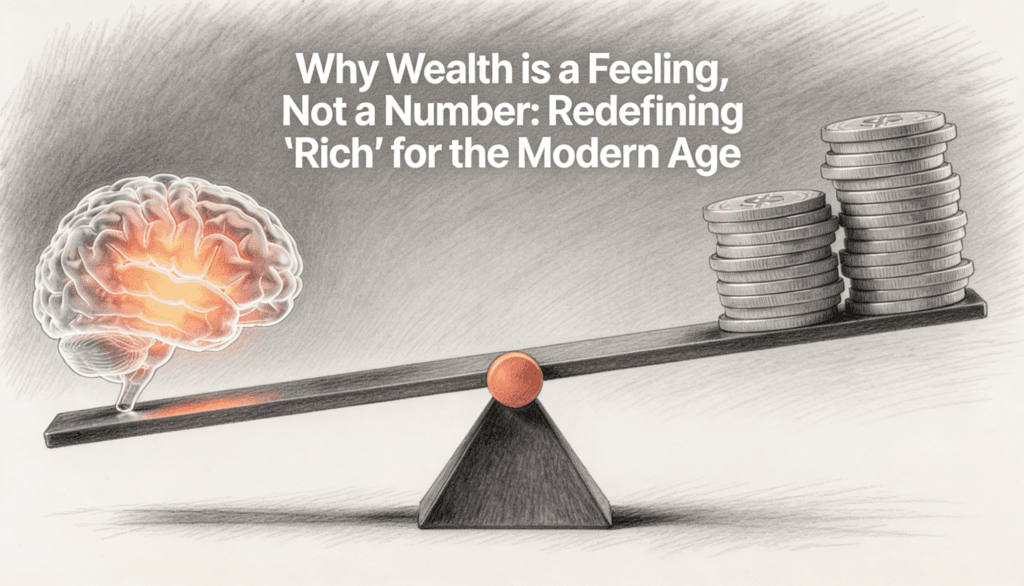
Think of your sense of wealth like a thermostat, not a thermometer. A thermometer reads the room. A thermostat decides what the room should feel like and adjusts accordingly. Your brain does not read your bank account and generate a proportional amount of calm. Instead, it sets a target for how much money feels like “enough,” and then it adjusts your anxiety to keep you reaching.
This is why a person making $40,000 in a small town can feel more financially secure than someone making $400,000 in Manhattan. The numbers are irrelevant. The thermostat settings are everything.
Psychologists have a term for this. It is called the hedonic treadmill. You get the raise, you feel great for about two weeks, and then your expectations recalibrate. The new salary becomes the new normal. The brief warmth of achievement gives way to the familiar chill of wanting more. You are running, but the scenery is not changing.
What makes this particularly cruel is that it operates below conscious awareness. Nobody decides to feel poor after getting a promotion. It just happens, the way your eyes adjust to a bright room until the brightness becomes invisible.
When the Scoreboard Replaces the Game
Here is where things get interesting from a psychological standpoint. Money was supposed to be a tool. You use it to buy shelter, food, time, and experiences. But somewhere along the way, money stopped being the tool and became the score. We stopped asking “what does this money let me do?” and started asking “where does this money rank me?”
This is a fundamental shift, and it has consequences.
When money is a tool, you can have enough of it. You have enough hammers when the shelf is built. You have enough money when your needs and reasonable wants are met. But when money is a score, there is no such thing as enough. Scores only matter in comparison, and there is always someone with a higher one.
Social media made this infinitely worse. It used to be that your comparison group was your neighborhood, maybe your extended family. You could feel wealthy relative to a few dozen people. Now your comparison group is everyone who has ever posted a photo from a yacht. The reference frame expanded, and our sense of adequacy collapsed to fill the new, impossible space.
The Enough Question
If wealth is a feeling, then the practical question becomes: how do you feel wealthy without needing an ever increasing number to get there?
This is where the conversation gets uncomfortable for the financial industry, because the answer has almost nothing to do with financial products.
Research in behavioral economics points to a few consistent findings. The feeling of wealth is most strongly correlated with three things: autonomy over your time, the absence of financial shame, and the ability to absorb an unexpected expense without panic. Notice what is missing from that list. A specific number. A portfolio size. A net worth target.
A freelance designer who earns $70,000 a year, sets her own schedule, has no debt, and keeps a six month emergency fund may feel wealthier than a corporate lawyer earning $300,000 who works eighty hour weeks, carries law school debt, and spends to match the lifestyle of partners at the firm. On paper, the comparison is absurd. In lived experience, it is not even close.
This does not mean money is irrelevant. Having enough to cover your basic needs and a buffer for emergencies is foundational. Below that threshold, more money genuinely does improve wellbeing. But above it, the relationship between income and life satisfaction flattens dramatically. The curve bends. Extra dollars buy less and less peace.
The controversial implication is this: past a certain point, the pursuit of more money can actually make you feel less wealthy, because it consumes the very things, time, autonomy, presence, that create the feeling of wealth in the first place.
The Comparison Trap Has an Exit
There is a concept in philosophy called the “view from nowhere.” It is the idea that we can try to see our lives from an objective, detached perspective, free from our own biases and context. It sounds enlightening. In practice, when applied to personal finance, it is a disaster.
You cannot evaluate your financial life from nowhere. You can only evaluate it from somewhere. And the “somewhere” you choose determines whether you feel rich or poor.
If your somewhere is Instagram, you will feel poor forever. If your somewhere is a historical perspective, you are living better than virtually every human who ever existed. Air conditioning alone would have made you a deity in most centuries.
The useful move is not to find the “right” comparison. It is to notice that you are comparing at all, and to ask whether the comparison is serving you or consuming you. Most of the time, it is consuming you. Most of the time, the comparison is not even with a real person. It is with a curated projection of a person who is also comparing themselves to someone else. It is anxiety all the way down.
Redefining Rich
So what would it mean to actually redefine wealth as a feeling?
It would mean that financial planning starts with a psychological audit, not a spreadsheet. What makes you feel secure? What makes you feel free? What makes you feel like you have enough? These answers are personal, specific, and often have very little to do with conventional financial goals.
It would mean that “I have enough” becomes a radical statement rather than a passive one. In a culture that treats wanting more as a virtue and contentment as laziness, saying “this is sufficient” is almost an act of rebellion.
It would mean measuring financial success not by accumulation but by alignment. Is your money supporting the life you actually want, or is it funding a life you think you should want based on signals from people you do not actually know?
And it would mean taking financial anxiety seriously at every income level. Not because all financial problems are equal. They are obviously not. But because the mental health consequences of feeling financially insecure are real regardless of the number on the screen. A doctor does not refuse to treat a patient because someone else is sicker.
The Quiet Part
Here is what rarely gets said in personal finance writing. The industry benefits from your dissatisfaction. If you felt wealthy, you would stop buying financial products, stop clicking on articles about building wealth, stop watching videos about the next investment strategy. The entire ecosystem depends on a gap between where you are and where you think you should be. Contentment is bad for business.
This does not make the industry evil. It makes it an industry. Industries need customers, and satisfied customers stop buying. The natural incentive is to keep moving the goalpost.
Knowing this does not make you immune to it. But it does give you a useful filter. The next time you feel a pang of financial inadequacy, it is worth asking: is this feeling coming from my actual life, or is it coming from a system that profits when I feel this way?
Wealth is not a number. It never was. It is the feeling of having enough, and the wisdom to recognize it before it passes. That sounds simple. It might be the hardest financial skill there is.