Table of Contents
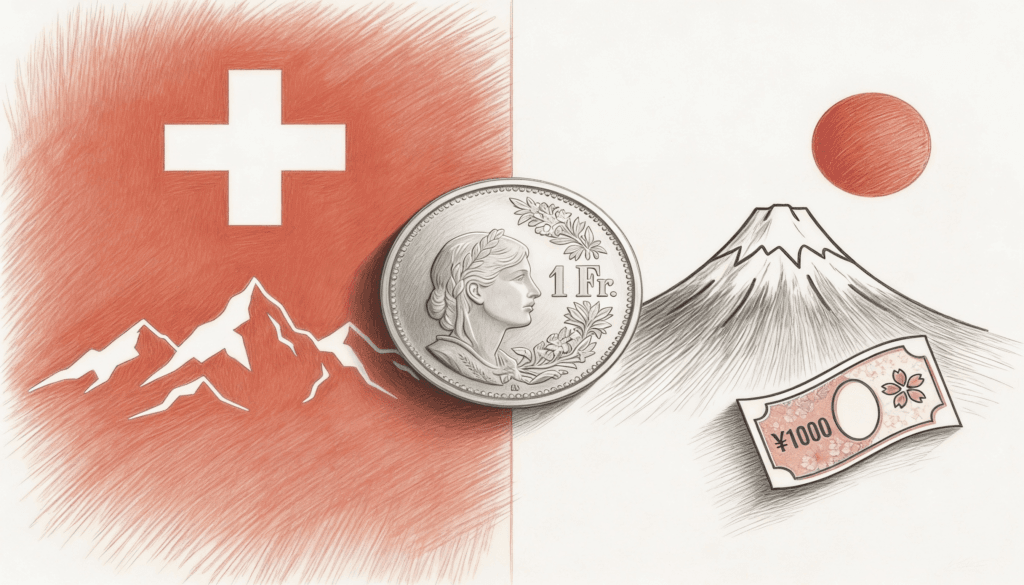
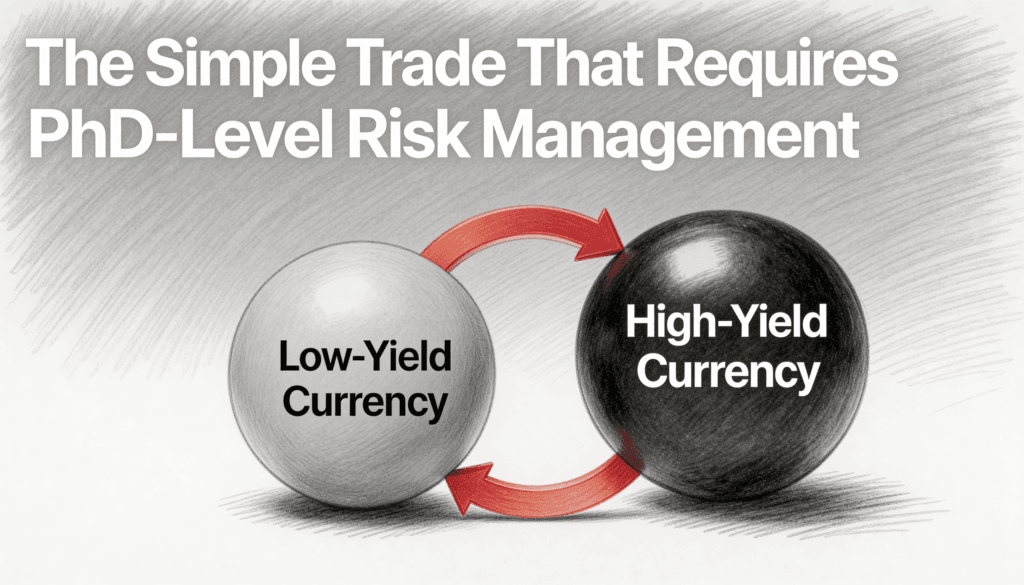
There is a strategy in finance so elegantly simple that a child could understand it in thirty seconds. Borrow money where it is cheap. Park it where it pays more. Pocket the difference. That is the carry trade, and it has minted fortunes for hedge funds, central bankers in their private accounts, and Japanese housewives who became legendary currency speculators in the early 2000s.
It is also the trade that has periodically blown up the global financial system.
The carry trade sits at one of the strangest intersections in modern markets. It is a strategy that looks like free money for years, sometimes decades, until one Tuesday morning it stops looking like that. The people who run it well are not the ones with the best macro forecasts or the slickest spreadsheets. They are the ones who understand that the trade is not really about interest rates at all. It is about something far more uncomfortable to think about.
The Idea That Will Not Die
The mechanics are almost insulting in their simplicity. Imagine Japan offers you a loan at half a percent. Brazil offers you a bond paying fourteen percent. You borrow yen, convert to reais, buy the bond, and collect thirteen and a half percent for doing essentially nothing. Repeat this with leverage and you have what looks like a money printing machine wearing a respectable suit.
For long stretches, this is exactly what it is. The yen weakens predictably. The reais bond pays out. You convert back, settle the loan, and book a tidy gain. Do this every quarter and your annual returns start to embarrass your colleagues who are out there actually analyzing companies or building DCF models. They are reading 10Ks. You are reading interest rate differentials. They look tired. You look smug.
This is the part that makes the carry trade addictive. It pays you to do almost nothing intellectually demanding, which is the most dangerous quality any financial strategy can have.
The Hidden Insurance Premium
Here is the lens that reveals what is actually happening. The carry trade is not a yield strategy. It is an insurance strategy in disguise, except you are the insurance company and you do not realize you have sold a policy.
When you borrow in a low yield currency and invest in a high yield one, the market is essentially paying you a premium to absorb a specific kind of risk. That risk is sudden, violent currency movement. The reason the Mexican peso pays more than the Swiss franc is not because Mexicans are bad at finance. It is because pesos occasionally crater while francs occasionally rally to the moon when the world panics. The interest rate gap is the compensation for sitting on that powder keg.
Every carry trader is, in effect, an insurance underwriter. They collect small, regular premiums during calm weather. Then, every few years, a hurricane arrives and they pay out everything they made plus some. There is a strategy that manifests as nickel collecting in front of steamrollers. The carry trade is the original steamroller, and the nickels are very real until they are not.
What makes this lens uncomfortable is that proper insurance companies know they are insurance companies. They hold reserves. They reinsure. They have actuaries running probability distributions on disasters. The average carry trader holds none of this. He holds a position and a conviction that this time the weather will hold.
The Sociology of Free Money
There is a question worth asking that almost nobody in finance asks. Why does the opportunity exist at all? Markets are supposed to arbitrage away free lunches. The carry trade has been documented, studied, and discussed for over forty years. If it really were free money, it would have been competed into oblivion long ago.
The fact that it persists tells us something important. The compensation is real because the risk is real, and the risk has a particular structure that makes it socially difficult to hedge against. Imagine a fund manager who decides to fully hedge his carry exposure. He gives up most of the yield to buy protection. He underperforms his peers for years. Investors leave him. He gets fired. Meanwhile his unhedged competitors look like geniuses, raise more capital, and dominate magazine covers.
The market does not reward prudence in real time. It rewards it in retrospect, often after the prudent person has already lost his job. This is why the carry trade survives. It is not that traders are stupid. It is that the career incentives of finance push almost everyone toward looking smart for as long as possible, and looking smart means collecting the premium.
The economist Hyman Minsky had a theory about this. Stability breeds instability. The longer a system goes without a crisis, the more confidence builds, the more leverage accumulates, the more people pile into the same trades. By the time the trade is most crowded, it is also most fragile. Carry trades are essentially Minsky in liquid form. They reward the herd until the moment they punish it.
What PhD Risk Management Actually Means
People hear PhD level risk management and assume it means complicated math. Stochastic calculus, fat tailed distributions, Monte Carlo simulations with ten thousand paths. The math is real and it matters. But it is not the hard part.
The hard part is psychological. The hard part is sizing a position so small that it does not feel exciting. The hard part is unwinding a profitable trade because the volatility regime is shifting, even when nothing visible has changed. The hard part is admitting that you do not know when the steamroller will arrive, only that it will, and structuring your life so its arrival is survivable rather than catastrophic.
Real risk management in the carry trade looks boring from the outside. It looks like keeping leverage at a fraction of what your prime broker would allow. It looks like maintaining hedges that drag on returns for years. It looks like sitting in cash while everyone else is making money, because some indicator you have been watching for a decade is flashing yellow. It looks, in other words, like underperforming on purpose, repeatedly, in front of people whose opinion of you matters.
This is why the trade is so hard despite being so simple. The mechanical part requires nothing more than a brokerage account. The discipline part requires you to have a relationship with your own envy, your own fear of missing out, and your own need to be respected by your peers that is closer to a monk than to a banker. Almost nobody has this relationship. The few who do tend to run small, private capital pools and never appear on television.
The Reflexive Nature of the Beast
There is a second order problem that makes carry trades particularly treacherous. The trade itself changes the world it operates in. When enough capital flows into a high yield currency, that currency strengthens, which makes the trade look even better, which attracts more capital, which strengthens it further. The strategy creates the conditions for its own success right up until the conditions for its own failure.
When the unwind comes, it works in reverse with terrifying symmetry. A small move triggers some traders to exit. Their exit pushes the currency further. That push triggers more exits. Within hours or days, what looked like a slow grinding profit machine becomes a violent unwind that takes out years of gains. The carry trade does not crash because of external shocks alone. It crashes because of its own internal feedback loops, which the participants helped build.
This is the part that quantitative models genuinely struggle to capture. The trade is not a static bet on a stable system. It is a participant in the system, and its returns are partly a function of how many other people are running the same trade with the same leverage at the same time. Risk in this context is not just market risk. It is the risk of being in a crowded room when someone yells fire, except the room has no exits and you helped fill it.
The Quiet Wisdom of Doing Less
If you take all this seriously, you arrive at a strange conclusion. The best way to run a carry trade is to be slightly bored by it. To treat it as one position among many. To never let it become the centerpiece of your strategy or your identity. To accept that you will give up significant upside to avoid catastrophic downside, and to make peace with the years when this trade off looks foolish.
The traders who have survived multiple carry blowups tend to share a temperament rather than a methodology. They are skeptical of their own conviction. They reduce positions when they feel most certain. They view leverage as a tool with edges, not a multiplier of brilliance. They have, often through painful experience, internalized that being right and being early are indistinguishable from being wrong if your position size is too large to survive the journey.
There is an old line in trading circles that the carry trade goes up by the stairs and down by the elevator. This is not a metaphor about speed. It is a description of asymmetry. The structure of the payoff is permanently lopsided. You collect small amounts of money over long periods and lose large amounts of money over short ones. Any risk framework that does not start from this asymmetry is not really a risk framework. It is wishful thinking with a Greek letter on top.
The Philosophical Punchline
There is something almost theological about the carry trade. It rewards faith during the long periods when nothing seems to be happening, and it punishes that same faith brutally when the world finally moves. It selects, over time, for participants who can hold two contradictory ideas at once. The first idea is that the trade works and they should keep doing it. The second idea is that the trade will eventually fail catastrophically and they must be ready.
Most human minds cannot hold both ideas simultaneously. We tend to collapse the contradiction. Either we become true believers who scale up until we are destroyed, or we become permanent skeptics who never participate and miss the decades of gains. The narrow path between these errors is where the actual money is, and it is narrow because almost nobody can walk it without falling off one side or the other.
This is why the carry trade is the perfect lens for understanding finance more broadly. It exposes the gap between intellectual understanding and practice. Everyone knows what to do. The strategy itself is trivial. The temperament required to run it without ruin is not something you can download. It is built slowly, usually through losses, and it is the most valuable thing any trader will ever possess.
The trade is simple. The trader has to become complicated. That is the real lesson, and it is the one almost nobody wants to hear, which is precisely why the opportunity still exists.