Table of Contents
You Read the Earnings Report. It Was Good. So Why Did the Stock Drop?
You did everything right. You waited for the company to report. The numbers came in strong. Revenue beat expectations, margins improved, management sounded confident on the call. And then, while you were still reading the press release feeling smart, the stock fell eight percent. Maybe twelve. You stared at the screen wondering whether you misread something. You did not. The report really was good, and the stock really did drop.
This experience is one of the most disorienting moments in investing, and almost nobody explains it honestly. The standard answer you will hear is that good news was already priced in, which is technically true and practically useless. If you have ever watched a good earnings report tank a stock and felt like the market was personally mocking you, this article is for you.
There is a strange asymmetry that lives at the heart of every market. A company can spend ten years quietly compounding cash flows, improving margins, and expanding into new markets, and the market will reward it with a polite nod and a modest re-rating. Then one Tuesday afternoon the same company misses earnings by two cents and the stock falls twelve percent before lunch. Everyone shrugs. This is just how markets behave. But why? Understanding the answer will save you from selling at the worst possible moment and help you spot opportunity where most investors see only chaos.
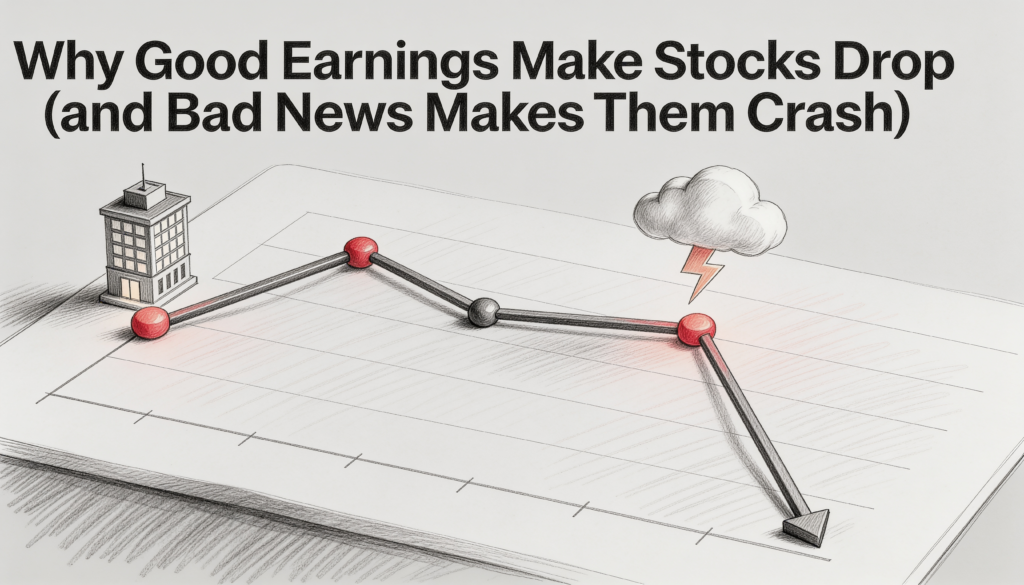
Why Good Earnings Make Stocks Drop
Let us deal with your immediate frustration first, because that is what brought you here. Your stock reported good earnings and fell anyway. Here is what actually happened, and it has very little to do with the quality of the report you read.
The Expectation Was Higher Than the Headline
When a stock has been climbing for months, the price already contains a forecast. By the time the company reports, the market is not asking whether the news is good. It is asking whether the news is good enough to justify a price that was set weeks ago by optimists. A company can beat the published analyst estimate and still miss the unpublished number that traders were quietly betting on. This shadow figure is sometimes called the whisper number.
So your report beat the visible bar and missed the invisible one. The stock falls because the buyers who pushed it up were already expecting a beat. A beat was the floor, not the surprise. To make the price rise further, the company needed to deliver something extraordinary, and merely good was not extraordinary enough.
Guidance Outweighs the Past
The earnings you read about describe a quarter that has already ended. The market trades the future, not the past. A company can post a brilliant quarter and then guide cautiously for the next one, and the stock will punish the guidance while ignoring the triumph. The numbers in the headline are history. The sentence buried on the conference call where the chief financial officer says demand is normalizing is the present.
A company that beats earnings by three percent and guides down for the next quarter will often be punished harder than a company that misses earnings by three percent and guides up. The market responds to the trajectory, not the trophy.
This is why two companies can report nearly identical quarters and move in opposite directions. The one that whispers reassurance about tomorrow rises. The one that hedges falls. You read the part of the story that was good. The market read the part that was uncertain.
The Mechanics of the First Hour
There is also a structural reason that has nothing to do with fundamentals. Earnings releases trigger automated trading. Algorithms scan the release in milliseconds for specific phrases and numbers, and they trade before any human has finished the first sentence. If the language differs even slightly from what these systems expect, they sell first and let humans sort out the meaning later. The drop you witnessed may have been machines reacting to syntax, not investors reacting to substance.
This is genuinely good news for you as a long-term investor. A move driven by automated profit-taking on a fundamentally strong report is frequently reversed within days or weeks once human analysts digest the full picture. The crash that ruined your afternoon may be the bargain that builds your decade.
Why Bad News Makes Stocks Crash Far Harder
Now flip the situation, because the asymmetry runs deeper than expectations. Bad news and good news are not equal opposites. They travel at different speeds, they are priced by different participants, and they are interpreted through different mental machinery. Once you understand this, the violent overreaction to bad news stops looking like a malfunction and starts looking like a permanent feature of how markets are built.
Loss Is a Sharper Teacher
Begin with the obvious. Humans feel losses more intensely than gains of equal size. This is the famous insight from behavioral economics, and it explains part of the asymmetry. If you lose a hundred dollars, you feel it roughly twice as much as you would feel finding a hundred dollars. Multiply this across millions of investors making thousands of decisions a day, and you get a market that is structurally more sensitive to negative information.
But this is only the first layer, and it is the least interesting one. Loss aversion explains why people flinch. It does not explain why the flinch gets amplified by the market itself into something violent. To understand that, you have to look at who stands on the other side of the trade when bad news arrives.
The Vanishing Buyer
When good news arrives, sellers do not disappear. They simply raise their asking prices. The stock drifts up in an orderly way as buyers and sellers renegotiate. The market behaves like a well-lit auction house. When bad news arrives, the buyers vanish. Some of them are frightened, certainly, but most of them step away because they genuinely no longer know what the right price is.
A profit warning is not merely information about earnings. It is information about everything you thought you knew about the company. Perhaps management has been concealing problems. Perhaps the industry is shifting. Perhaps the auditor is about to resign next quarter. Buyers refuse to bid not because they are emotional but because they need time to think, and time is the one thing a falling market refuses to grant them.
The market makers, the firms whose entire job is to provide liquidity, respond by widening their spreads dramatically. They are not being cruel. They are pricing in the risk of what they do not know. When uncertainty spikes, the cost of being a buyer climbs. The bid retreats. The price falls until it reaches a level where someone, somewhere, is finally willing to step in and absorb the shares.
The market is not overreacting to bad news. It is paying for liquidity at the precise moment when liquidity has become brutally expensive. The price must fall far enough to compensate the brave for the privilege of catching a falling knife.
Good news demands no such discount. A positive surprise may attract new buyers, but it never makes sellers afraid to sell. The supply of shares remains. The market processes good news through its normal channels, and the reaction stays muted because the machinery is functioning exactly as designed. Fear removes liquidity. Optimism never does.
The Story Problem and the Speed of Fear
There is another asymmetry that almost nobody discusses, and it concerns narrative. Bad news arrives wrapped in a story. Good news rarely does.
Conflict Travels Faster Than Competence
When a company reports a disastrous quarter, the headlines write themselves. There is a villain. There is a betrayal. There is a precise moment where things went wrong. The story satisfies because it has structure. The chief executive did this. The competitor did that. The regulator changed its mind. Journalists, analysts, and social media strategists assemble a coherent narrative within minutes, and that narrative spreads faster than the underlying facts ever could.
When a company reports an excellent quarter, the story is boring. They executed well. Margins improved. Demand was strong. There is no villain, no twist, no moment of revelation. The narrative does not travel because there is nothing dramatic to carry it forward.
This matters enormously because markets are partly priced by attention. A story that grabs attention pulls in more participants, more analysis, more trading volume. Bad news creates a feedback loop. The story attracts attention, the attention attracts selling, the selling validates the story, and the cycle repeats. Good news enjoys no such loop. The stock drifts up quietly, and most people fail to notice until the move has already finished. This is why great companies tend to be discovered slowly. The market is not blind to them. It is simply uninterested in stories that contain no conflict.
The Career Risk Distortion
Now consider the people who actually move the largest pools of money. Fund managers and institutional investors play a different game than you do. They play a game where being wrong in an interesting way can end a career, while being wrong in a boring way usually costs nothing.
If you are a fund manager holding a stock that collapses on bad news, you have a serious problem. You will be asked why you failed to see it coming. You will be asked why you did not sell. You will be measured against peers who did sell. Your reputation, your bonus, and possibly your job depend on the answer. But if you fail to buy a stock that quietly doubles over two years, almost nobody notices. You did not lose money. You merely made less than you might have. That kind of mistake dissolves into the noise, because investors do not call to complain about the things you chose not to buy.
So institutional investors carry a structural bias toward selling on bad news and waiting on good news. Selling protects them. Waiting protects them. The asymmetry of professional risk becomes baked directly into the asymmetry of price reactions. The market overreacts to bad news partly because the people making the decisions are protecting their careers, not optimizing your returns.
This is one of the great open secrets of professional money management during crisis. The job is frequently not to be right. The job is to be defensibly wrong.
The Compounding Blindspot That Underprices Greatness
There is a deeper cognitive issue at work, and it concerns the way human brains process exponential change. We are linear creatures living in a compounding world. We can picture a company growing twenty percent. We struggle to picture what twenty percent growth for ten consecutive years actually produces.
When a company reports a great quarter, the market prices the immediate good news. It rarely prices the implications of what that good news means for the trajectory of the business over the next decade. This is not stupidity. The human mind simply struggles to feel the weight of compounding in its bones.
The market sees the next quarter clearly. It sees the next year reasonably well. Beyond that the picture grows fuzzy, and the brain defaults to assuming that things will revert to the average. Most things do revert to the average. But the businesses that refuse to revert are the ones that generate most of the returns in any market, and they are systematically undervalued by a crowd that cannot quite bring itself to believe in their persistence.
Bad news, by contrast, gets priced linearly and then some. A company that misses earnings gets punished not only for the miss but for the implied future. The market assumes the bad news will compound. The good news, it assumes, will fade. The market believes in the durability of trouble far more readily than it believes in the durability of excellence.
What This Means for You in Practice
If you take all of this seriously, several practical conclusions follow, and they directly address the frustration that brought you here.
Do Not Sell Into the Panic
The worst time to sell is usually right after bad news, because that is the exact moment when the price reflects not just the news but the cost of liquidity in a panicked market. The information has been priced. The liquidity discount has not yet recovered. Selling at that moment means you are paying twice for the same problem. The investor who waits for the spread to normalize and for the algorithms to finish their work frequently sells at a far better price a week later, assuming they want to sell at all.
When Good Earnings Drop the Stock, Ask the Right Question
If your stock fell on a strong report, do not assume the report was secretly bad. Read the guidance. Check whether the stock had already run up sharply before the announcement. Look at whether the drop happened in the first few minutes, which suggests automated trading, or built steadily over days, which suggests genuine reassessment. A high-quality business that drops on machine-driven profit-taking is often handing patient buyers a discount. A business that drops because management quietly lowered guidance is telling you something you need to hear.
Pay Attention When Nothing Is Happening
The best time to study a company is when nothing interesting is happening to it. Good businesses build value during the boring quarters. The market does not notice. The story is dull. The professional managers are looking elsewhere. This is where the asymmetry can be exploited.
Trade the Narrative, Not Just the Numbers
The framing of news matters more than the news itself. The investor who can separate the narrative from the numbers holds an edge that requires no special information and no inside knowledge. You simply need to recognize when the crowd is reacting to a story rather than to a fact.
The market is not a calculator. It is a crowd, and crowds have moods, and moods have a structure. The structure of fear is loud and fast. The structure of confidence is quiet and slow. If you understand which one is operating at any given moment, you understand more about price than most of the people setting it. So the next time a good report sends your stock tumbling, remember that you are not watching a verdict on the company. You are watching the machine respond to expectation, attention, and fear. And that, in the end, is the real edge. Not predicting the news, but understanding how the machine reacts to it.