Table of Contents
What Loss Aversion Really Means for Investors
In 1979, two psychologists published a paper that would eventually win a Nobel Prize and quietly rewire how we understand money. Daniel Kahneman and Amos Tversky demonstrated that losses feel roughly twice as painful as equivalent gains feel pleasurable. A 10 percent gain might make you feel mildly pleased. A 10 percent loss will keep you awake at three in the morning, doing math you already finished hours ago.
This is the principle of loss aversion, and most investing advice stops there. The conventional takeaway is practical: because losses sting more, people hold losing stocks too long, sell winners too early, and avoid sensible risks. All true. But there is a layer underneath this research that Kahneman and Tversky did not explore directly, and it explains far more about why market declines hurt the way they do.
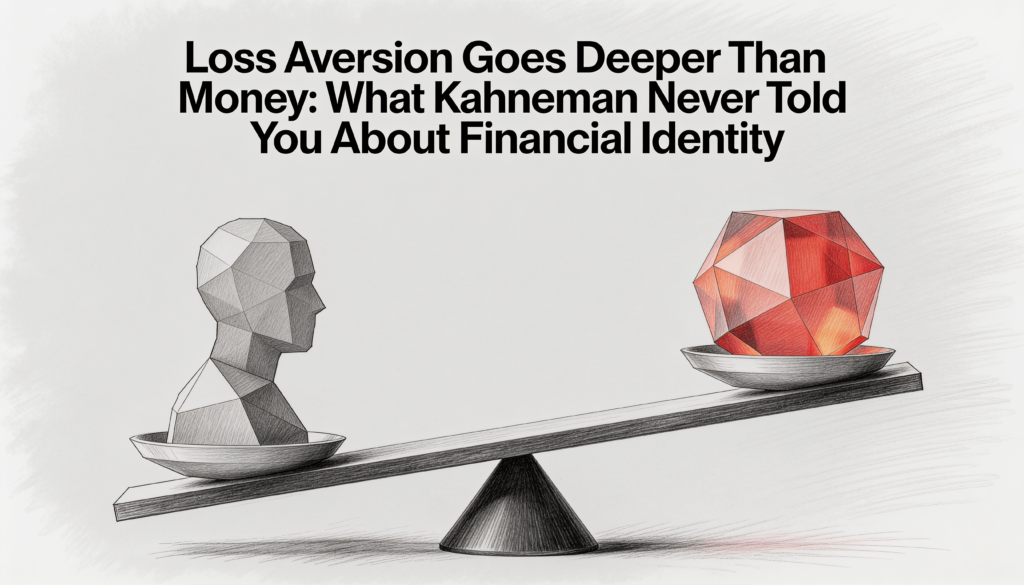
The hidden truth is that loss aversion does not only apply to money. It applies to identity. Once you have woven financial success into your sense of self, a portfolio decline is no longer a financial loss alone. It becomes a financial identity loss. And identity losses activate some of the same neural pathways as physical pain. When a market crash makes you feel genuinely wounded, you are not being dramatic. Your brain is processing the event through the same channels it uses for real injury.
This article takes the foundational research on loss aversion in investing and follows it somewhere the original studies never went: into the question of who you become when the number on the screen gets smaller, and why that feeling is so much harder to diversify away than the money itself.
The Asymmetry Built Into Your Brain
Kahneman and Tversky called their broader framework prospect theory, and the asymmetry between gains and losses sits at its center. They found that the displeasure of losing a sum of money was consistently larger than the pleasure of gaining the same sum. Later research refined the ratio, but the general finding has held up across decades of replication. The pain to pleasure ratio for equivalent financial outcomes tends to land somewhere between 1.5 and 2.5 to 1.
Consider what this means in practice. Imagine you invest and watch your account climb by 20,000 dollars over several months. You feel competent, maybe even a little proud. Now imagine the market reverses and that same 20,000 dollars vanishes. The relief of the gain does not cancel the agony of the loss. They are not the same size emotionally, even though they are identical mathematically. Your nervous system keeps a lopsided ledger.
Diversification protects your portfolio. It does not protect your nervous system. Cortisol does not care about your asset allocation, and your amygdala has never read Benjamin Graham.
This asymmetry exists for reasons that predate modern markets by hundreds of thousands of years. For most of human history, resources meant survival. Having more meant safety. Having less meant exposure to cold, hunger, and threat. A creature that treated potential losses as twice as urgent as potential gains was a creature that survived to reproduce. The brain never updated this software for a world where a 15 percent portfolio decline does nothing to threaten your ability to eat dinner tonight.
Why Rational Thinking Cannot Fully Override It
You can understand loss aversion completely and still feel its full force. This is one of the most frustrating features of the phenomenon. Knowing that markets recover does not stop your chest from tightening on a red day. Knowing that index funds reward patience rather than cleverness does not prevent the wave of regret when prices fall.
The reason is structural. The emotional response originates in faster, older parts of the brain than the parts responsible for deliberate reasoning. By the time your rational mind constructs a calm argument about long term returns, the feeling has already arrived and settled in. Insight does not delete instinct. It only gives you something to do with it.
From Money Loss to Identity Loss
Here is where the story departs from the textbook version of loss aversion. The original research measured how people respond to gaining and losing money. It did not ask what happens when people have fused their sense of self to that money in the first place. Yet that fusion is exactly what has happened to a large number of modern investors, often without their conscious permission.
Think about the last time your investments dropped significantly. Not a minor dip, but a real drawdown, the kind where you start calculating how many months of salary just evaporated. Did you feel anxious? Almost certainly. Did you feel embarrassed? Possibly. Did you feel stupid? That last one is the tell.
A falling portfolio does not make you stupid. Markets move for reasons that have nothing to do with your intelligence, your effort, or in most cases your specific decisions. A broad market correction is not a performance review of your character. And yet the feeling lands as if it were. Somewhere along the way, many people started treating investment returns as evidence about who they are. A rising portfolio means smart, disciplined, worthy. A falling one means careless, foolish, somehow lesser than the version of yourself that existed at the market peak.
The Cultural Machinery Behind the Merge
Evolution explains why losses hurt. Culture explains why they feel like a verdict on your worth. We live in a society that treats financial success as proof of personal virtue, and the language gives it away. We call people self made, as if a fortune were a craft project assembled by hand. We describe a business failure as a personal failure. Financial media frames investing as a continuous test of character with recurring characters: the disciplined investor, the smart money, the savvy trader.
If gains are proof of wisdom, then losses must be proof of its absence. This framing seeps in even when you believe yourself immune to it. The person who insists money does not define them will still feel a knot in the stomach during a correction. The person who preaches long term thinking will still refresh the brokerage app six times before lunch on a red day. The gap between what we believe intellectually and what we feel emotionally is where financial stress does its real damage.
The Compounding Cost of Identity Loss Aversion
When loss aversion operates on money alone, the consequences are bad enough. When it operates on identity, the consequences compound. A financial loss you can recover from. An identity that depends on financial outcomes you cannot fully control is fragile in a way that produces ongoing harm long after the market stabilizes.
Chronic financial stress carries documented physical consequences. It disrupts sleep. It strains relationships. It impairs decision making, which is a particularly cruel detail because the moments when you most need to think clearly about money are precisely the moments when stress has most degraded your capacity to do so.
This produces a feedback loop with real teeth. Market drops cause stress. Stress causes poor decisions. Poor decisions cause more financial damage. More financial damage causes more stress. It functions like a margin call on your wellbeing, where each turn of the cycle demands more emotional collateral than the last.
The Comparison Tax
Social media has added an entirely new dimension to this problem. It is no longer enough to watch your own portfolio decline. Now you also get to watch other people appear to thrive while you suffer. During every downturn, there is always someone on the internet who called it. Someone who went to cash at the top. Someone whose contrarian bet paid off magnificently. They will post about it, extensively.
What you do not see is the 18 times that same person made a bold call and was completely wrong. You do not see the anxiety behind the strategy, or the gains they missed by being perpetually defensive. You see their highlight reel and compare it to your behind the scenes footage. Psychologists call this social comparison theory, and in an investing context it operates as a hidden tax on your mental health. You pay it every time you measure your situation against a curated version of someone else’s.
The people who are genuinely comfortable with their financial position rarely broadcast it. The loudest voices in any market belong to people who are either selling something or managing their own insecurity by performing confidence.
Why the Stoic Investor Is Usually Performing
Financial culture has a favorite archetype: the stoic investor who watches markets crash without flinching. Warren Buffett calmly reading annual reports while the world panics. The unshakeable long term thinker who treats volatility as background noise. This image is useful as an aspiration. It is misleading as a description of reality.
Almost no one experiences significant financial loss without an emotional response. The people who appear calm tend to fall into one of two categories. They are either so wealthy that the loss is immaterial to their daily life, or they are performing calmness because financial culture has told them that feeling things about money is a sign of weakness. Loss aversion does not skip the rich and disciplined. It simply gets better at hiding.
This performance carries costs. When people believe they should not feel stressed about financial setbacks, they suppress the emotion rather than processing it. Suppressed financial stress does not vanish. It reappears as irritability, insomnia, relationship conflict, or physical symptoms that seem unrelated until you trace them back to their origin. The stoic mask does not eliminate the loss aversion underneath. It just stops you from dealing with it honestly.
What the Research Actually Recommends
Kahneman himself was candid that understanding these biases did not make him immune to them. He described loss aversion as a feature of how the mind works, not a bug you can debug through willpower. The practical lesson is not to eliminate the feeling but to design your behavior around its predictable presence. You build systems that account for the bias rather than pretending you have transcended it.
Building a Diversified Identity
So what actually helps when loss aversion extends into the territory of identity? The solutions are less about controlling markets and more about restructuring your relationship to them.
Step One: Name What Is Happening
The first step is almost embarrassingly simple, which is probably why people skip it. When your portfolio drops and a wave of shame or inadequacy arrives, name it out loud, even if only to yourself. Say something like, I am feeling less valuable as a person because a number on a screen got smaller. Hearing the words exposes the logic, and that particular logic does not survive exposure well. Spoken plainly, it sounds as absurd as it actually is.
Step Two: Insert a Gap Between Information and Reaction
The second step is structural. Build distance between financial information and financial reaction. In practice this often means checking your portfolio far less frequently. The reasoning is not that ignorance brings peace. It is that the frequency of observation directly amplifies emotional volatility through the mechanism of loss aversion.
Consider the mathematics. A portfolio that declines 10 percent over a year feels like a mild disappointment when you encounter it once. The exact same decline, experienced as 40 separate daily losses, feels like a slow rolling emergency. Same outcome, radically different psychological experience. Because each individual down day registers as a loss, and each loss carries that 2 to 1 emotional weight, watching constantly means paying the loss aversion tax dozens of times for a single annual result.
Step Three: Treat Your Identity Like a Portfolio
If your entire sense of self is invested in financial performance, you are maximally exposed to conditions you cannot control. Every dip becomes existential. Every correction becomes personal.
A diversified identity, one that draws meaning from relationships, craft, health, contribution, curiosity, and yes, also financial stability, can absorb a market shock without structural damage. The portfolio drops, and it hurts, but you remain standing because your sense of self was never a single holding. Loss aversion still fires, but it fires against one position in a broad portfolio rather than against your whole existence.
There is a difference between wanting financial security and needing the market to validate your existence. One is a strategy. The other is a trap.
The Question the Market Will Never Answer
None of this is an argument to stop caring about money. Money matters. Financial security is a legitimate and important goal worth pursuing seriously. The argument is narrower and sharper than that. It is that the research on loss aversion, taken to its logical conclusion, reveals something the original studies never stated outright: the deepest losses we fear are not financial at all. They are losses of self that we have disguised in financial clothing.
The next time your portfolio drops and you feel that familiar sinking sensation, try asking a different question. Not should I sell, and not will it recover. Ask this instead. If I subtract the money from the equation, who am I? If the answer feels thin, that is not a financial problem. It is an identity problem dressed up as a market one, and no brokerage account will ever solve it.
Kahneman and Tversky gave us the map of how losses feel twice as heavy as gains. They measured it precisely and changed economics forever. What they left for the rest of us to discover is where that asymmetry travels once it escapes the spreadsheet. It travels into the story you tell about your own worth. The market will recover, or it will not, or it will do that maddening thing where it climbs just enough to feel safe before falling again. What it will never do is tell you who you are. That part was never its job. It never was.