Table of Contents
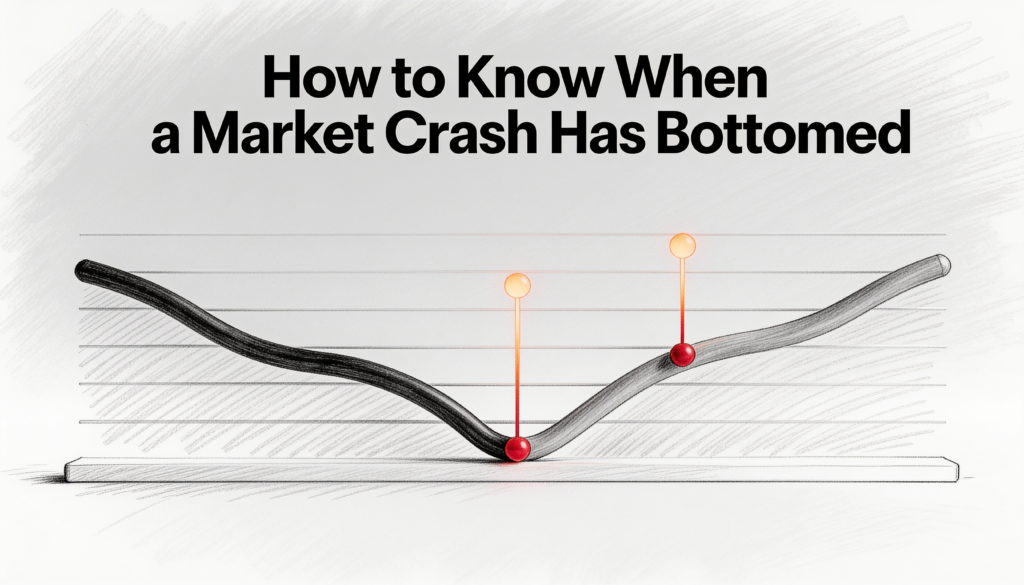
How to Know When a Market Crash Has Bottomed
There is a peculiar moment during every market crash when serious people on television start using the word “unprecedented” with the same frequency that teenagers use “literally.” Charts turn red, anchors lower their voices as if attending a funeral, and somebody inevitably brings up 1929, then 2008, then mutters something about the Dutch tulip mania for good measure. And the question hanging over all of it, the one nobody can answer but everyone keeps typing into a search bar at two in the morning, is brutally simple: how do I know when a market crash has bottomed?
You want a checklist. You want signals. You want a number on a calendar that tells you the worst has passed and it is safe to buy again. This article will give you the closest thing that honestly exists, which is a set of observable conditions that historically appear near major bottoms. But it will also do something more useful. It will explain why the way you ask this question almost guarantees you will answer it wrong, and how to fix that before you lose real money waiting for a signal that never arrives in the form you expected.
The Practical Signs a Market Crash Is Bottoming
Let us start with what you actually came here for. Nobody can ring a bell at the exact bottom, and anyone who claims they can is selling something. But market bottoms throughout history share a recognizable fingerprint. When several of these conditions appear together, the odds that the worst of a decline has passed rise meaningfully.
Capitulation: when the last forced seller has sold
The most reliable marker of a bottom is capitulation. This is the moment when selling stops being a strategic choice and becomes an emergency. Margin calls, fund redemptions, retirement deadlines, panic. The people who must sell finish selling because they have run out of things to sell. Volume spikes to extremes, often the highest single day reading of the entire decline, and then it exhausts itself.
The floor arrives when the last forced seller has sold. Not the patient seller, not the strategic seller, but the seller who had no choice. When that wave passes, the floor reveals itself, and it is rarely where anyone expected it to be.
You can watch for this in the data. A sudden surge in trading volume followed by a sharp intraday reversal, where prices crater in the morning and recover by the close, frequently marks the day the sellers exhausted themselves.
Sentiment readings hit terror
Bottoms are emotional events. By the time a market truly bottoms, the mood has usually curdled from anxiety into outright despair. There are specific tools that measure this. The CBOE Volatility Index, known as the VIX, tends to spike above 40 or even 50 near major bottoms, signaling that traders are paying enormous premiums for protection against further losses. Headlines stop asking whether stocks will recover and start asking whether the system itself will survive.
The cruel irony is that maximum pessimism and maximum opportunity tend to arrive on the same afternoon. When everyone you know has stopped checking their accounts and started questioning whether investing was ever a good idea, you are usually closer to the bottom than the top.
Breadth begins to improve
Market breadth measures how many stocks are participating in a move rather than just the headline index. During the worst of a crash, almost everything falls together. A genuine bottom often shows up first in breadth. The number of stocks making fresh lows shrinks even as the index dips again, a condition traders call a positive divergence. Fewer companies hitting new lows while the index appears to drop further suggests selling pressure is quietly fading beneath the surface.
Bad news stops moving the price
This is one of the most overlooked signals, and one of the most powerful. Near a bottom, terrible headlines arrive and the market simply refuses to fall further. A disastrous earnings report, a frightening inflation print, a grim economic forecast, and the price barely budges. When awful news can no longer push prices lower, it usually means everyone who wanted to sell has already done so. The bad news is fully priced in. From that point, even slightly less terrible news becomes a reason to buy.
Why the Floor Keeps Moving
Now here is the part most articles skip, and it is the part that determines whether any of those signals will actually help you. To use them well, you have to understand what the floor truly is, because almost everyone gets this wrong.
The market is made of opinions, not concrete
We tend to think of the stock market the way we think of a building. There is a ceiling, there is a floor, and if things get really bad, there is a basement. This metaphor feels comforting because buildings are made of concrete and steel, reassuringly solid materials that do not vanish when people get scared. The market is made of something far flimsier. It is made of opinions.
Every price you see on a screen is just two strangers agreeing, for one fleeting second, on what something is worth. Multiply that by millions of strangers, add caffeine, fear, ambition, and a great deal of borrowed money, and you have what economists call a market and what philosophers might more honestly call a mood. This is why the floor keeps moving. It is a temporary truce between the people who want to sell and the people who want to buy. When the buyers all decide, at roughly the same moment, that they would rather hold cash and watch from the sidelines, the floor simply dissolves. Nothing fundamental in the world has to change overnight. The agreement just evaporates.
The floor is made of liquidity
There is a mechanical answer underneath the philosophical one, and it has to do with liquidity. Liquidity is the financial term for the existence of someone willing to buy what you want to sell. When liquidity is abundant, the floor is high and stable. When liquidity dries up, the floor falls through itself, because there is literally nobody on the other side of your trade.
This is the dark secret of modern markets. They function beautifully when everyone is calm and terribly when everyone is scared, which is precisely the opposite of what you would want from a system that exists to allocate capital. It is rather like an umbrella that works perfectly except during rain. The crashes that become legends are often liquidity events. The underlying companies did not become worthless overnight. The machinery of trading temporarily seized up. Buyers stepped back, sellers piled in, and the price fell faster than anyone could rationally justify, because falling prices create more sellers, who create more falling prices, in a spiral that has very little to do with value and everything to do with the architecture of fear.
The Mental Traps That Sabotage Your Timing
You can memorize every bottoming signal and still lose money, because the real obstacle is rarely the data. The real obstacle is what happens inside your own head when the screen turns red.
The tyranny of reference points
Here is a strange experiment. Imagine you bought a stock at 100 dollars. It climbs to 150. You feel rich. Then it falls back to 100. You feel like you have lost money. But you have not. You are exactly where you started. The 50 dollars was never really yours. It was a number on a screen, briefly attached to your name, that you mistook for wealth.
This is what behavioral economists call anchoring, and it is the reason crashes feel so much worse than they truly are. We do not measure our losses against reality. We measure them against the highest point we remember. The peak becomes the baseline, and everything below it feels like an injury rather than the natural breathing of a system that was always going to breathe.
If you bought Amazon in 2000, you watched it lose more than eighty percent of its value over the following two years. Eighty percent. The kind of number that makes people stop opening their brokerage statements and start opening their wine bottles. And yet, if you had held on, you would now be sitting on one of the great fortunes of the modern age. The floor was not where it appeared to be. It was much lower than anyone expected, and then much higher than anyone could have imagined. The investors who survived were not the ones with the best floor estimates. They were the ones who stopped hunting for floors entirely and started looking at something else.
What the old money already knows
There is a particular kind of wealth that does not panic during crashes. You can spot it because it does not exist on social media, does not appear on financial news, and rarely says anything interesting at dinner parties. It is the money that has been around long enough to have seen all of this before. Several times. Possibly during a war or two.
When you have inherited assets that survived the Great Depression, two world wars, the oil shocks, the dot com bust, and the financial crisis, you develop a certain attitude toward red days. The attitude is roughly that of a Scottish farmer looking at a heavy rain. It is uncomfortable, yes. It is also Tuesday.
The Rothschilds reportedly told their bankers to buy when there is blood in the streets. The wisdom is correct. The execution requires a temperament that most of us do not possess and cannot acquire simply by reading about it.
What the old money understands is that the floor is not really a price at all. The floor is your ability to wait. If you can hold an asset for= years, almost any entry point looks reasonable in hindsight. If you have to sell in thirty days, almost no entry point is safe. The floor moves depending on how long you can afford to ignore it.
The Stoic in the storm
The Roman emperor Marcus Aurelius, who had quite a lot on his plate including barbarians and plague, kept a private journal about maintaining composure when everything was going wrong. He never traded a single stock, yet his observations apply with eerie precision to bear markets. He noticed that most of our suffering comes not from events themselves but from our judgments about them. The same red number on a screen can produce panic in one person and patience in another, depending entirely on what that number means to them.
The Stoic move is to ask what is actually within your control. The price of your portfolio is not. The macroeconomic environment is not. The decisions of central bankers, the moods of foreign governments, the velocity of money. None of these are things you can influence. What you can influence is your behavior in response to all of it. Whether you sell at the bottom because you cannot stand the pain any longer. Whether you panic into cash and then watch from the sidelines as everything recovers without you. Whether you transform a temporary paper loss into a permanent realized one through the simple act of clicking sell.
A Better Question Than Where Is the Bottom
So let us return to your original search, the one that brought you here. You want to know when the crash has bottomed. Fair enough. But it is worth asking why you want to know, because the honest reason changes which answer will actually help you.
If you are asking because you are afraid
If fear is driving the question, the answer will not soothe you. Even if someone could hand you the exact date and price of the bottom, you would not believe them, because nobody believes a forecast that contradicts their fear. When we are scared, we do not seek information. We seek reassurance, which is an entirely different thing, and which markets are famously terrible at providing. The signals listed earlier in this article will simply become new things to second guess.
If you are asking because you want to buy
If you have cash and courage, then the right question is not where the floor sits but what you want to own for the next decade. The floor is a tactical concern. Ownership is a strategic one. The people who grow wealthy in crashes are not the ones who perfectly time the bottom. They are the ones who decided in advance what they would happily own at any price below a certain level, and then had the discipline to actually buy when prices reached there.
A practical approach is to build a watchlist before the panic, with target prices attached. Then, rather than trying to catch the single lowest tick, deploy capital in tranches. Buy a portion when your targets are hit, hold reserves in case prices fall further, and accept that you will never nail the exact bottom. Buying in stages removes the impossible burden of perfect timing and replaces it with a process you can actually follow under stress.
If you are asking because you want to sell
If selling is the urge, you have probably already missed the right moment. The time to think about selling was when everyone was euphoric and prices made no sense on the upside. Asking about the floor mid crash is usually a disguised way of asking whether you can survive holding a little longer. Answer that question instead.
What Remains When the Numbers Move
There is a quiet truth that surfaces during every market downturn, and it rarely gets discussed because it is too simple to make for good television. Most of life is unaffected by what the market does on any given day. The bread you eat tastes the same. The conversations you have with people you love continue. The sun, indifferent to the financial press, rises and sets right on schedule.
This is not meant to wave away the genuine pain that crashes inflict on real people, especially those nearing retirement or already in it. Those concerns are valid, serious, and deserve far more attention than they typically receive. If your time horizon is short, the bottoming signals in this article matter enormously, and so does protecting capital you cannot afford to lose. But for the much larger group of investors who still have time on their side, the crash is mostly a story they are telling themselves about a series of numbers that will probably look very different in five years.
The market does not really have a floor. It has gravity, it has cycles, and it has fear and greed in alternating doses. The foundation on which any sane investing life is built is not made of prices. It is made of patience.
So watch the volume spikes. Track the VIX. Notice when bad news stops pushing prices down. Wait for breadth to improve and for the first powerful rally to confirm the turn. These signals are real and worth knowing. But understand that they will only ever give you probabilities, never certainty, and that the bottom is always clearest after it has already passed.
When everything is crashing, the most useful question is not where the floor is. The most useful question is whether you can become the kind of investor who does not need to know, because that person, far more than any signal, is the one who is still standing when the recovery finally arrives.