Table of Contents
There is an old joke among traders that the Japanese yen is not really a currency. It is a mood ring for the entire global financial system. When the yen behaves strangely, something somewhere is about to break. When speculators pile into short positions against it, the world is feeling brave. When they suddenly run for the exits, the world has remembered that bravery and stupidity often share a postcode.
This is the strange magic of the yen. It is the currency of a country with anemic growth, a shrinking population, and a debt to GDP ratio that would make most finance ministers reach for a stiff drink. And yet, paradoxically, it is one of the most important risk barometers on the planet. To understand why, you need to look at a quiet weekly publication that most retail investors have never opened. The Commitment of Traders report.
The Report Nobody Reads That Tells You Everything
Every Friday, the Commodity Futures Trading Commission releases a document showing how big speculators and hedgers are positioned in futures markets. It is bureaucratic, unglamorous, and free. Which is probably why most people ignore it. Wall Street has a curious habit of overlooking anything that does not come wrapped in a subscription fee.
But inside this report lives one of the most useful psychological maps in finance. The yen section in particular. Because the yen is not just a currency. It is the funding leg of the carry trade, which is the financial equivalent of borrowing from your patient uncle to bet on horses. You borrow in something cheap and stable, then you invest in something with a higher yield and a more colorful personality. The Mexican peso. The Brazilian real. The Australian dollar. Tech stocks. Anything that pays you to wait, or at least promises to.
For decades, the yen has been the favored borrowing currency because Japanese interest rates have been somewhere between zero and a polite cough. So when speculators feel optimistic about the world, they short the yen and buy something racier. When they feel scared, they unwind that trade in a hurry. The COT report shows you, in plain numbers, how crowded that bet has become.
The Crowd That Cannot Run Through the Door at the Same Time
Here is where it gets interesting from a behavioral standpoint. Markets are not really about assets. They are about people standing in rooms, and rooms have doors. The carry trade is essentially a room with a very narrow door and a sign on the wall saying “the bar is open, enjoy yourselves.”
When speculative short positions on the yen reach extreme levels, what you are actually looking at is not a market view. You are looking at a fire safety violation. Everyone is leaning the same way. Everyone has the same trade on. And everyone is assuming that when the music stops, they will be the first to find a chair.
They will not be.
The yen has a habit of doing something cruel in these moments. It rallies. Not because Japan’s economic prospects have suddenly improved. They almost never do. It rallies because traders need to buy back the yen they borrowed and sold. A short squeeze in the yen is not a Japanese story. It is a global confession.
Think of it this way. When the yen suddenly strengthens for no obvious local reason, it is usually because something is breaking elsewhere. A hedge fund is blowing up. An emerging market is wobbling. An asset class is repricing. The yen is the last man standing not because he is the strongest, but because everyone else has been knocked over and is reaching out to grab him on the way down.
July 2024, or the Lesson Nobody Wanted
You do not need to look far for an example. In the summer of 2024, the yen carry trade had become one of the most crowded positions in modern memory. Speculators were short the yen in size that had not been seen in years. Japanese rates had been low for so long that betting against the yen felt like a free lunch. And in finance, the moment something feels like a free lunch is usually the moment someone is quietly setting the table for you.
Then the Bank of Japan made a small adjustment. Not dramatic. Just a hint of policy normalization. And the global market had what can only be described as a small nervous breakdown. The yen surged. Equities cratered. Volatility spiked to levels that suggested either the end of the world or, more accurately, the end of a very lopsided trade.
The COT data had been screaming about this for months. Anyone paying attention to the positioning of speculators in yen futures could have seen the crowd gathering near the same exit. The question was not whether something would happen. The question was when.
This is the qualitative lesson. The COT report does not tell you the future. It tells you the present in a way that makes the future easier to imagine. It is less a crystal ball and more a mirror held up to collective behavior.
The Yen as Confession Booth
There is something almost philosophical about why the yen works this way. Currencies are, at their core, social contracts. They represent trust in institutions, in monetary discipline, in the boring competence of central bankers. The yen, perhaps more than any other major currency, represents the absence of risk taking. It is the financial equivalent of staying in on Friday night.
So when global investors get excited, they leave the yen behind. They borrow it and abandon it for sexier places. The yen sits at home, alone, presumed dull. And then something goes wrong somewhere in the world, and suddenly everyone remembers that dull and reliable have a long and underrated friendship.
The COT report captures this rhythm. When speculative net short positions are extreme, the world is in its risk on phase. The optimists are crowded, the pessimists are quiet, and the carry trade is paying for everyone’s drinks. When those positions unwind rapidly, the world is in confession. Whatever risks were being taken are being undone, often violently.
This is why seasoned macro investors watch the yen positioning data with the same attention that a doctor watches a heart monitor because it tells you whether the patient is calm or panicking.
The Counterintuitive Truth About Safe Havens
Most financial commentary treats safe haven currencies as if they have intrinsic safety properties. As if the yen, the Swiss franc, and the dollar contain some special molecule of stability. They do not. Their safety is entirely relational. It comes from the structure of global capital flows, not from any inherent virtue.
The yen is a safe haven precisely because it is the currency people borrow to take risks. When risks are unwound, those borrowings must be repaid. The act of repaying creates demand for the yen. The demand creates strength. The strength creates the illusion of safety. It is a circular trick of plumbing, not a moral judgment about Japan.
This matters because it means the yen’s safe haven status is not permanent. It depends on Japan maintaining ultra low interest rates relative to the rest of the world. If that gap narrows, as it has slowly begun to, the yen loses some of its function as a carry currency. And when it loses its function as a carry currency, it loses some of its power as a risk barometer.
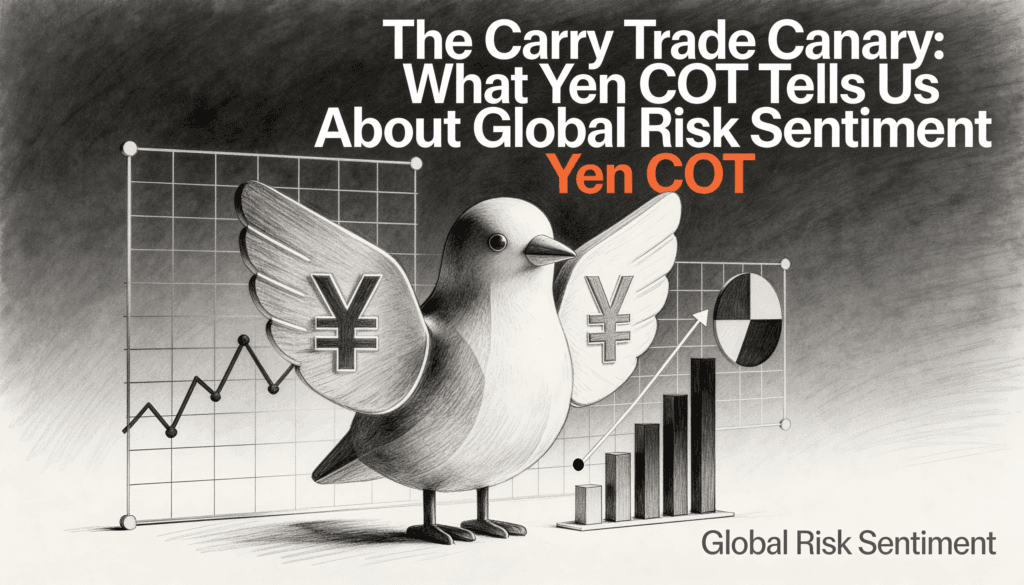
Which is to say, the canary may eventually need to find a new mine.
How to Read the Tea Leaves Without Drowning in Them
For the practical investor, the value of watching yen COT data is not in trading the yen itself. Currency trading is a brutal sport where even the professionals get humbled regularly. The real value is contextual. It is in using the yen as a thermometer for global appetite.
When speculative shorts on the yen are crowded and stretched, you should treat risk assets with a degree of caution that does not come naturally during euphoric markets. Not because the world will end tomorrow. It probably will not. But because the conditions for a sudden reversal are quietly being built. Crowded trades do not need a major catalyst to unwind. Sometimes a polite sneeze from a central banker is enough.
When speculative shorts have already been crushed and positioning has reset, the carry trade has room to breathe again. Risk assets often perform well in these phases because the weak hands have been shaken out and the survivors are less leveraged.
The trick is not to use the COT report as a timing tool. It is terrible at timing. Crowded positions can stay crowded for months. The trick is to use it as a context tool. To know what regime you are in. To understand whether the financial system is leaning toward courage or fear, and to calibrate your own behavior accordingly.
The Quiet Genius of Reading What Others Ignore
There is a broader lesson buried in all this, and it has very little to do with currencies. It is about where edges actually live in modern markets. They do not live in newer, faster, more expensive data. They live in older, slower, freely available data that most people have decided is not worth reading.
The COT report has been published for decades. It is available to anyone with an internet connection. It contains no proprietary insights, no insider information, no algorithmic wizardry. And yet most investors will go their entire careers without looking at it. They will pay for Bloomberg terminals, subscribe to research firms, and chase the latest hedge fund newsletter, all while ignoring a free weekly document that tells them how the most sophisticated players in the world are actually positioned.
This is one of the more amusing features of financial markets. The edge is often hiding in plain sight, dressed in boring clothes, refusing to advertise itself.
The yen carry trade is a story about leverage and crowding and the strange psychology of borrowing one currency to chase yield in another. But it is also a story about attention. About which signals you choose to track and which you let pass unnoticed. Markets reward people who can read the room. The COT report is one of the cheapest ways to find out who else is in the room and what they are wearing.
The Canary Still Sings
Carry trades will continue to exist as long as interest rate differentials exist. Which is to say, forever. The currencies involved may change. The destinations of the borrowed money may rotate. But the basic dynamic, where investors borrow something cheap to chase something rich, will keep repeating itself with the persistence of a bad pop song.
And as long as that dynamic exists, the yen, or whatever takes its place, will function as a barometer of global confidence. When speculators are crowded short, the world is partying. When they get squeezed, the party is being raided.
You do not need a doctorate in finance to read this signal. You just need the patience to open a free weekly report that most people scroll past. The canary is still singing. The question is only whether you are listening.