Table of Contents
Money is one of those things everyone uses and almost nobody thinks about. Not what to spend it on. What it actually is. We treat it like water from a tap. It flows, we use it, we want more of it. But we rarely ask what the tap is connected to.
Now the tap is changing. Cash, the physical kind you can fold and lose in coat pockets, is disappearing. Not in some distant future. Right now. Sweden is nearly there. China is sprinting toward it. India took a dramatic swing at it in 2016 by pulling most banknotes out of circulation overnight.
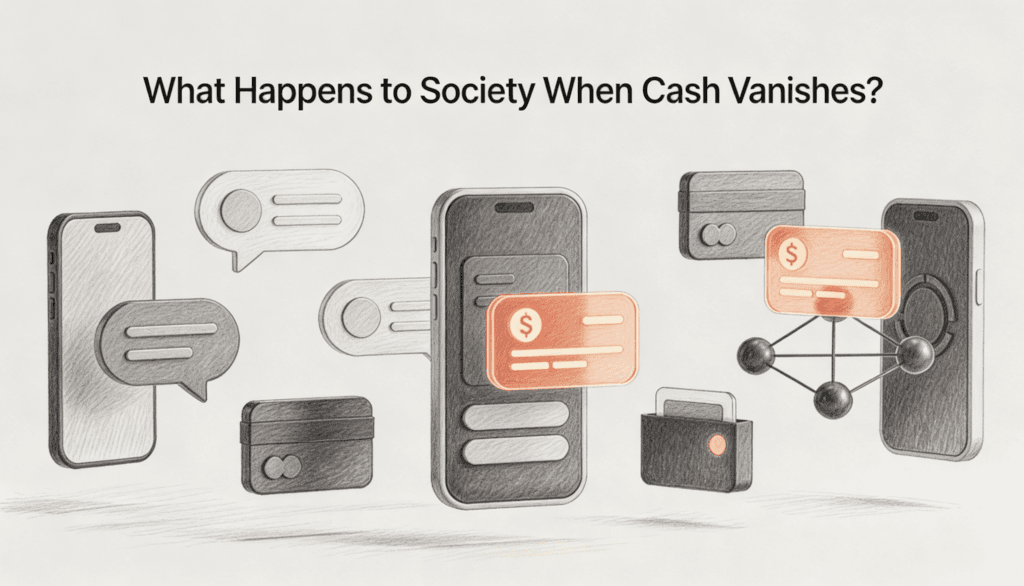
So here is the question almost no one is asking carefully enough: what do we lose when money loses its body?
To answer that, we have to start with something that sounds academic but is not. We have to ask what money actually is.
Money Is a Story We Agreed to Believe
This is not a metaphor. It is the literal operational reality.
A dollar bill has no inherent value. You cannot eat it. It makes a poor blanket. It is a piece of cotton and linen with ink on it, and the only reason it works is that everyone around you has silently agreed to pretend it is worth something. Money is a collective hallucination that happens to function. It is arguably the most successful fiction humans have ever written, more widespread than any religion, more universally accepted than any scientific theory.
Yuval Noah Harari made this point famous, but economists have known it for centuries. Money works because of trust. Not trust in the paper. Trust in the system that issues it, regulates it, and promises it will still mean something tomorrow.
Now here is where it gets interesting. Cash, for all its problems, is a physical embodiment of that trust. When you hold a bill, you hold a token that carries the agreement within it. It does not need permission to move. It does not need a network connection. It does not need a third party to verify that you have it. You have it. That is the verification.
Digital money is a fundamentally different animal. When your money exists only as numbers in a bank’s database, you do not hold the agreement. You hold a claim on someone else’s record of the agreement. That is not a small distinction. That is the entire game.
The Middleman Becomes the Room
When cash exists, you and I can transact directly. I give you paper, you give me bread. Nobody else needs to be involved. Nobody else even needs to know.
When cash disappears, every single transaction must pass through an intermediary. A bank. A payment processor. A tech company. A government system. There is no way around it. The middleman is no longer optional. The middleman becomes the infrastructure itself.
Think about what this means. In a cashless society, your ability to buy food is not determined by whether you have money. It is determined by whether the system that records your money is functioning and willing to let you use it. Those are two very different things.
Your bank can freeze your account. A payment processor can decline your card. A government can flag your transactions. A software glitch can make your balance temporarily vanish. None of these scenarios involve you actually having less money. They involve someone else deciding, or accidentally causing, your money to stop working.
This has already happened at scale. When Canada froze the bank accounts of trucker convoy protesters in 2022, it did not matter whether you agreed with the protest or not. What mattered was the precedent: a government reached into private accounts and turned off people’s money. That is something you simply cannot do with cash in a shoebox.
Privacy Dies Quietly
There is a reason authoritarian governments love the idea of cashless societies. And there is a reason democratic governments are warming up to it too.
Cash is anonymous. That is sometimes a problem, because criminals like anonymity. But it is also a feature, because privacy is not a criminal enterprise. When you buy a book with cash, nobody knows what you read. When you buy it digitally, your bank knows, the payment processor knows, the retailer knows, and depending on the jurisdiction, the government can find out.
The argument for surveillance is always safety. It always sounds reasonable in the abstract. We need to stop money laundering. We need to catch tax evaders. We need to prevent terrorism financing. All true. But the tool built to catch criminals does not limit itself to criminals. It catches everyone.
There is a concept in architecture called a panopticon. It is a prison designed so that a single guard can observe every cell without the prisoners knowing whether they are being watched at any given moment. The effect is that prisoners begin to police themselves. They behave as if they are always watched, because they might be.
A fully cashless economy is a financial panopticon. You might never be investigated. But you can never be sure. And that quiet uncertainty changes behavior in ways that are hard to measure but easy to feel.
The Unbanked Become the Invisible
Here is something the cashless enthusiasts rarely talk about. Roughly 1.4 billion adults on Earth do not have a bank account. They are not edge cases. They are a population larger than the entire continent of Europe.
These are people who survive on cash. Day laborers. Street vendors. Elderly people who never adopted digital tools. Refugees. Undocumented workers. People living in areas where the nearest bank branch is a two hour journey.
When you remove cash, you do not automatically include these people in the digital system. You exclude them from the economy entirely. Their money does not just change form. It ceases to exist in any form the system recognizes.
This is the quietly cruel part. A cashless society sounds modern, efficient, clean. But its cleanliness comes from making certain people invisible. If you cannot participate in the digital payment system, you do not show up in the economy at all. You become a ghost in a world that only counts what it can track.
Programmable Money and the End of Ownership
Central Bank Digital Currencies, or CBDCs, are being developed by over 100 countries. These are not cryptocurrency. They are government issued digital money, designed to replace or supplement cash.
Here is what makes them different from the digital money you already use. CBDCs can be programmable. The government can, in theory, build rules into the money itself.
Imagine money that expires if you do not spend it within 90 days. Stimulus money that can only be used at approved retailers. Currency that cannot be spent on certain categories of goods. Money that earns negative interest, meaning it shrinks over time if you save it, punishing you for not consuming.
This is not science fiction. China’s digital yuan has already been tested with expiration dates. The European Central Bank has discussed programmability features. The Bank of England has published papers on it.
This changes the fundamental nature of what money is. Traditional money, whether physical or digital, is a general purpose tool. You earn it, and then you decide what to do with it. Programmable money lets the issuer retain partial control after it reaches your hands. You hold it, but you do not fully own it. It is less like having cash in your wallet and more like having a gift card with terms and conditions.
The philosophical shift here is enormous. Money has always been a store of value and a medium of exchange. Programmable money adds a third dimension: a mechanism of control.
The Fragility Nobody Talks About
Cash works when the power goes out. Digital payments do not.
This sounds trivial until the power actually goes out. After Hurricane Maria hit Puerto Rico in 2017, large parts of the island had no electricity for months. The only functioning economy was cash. After the 2022 Rogers network outage in Canada, millions of people could not use debit cards, credit cards, or e transfers for an entire day. People who had physical cash could still buy things. People who did not were stuck.
A cashless society is a society that has placed its entire economic infrastructure on a single dependency: the grid. The electrical grid. The internet. The server farms. The undersea cables. All of it has to work, all the time, for anyone to buy anything.
We do not build other critical systems this way. Buildings have fire stairs even though elevators exist. Planes have manual overrides even though autopilot is better at flying. But with money, we seem comfortable removing the backup system entirely and trusting that the primary system will never fail.
It will fail. It always does, eventually. The question is just how bad things get when it does.
So What Is Money, Really?
Money, at its deepest level, is not coins or bills or digits on a screen. Money is a relationship. It is the agreement between people that something will be accepted as valuable in exchange for something else. The form it takes, shells, gold, paper, pixels, is secondary. The relationship is primary.
But here is the catch. The form is not irrelevant. The form shapes the relationship. Physical money creates a relationship between individuals. Digital money creates a relationship between individuals and institutions. The institution becomes a required participant in every exchange, whether you want it there or not.
When cash vanishes, the nature of the agreement changes. It is no longer “I trust that this token has value.” It becomes “I trust that this institution will accurately record and faithfully honor my claim to value.” That is a much heavier kind of trust. And it is trust that historically, institutions have not always earned.
The Path Forward Is Not Binary
None of this means digital payments are bad. They are often faster, more convenient, and yes, they do reduce certain kinds of crime. The ability to send money across the world in seconds is genuinely remarkable. Mobile banking has lifted people out of poverty in parts of Africa where traditional banking never reached.
The problem is not digital money. The problem is the absence of alternatives. The problem is a world where the only way to participate in the economy requires you to be visible, verified, connected, approved, and continuously monitored.
Cash is not perfect. It gets stolen, it gets counterfeited, it carries germs, and it makes tax collection harder. But it serves a function that no digital system has yet replicated: it lets you exist economically without anyone’s permission.
Maybe the answer is not to cling to cash or to rush toward a cashless world. Maybe it is to insist that whatever replaces cash must carry the same properties that made cash valuable in the first place. Privacy. Autonomy. Resilience. The ability to function without a gatekeeper.
Because money was never really about the paper or the metal or the code. It was about the freedom embedded in the exchange. And if we are not careful, we will build a system that is sleek and efficient and modern and frictionless, and in the process, quietly remove the freedom that made the whole thing work.
That would be the most expensive upgrade in human history.