Table of Contents
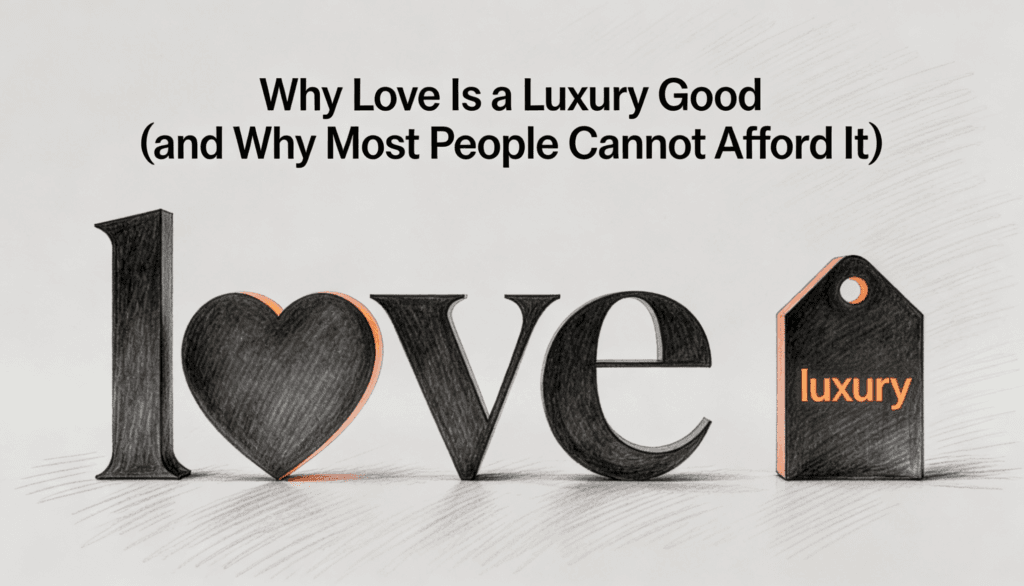
There is a brutal honesty in economics that most romantic advice refuses to touch. We talk about love as if it exists outside the market. As if it floats above supply and demand, untouched by balance sheets and bank statements. But love, in practice, operates exactly like a luxury good. The more financial security you have, the more of it you can access. The less you have, the more you settle for whatever version of it you can grab off the clearance rack.
This is not cynical. This is observable.
The Price of Admission Nobody Mentions
Economists have a concept called the hierarchy of needs, borrowed from psychology but deeply financial in nature. You cannot optimize for belonging and intimacy when you are worried about rent. You cannot be emotionally present for a partner when your nervous system is running a background program called “how am I going to eat next week.”
Love requires bandwidth. And bandwidth is expensive.
Think about what a healthy relationship actually demands. Time. Patience. Emotional regulation. The ability to sit with discomfort without exploding. The willingness to have a hard conversation instead of slamming a door. Every single one of these skills is harder to access when you are financially stressed. Not impossible. But harder in the same way that running a marathon is harder when you have not slept in three days. You can still do it. You will just do it badly.
Financial stress does not just reduce the quality of love. It changes the kind of love you seek. When you are broke, you are not shopping for compatibility. You are shopping for survival. A partner becomes a cost sharing arrangement. A roommate with benefits and a joint utility bill. This is not romance. This is resource pooling dressed in a relationship costume.
The Compound Interest of Emotional Wealth
Here is where the investing lens gets interesting.
In finance, compound interest is the most powerful force available to patient capital. Small amounts, consistently invested, grow into something enormous over time. Love works the same way, but with a cruel twist. You need starter capital.
The people who grow up in emotionally wealthy households, where conflict was handled with maturity, where affection was not transactional, where stability was the default setting, enter the relationship market with an enormous head start. They have emotional compound interest working in their favor before they even go on a first date. They know what healthy looks like because they have seen it. They can regulate their emotions because someone once regulated emotions for them.
Now consider the person who grew up in an emotionally bankrupt household. Every relationship becomes a first generation attempt at something they have never witnessed. They are essentially trying to build a portfolio from zero with no financial advisor, no model to follow, and a deep suspicion that the entire market is rigged.
This is not a moral failure. This is an inheritance gap.
And just like financial inheritance, emotional inheritance tends to compound across generations. Wealthy families produce children who know how to manage wealth. Emotionally healthy families produce children who know how to manage love. The rest of us are reading self help books at midnight trying to reverse engineer what some people absorbed at the dinner table by age seven.
Scarcity Makes You a Terrible Investor
One of the most well documented phenomena in behavioral finance is the scarcity mindset. When people feel resource constrained, they make worse decisions. They grab short term gains. They ignore long term costs. They hold onto bad positions because the fear of having nothing outweighs the logic of cutting losses.
Translate this directly into relationships and you have the entire dating landscape explained in one paragraph.
People who feel emotionally scarce, who believe love is rare and they are lucky to have any of it, will tolerate almost anything. They stay in relationships that are clearly depreciating assets. They pour energy into partners who offer negative returns. They confuse the sunk cost of years spent with actual value created. And when someone suggests they leave, they respond the way a panicked investor does during a market crash. “But I have already put so much into this.”
The sunk cost fallacy is not just a financial error. It is the engine that keeps bad relationships running for decades.
Meanwhile, people with emotional abundance, those who genuinely believe they are worthy of good love and have the stability to wait for it, make entirely different choices. They can walk away from a bad deal because they trust that a better one exists. They do not panic buy. They do not settle for the first offer out of desperation. They have what investors call a “strong cash position,” which in relationship terms means a solid sense of self that does not collapse the moment they are alone.
The Hidden Tax on Being Poor in Love
There is a tax that nobody talks about. Call it the poverty premium of relationships.
When you are financially stressed, every relationship problem costs more. A fight about dishes is never just about dishes. It is about the fact that you both work fifty hours a week and nobody has the energy to be generous. A disagreement about spending is never just about money. It is about control, security, and the terrifying possibility that one wrong purchase could destabilize everything.
Wealthy couples fight about philosophy. Poor couples fight about electricity bills. The content of the argument changes everything about its resolution. You can compromise on philosophy. You cannot compromise on whether the lights stay on.
This is the part that relationship advice columns consistently get wrong. They treat every couple as if they are operating in the same economic environment. “Just communicate better.” Sure. Easy to do when communication is the only problem. Much harder when communication is competing with exhaustion, resentment, and the ambient hum of financial anxiety that never fully shuts off.
The Market for Partners Is Not as Free as You Think
We like to believe that love is a free market. Anyone can find anyone. Chemistry does not check your credit score. Attraction does not care about your net worth.
Except it does. Not directly, but through a thousand quiet mechanisms.
Where you live determines who you meet. What you can afford to do on a weekend determines the social pools you swim in. Whether you can afford therapy determines how much emotional baggage you bring to the table versus how much you have processed and shelved. Whether you have the luxury of free time determines whether you can actually invest in getting to know someone slowly, or whether every date needs to “go somewhere” because you cannot afford to waste an evening.
The dating market is stratified in the same way the housing market is. There are neighborhoods of romantic possibility, and your financial situation determines which ones you can enter. This is not about gold digging or shallow materialism. This is about access. The zip code of your economic life shapes the zip code of your romantic one.
And like housing, the best neighborhoods keep appreciating while the worst ones keep losing value. People with resources attract other people with resources. Emotional health attracts emotional health. The rich get richer in love the same way they do in markets. Not because of some conspiracy, but because stability is magnetic and chaos is repellent.
The Counterintuitive Part
Here is where it gets uncomfortable for the luxury argument.
Money does not guarantee good love. In fact, extreme wealth introduces its own distortions. When you are very rich, you can never be sure if someone loves you or your lifestyle. Trust becomes paradoxically harder. Prenups are just due diligence documents for the heart. And the ability to buy your way out of any discomfort means you never develop the tolerance for friction that real intimacy requires.
There is a sweet spot. Enough money to remove survival anxiety, but not so much that it insulates you from the necessary roughness of genuine human connection. Behavioral economists might call this the “diminishing marginal returns of wealth on relationship quality.” Normal people would just call it the observation that billionaires seem to get divorced a lot.
The ideal financial position for love is not extreme wealth. It is sufficiency. Enough to not be desperate. Enough to choose freely. Enough to absorb a shock without the whole structure collapsing. In portfolio terms, you do not need to be the largest fund on the street. You just need to be solvent.
So What Do You Actually Do With This Information
If love is a luxury good, the question is not whether you can afford it. It is how you build the capacity to afford it.
And the answer looks a lot like sound financial planning.
First, invest in your own emotional infrastructure before you try to build with someone else. Therapy, self awareness, the boring work of understanding your own patterns. This is the equivalent of paying down high interest debt before you start investing. It is not exciting. But it changes everything downstream.
Second, stop making romantic decisions from a scarcity position. If you are choosing a partner because you are afraid of being alone, you are panic buying. The market will punish you for it. Learn to be solvent on your own first.
Third, recognize that the system is not fair. Some people start with more emotional capital than others. Acknowledging this is not self pity. It is accurate accounting. And accurate accounting is the foundation of every good financial plan.
Finally, understand that love, like any luxury good, is not actually about the price tag. It is about the value it creates in your life. A luxury good is not just expensive. It is something whose quality justifies its cost. The reason most people cannot afford love is not that love costs too much. It is that they have not built the foundation that allows them to hold it without breaking.
The market for love is real. The prices are real. And the returns, for those who can afford to invest wisely, are unlike anything else available.
But you have to be solvent first.