Table of Contents
There is a particular silence that happens when you check your bank account after a weekend with the wrong person. It is not the silence of peace. It is the silence of a small animal realizing the trap has already closed. You stare at the number, then at the ceiling, then at the framed photo of the two of you laughing in a city neither of you could afford to visit. And somewhere in that silence, a question forms that you will not ask out loud for another six months: why do I keep choosing this?
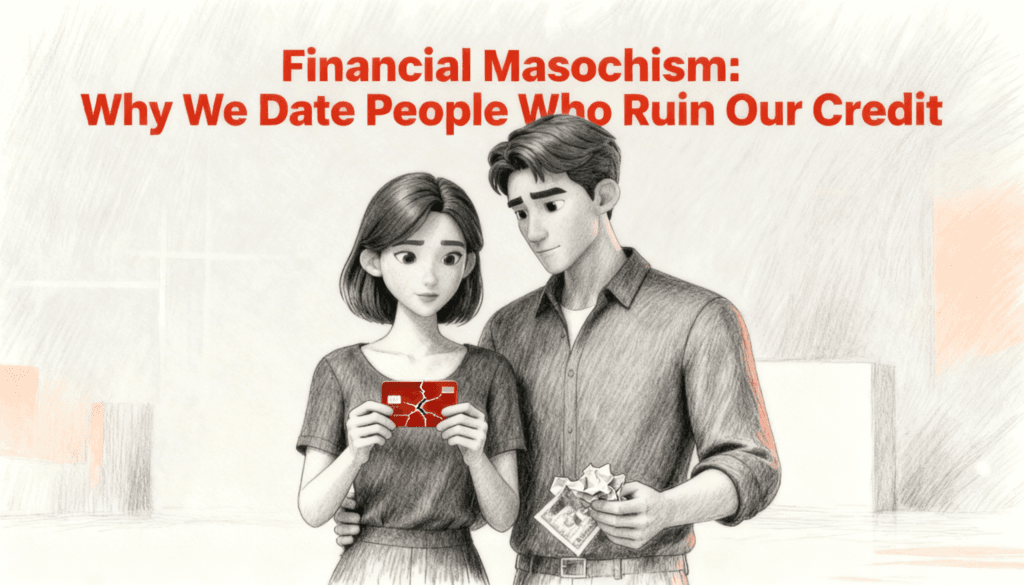
Welcome to financial masochism, the most underdiscussed romantic genre of our time.
The Economist Falls in Love and Loses His Wallet
Classical economics likes to imagine humans as rational actors. We weigh costs, we weigh benefits, we make decisions that maximize our wellbeing. It is a beautiful theory, mostly because it has almost nothing to do with how people behave when they are in love.
Behavioral economists figured this out decades ago. We are loss averse, except when the loss involves someone with good cheekbones. We discount the future, especially when the present smells like their cologne. We are subject to the sunk cost fallacy, which in romantic terms means we stay because we have already paid so much, emotionally and literally, that leaving feels like admitting we set the money on fire.
The interesting part is not that we are irrational. Everyone knows that. The interesting part is that our irrationality has a pattern. We do not lose money randomly in love. We lose it in remarkably consistent, almost ritualistic ways.
The Portfolio Theory of Bad Partners
Think about how a financial advisor talks about risk. There is volatility, which is the wild swing of returns. There is correlation, which is how your investments move together. There is downside risk, which is how much you can lose if everything goes wrong. There is liquidity, which is how easily you can get out.
Now think about your last difficult relationship through that exact frame.
The person was volatile. Wonderful on Tuesday, devastating by Friday, repentant by Sunday with a gift you did not want and could not return. They were highly correlated with your mood, meaning when their finances cratered, so did yours, because you were the safety net nobody asked you to be. The downside risk was enormous because you had cosigned, lent, covered, or quietly absorbed expenses that should have been theirs. And the liquidity was terrible. You could not just sell your position and walk away. There were apartments and pets and a shared streaming account and your mother who had finally started to like them.
A good investor would have looked at this portfolio and laughed. You looked at it and renewed the lease.
Why Stable Feels Boring and Chaos Feels Like Chemistry
Here is the part nobody likes to admit. A financially stable, emotionally consistent partner often registers, at first, as boring. Their texts arrive when they say they will. Their rent is paid. They do not need to be rescued. There is no drama, no late night phone call about a maxed out card, no thrilling emergency that requires your intervention.
The nervous system, particularly one trained early on chaos, can interpret this calm as absence. It does not feel like love. It feels like a waiting room.
Meanwhile, the person who texts at three in the morning asking if you can spot them rent until Friday produces something that feels indistinguishable from passion. Cortisol and dopamine in roughly equal measure. The body confuses stress for intensity, and intensity for meaning. You are not actually in love. You are just very, very activated.
This is where finance and neuroscience start dating each other. Variable reward schedules, the same mechanism that makes slot machines profitable, also make unreliable partners addictive. You cannot predict when the affection will arrive, only that it sometimes will, and the unpredictability itself becomes the drug. Reliable kindness, by contrast, gets taken for granted in about two weeks.
A casino would never let you walk in and cause you to lose money on a perfectly predictable schedule. They would go out of business. Yet we expect ourselves to find predictable kindness compelling, and then wonder why we keep wandering back to the roulette wheel of someone who might love us this week.
The Hidden Resume of a Credit Wrecker
There is a profile that emerges, if you start paying attention. The person who ruins your credit rarely arrives in a trench coat carrying a sign that says I will ruin your credit. They arrive charming. They arrive generous in the early days, often theatrically so, picking up dinners and ordering bottles, which is its own form of borrowing against the future. They arrive with a story about why their last situation was unfair. The landlord was crooked. The ex was crazy. The boss did not understand them. The bank made a mistake.
You will hear yourself, weeks in, repeating these explanations to your friends. That is the moment to notice. You have started absorbing their narrative, which is the first asset you will hand over. The money comes later.
The deeper trick is that financial chaos in another person often masquerades as freedom. They seem unburdened by the small anxieties that govern your life. They do not flinch at the bill. They book the trip. They live, as the phrase goes, in the moment. What you are watching is not freedom. It is the pleasant view from inside someone else’s debt, and you are about to become the wall holding it up.
The Borrowed Identity Problem
Money in a relationship is rarely just money. It is a way of saying who matters, who decides, who is allowed to want things, who is responsible when things break. When you start subsidizing a partner, you are not only transferring funds. You are quietly volunteering to become the adult in a two adult relationship, which means you are agreeing to a role that will exhaust you and a dynamic you will resent.
The economist Albert Hirschman wrote about three responses to a declining situation. Exit, voice, or loyalty. You can leave, you can speak up, or you can stay quiet and stick around. In financially imbalanced relationships, people tend to choose loyalty long past the point where voice would have served them, and exit becomes harder every month because the entanglements multiply. Each shared bill is a small chain. Each loan is a slightly larger one. By year two, the door is still there, but you have forgotten where you put the key.
The Counterintuitive Part
Here is something that sounds wrong but is not. People with good financial habits are often more vulnerable to financial masochism, not less.
The reason is simple. They have resources. They have credit to extend, savings to dip into, a steady income that can absorb someone else’s chaos for a surprisingly long time. Their competence becomes the very thing that enables the dynamic. A person living paycheck to paycheck cannot rescue anyone, so they tend not to date people who require rescuing for very long. The relationship simply collapses under its own weight within months.
The responsible saver, the diligent earner, the person with the emergency fund, can sustain a financially destructive partnership for years. Their discipline subsidizes the disorder. In a strange way, being good with money makes you a better target, because you can survive the bleeding longer before you notice you are pale.
The Exit Strategy Nobody Wants to Hear
Leaving a financially destructive relationship is rarely a single decision. It is a slow rebuilding of the muscles you stopped using. You start by noticing where the money actually goes, not where you tell yourself it goes. You stop floating loans that get described as temporary and never are. You watch what happens when you say no to a financial request, because the response will tell you everything about whether you are in a relationship or a quiet extraction.
The credit score will recover. It always does, with time and boring discipline. The harder repair is the one where you learn to find calm interesting again, to read steadiness as care rather than absence, to sit across from a person who is not in crisis and feel something other than restlessness. That work takes longer than rebuilding credit, and there is no app for it.
A Final Thought from an Unlikely Place
There is a concept in engineering called a load bearing wall. It is the wall that holds the building up. You can paint it, you can hang things on it, you can ignore it for years, but you cannot remove it without consequences. If you do, the structure does not fall immediately. It sags. It cracks in places that seem unrelated. Eventually something gives, and by then it is impossible to point at the original cause.
A lot of people are load bearing walls in their relationships and do not know it until they try to leave and watch the whole thing collapse onto them. The collapse is not proof you were loved. It is proof you were structural.
Finance teaches us to diversify, to hedge, to never put everything into a single position with unlimited downside. We accept this wisdom for our retirement accounts and ignore it completely in our love lives. The portfolio of a healthy life includes a partner who adds value rather than extracts it, and the most expensive mistake you can make is confusing the difference between someone who needs you and someone who chooses you.
One of those will cost you nothing. The other will cost you everything, and send you a thank you note written on the back of an overdraft notice.