Table of Contents
Why the Attention Economy Quietly Sabotages Your Dividend Investing Strategy
There is a reason you have never watched a dividend growth investor go viral. It is not because their math is wrong. It is because the slow, quiet act of collecting dividends and reinvesting them does not trend, and the platforms you scroll through every morning are engineered to make you forget that this is exactly the point.
Every quarter, millions of investors receive small deposits into their brokerage accounts. Coca Cola pays them. Johnson and Johnson pays them. A utility company in the Midwest that most people could not find on a map pays them. The money shows up. They reinvest it. They do the same thing again three months later. That is the entire plot. There is no twist, no villain, no cliffhanger.
Now try turning that into a post that earns ten thousand likes. You cannot. And financial social media, which lives and dies by the engagement metrics of platforms that reward adrenaline, has quietly figured this out. The dividend investor is simply invisible to it, and depending on how you look at things, that invisibility might be the highest compliment a strategy can receive.
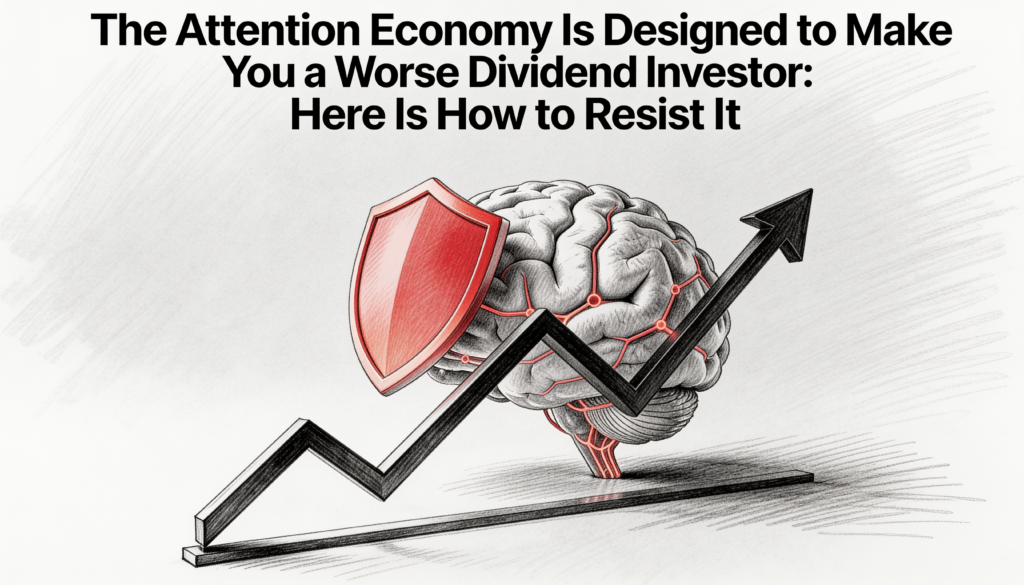
This article is about how to keep that invisibility working in your favor. It is a practical resistance guide for anyone trying to protect a long term dividend compounding strategy from the relentless pull of the attention economy.
The Content Problem Nobody Talks About
Here is something strange about modern finance. The quality of a strategy and its ability to generate interesting content are almost perfectly inversely related. The better something works over thirty years, the worse it performs in a fifteen second video.
Dividend investing is the clearest example. The whole point is that nothing dramatic is supposed to happen. You buy a business that has paid its owners for fifty years. You expect it to keep doing so. You are not trying to outsmart anyone. You are not timing anything. You are essentially signing up to be a very patient landlord who owns tiny pieces of many buildings, and your only job is to collect rent and avoid doing anything foolish.
There is no narrative arc to this. There is no moment where the dividend investor stares at a screen, sweating, waiting for a Federal Reserve announcement. There is no screenshot of an account climbing five hundred percent in a week. There is no story, and stories are the currency of the internet.
The dividend investor cannot compete in the attention economy because the dividend investor has nothing to sell except time, and time is the one thing social media has no patience for.
Financial social media runs on stories. Big calls. Bigger blowups. Predictions that aged badly. Predictions that aged brilliantly. Threads that start with the phrase nobody is talking about this when in fact everybody is talking about it. Understanding this dynamic is the first defensive move, because once you see the machinery, you stop mistaking volume for signal.
How the Medium Strips Away What Makes a Strategy Work
There is an idea from media theory that applies here better than it has any right to. The shape of a medium determines what kinds of messages can travel through it. A cathedral encourages certain kinds of speech. A comedy club encourages others. You cannot deliver a sermon at a roast and expect it to land.
The major social platforms are built for immediacy. They reward reaction over reflection. They reward now over later. They reward certainty over nuance. When you push a dividend strategy through this medium, something revealing happens. The message survives, but it arrives stripped of everything that made it useful in the first place.
You can post the words buy quality companies and reinvest the dividends for thirty years, and it is technically correct and completely useless as content. There is nothing to argue about. There is nothing to react to. There is nothing to do today. Meanwhile, somebody else is posting a chart of a small cap biotech with the caption this is about to rip, and thousands of people are paying attention. Not because the biotech is more likely to make them rich. It is probably less likely. People pay attention because the biotech post is a story with a potential ending, while the dividend post is a story with no ending at all.
The medium is never neutral. In an environment that hates slow things, the slowest thing in finance will always be the least visible, even when it is quietly making people wealthy in the background.
What Financial Social Media Actually Sells You
Financial social media is rarely in the business of selling investment advice. It is in the business of selling the feeling of being a smart investor. These are not the same product, and confusing them is how many people end up trading themselves out of a perfectly good plan.
The feeling of being a smart investor requires constant engagement. You need to be checking charts, forming opinions, reacting to news, taking positions, arguing with people who disagree with you, and occasionally being proven right in a way that feels thrilling. The actual results of being a smart investor are almost entirely invisible on a daily basis and only become clear after a year or two, by which point the audience has already moved on.
So the platforms optimize for the feeling, and the feeling is what gets monetized. Newsletters, courses, premium channels, signals, alerts, live streams, all of it. The dividend investor is not a customer for any of this. The dividend investor has already decided that the experience of feeling engaged is not what they are buying. They are buying cash flows from companies that have paid them for decades and will probably continue to do so.
Understanding Conspicuous Consumption in Financial Content
There is a concept in sociology called conspicuous consumption. It was coined more than a century ago by the economist Thorstein Veblen, and it described how people spend money not to enjoy things but to signal status to other people. The yacht is rarely about the yacht. The yacht is about other people knowing you own a yacht.
Financial content online has the same quality. It is rarely about the investment itself. It is about the performance of the investment as an identity. When somebody posts their trading screen, they are not teaching you anything. They are performing a version of themselves that they want you to envy. They are a modern Veblen case study, except the yacht is a screenshot and the audience is strangers.
Dividend investors generally do not do this, and not because they are morally superior. They do not do it because there is nothing to perform. A quarterly dividend deposit is not a flex. You cannot post a screenshot of four hundred and twenty dollars arriving in your account and expect applause. The strategy is structurally incompatible with showing off because it produces wealth in a form that cannot be photographed. When people call dividend investors boring, what they often mean is unpostable, and only one of those accusations matters if your goal is to retire comfortably rather than to go viral.
A Practical Resistance Guide for Protecting Your Compounding
Diagnosis is interesting, but it does not change behavior on its own. The following practices are designed to keep the attention economy from eroding a dividend compounding strategy. They are specific, repeatable, and deliberately unglamorous, which is precisely why they work.
Build a Decision Schedule Instead of a Reaction Habit
The single most damaging thing the attention economy does is convert investing from a scheduled activity into a reactive one. The defense is to decide in advance when you will make decisions and to refuse to make them at any other time.
- Set a fixed review cadence. Look at your portfolio once a quarter, ideally tied to earnings season, and treat every other day as off limits for action.
- Automate your dividend reinvestment so that the most important habit in your strategy requires zero decisions and zero clicks.
- Write down the conditions under which you would ever sell a holding before you own it, so that a panicked feed cannot rewrite your rules in real time.
- Use limit orders and recurring purchases so that buying happens mechanically rather than emotionally.
When your decisions live on a calendar, a viral post loses its power. The post wants you to act now. Your schedule tells you that now is not a decision day, and the urge passes.
Curate Your Information Diet Deliberately
You would not let a stranger pour sugar into your coffee every morning, yet most investors let strangers pour anxiety into their portfolios every time they open an app. Treat your information intake the way a serious athlete treats food.
A strategy that produces no content is often a strategy that is letting time do the work, and time is the cheapest employee in finance.
- Unfollow accounts that profit from your activity. Anyone selling signals, alerts, or the constant thrill of the next big trade has an incentive that runs directly against your patience.
- Follow a small number of sources that publish slowly and reason carefully, then read them on your own schedule rather than in an endless scroll.
- Replace price tracking apps with dividend tracking tools, because what you measure is what you obsess over, and you want to obsess over income rather than daily noise.
- Mute keywords and tickers that pull you into speculation, and notice how quickly the relevant world goes quiet.
The goal is to arrange your environment so that doing nothing is the easiest option, because for a dividend investor, doing nothing is usually the correct option.
Reframe What Counts as Progress
The attention economy trains you to feel progress through movement. A green day feels like winning. A loud trade feels like skill. A dividend investor needs a different scoreboard, one that the internet cannot manipulate.
- Track your annual dividend income rather than your daily portfolio value, and watch that number rise across years rather than minutes.
- Measure your dividend growth rate, which tells you whether the businesses you own are increasing their payments to you, the only signal that truly reflects compounding.
- Keep a simple log of every dividend increase your companies announce, because those announcements are the genuine highlight reel of your strategy.
- Celebrate the milestones the internet ignores, such as the first time your annual dividends cover a recurring bill, because those are real and permanent in a way that a single green day never is.
When your sense of progress comes from income that grows quietly each year, a flashy chart on someone else’s feed simply stops feeling relevant to your life.
Create Friction Between You and the Feed
Resistance is far easier when the path of least resistance points toward patience. Add small frictions that make impulsive behavior slightly harder and disciplined behavior slightly easier.
- Remove trading apps from your phone home screen, or remove them from your phone entirely and access your brokerage only from a computer.
- Turn off all price and news notifications so that markets cannot interrupt your day uninvited.
- Introduce a mandatory waiting period of at least forty eight hours between wanting to make a trade and actually making it.
- Keep a one sentence written reason for owning each company, and reread it whenever a post tempts you to abandon the position.
Friction is not punishment. It is the gap in which your rational self can catch up to your reactive self before money changes hands.
The Real Trade Behind Every Strategy
If you zoom out far enough, the clash between dividend portfolios and financial social media is not really about which strategy is correct. It is about what you are willing to trade for what.
Participants in the attention economy are trading attention, stress, and often capital for the experience of feeling engaged with markets. Some of them do well at this. But the experience itself is the product they are buying, whether they recognize it or not. Dividend investors are trading patience and visibility for compounding. They accept that nobody will ever ask them about their portfolio at a dinner party because nobody finds it interesting. In exchange, they get to stop thinking about it.
One trade produces content. The other trade produces cash. You can probably guess which one the internet prefers.
The counterintuitive part is that the invisibility of dividend investing is a feature rather than a flaw. A strategy that produces a constant stream of content tends to do so because something is always happening, and in investing, things happening is usually expensive. Fees, taxes, decisions made in the heat of a moment, and the endless cost of reacting all eat away at returns. A strategy that produces no content is often one that is letting time do the work for free.
If dividend investing were genuinely exciting, the feeds would be full of it. The fact that they are not is not an indictment. It might be the highest endorsement the attention economy is capable of giving.
Where This Leaves You and What to Do Next
If you have read this far, you face a choice that most people never bother to articulate. You can pick a strategy that will give you something interesting to talk about, or you can pick a strategy that will give you something quietly valuable to own. These two things are almost never the same.
The dividend portfolio is the thing you own while you are busy living your life. It does not demand your attention, and it does not reward your attention either. It compounds in the background while you are doing something else, which for most people is the entire reason to have a portfolio in the first place.
The practices in this guide all point in one direction. Arrange your tools, your information, and your scoreboard so that patience is the easy path and reaction is the hard one. Automate the important things. Measure income rather than noise. Add friction where the attention economy wants speed. The market will always offer you a more thrilling story than the one your own portfolio is telling, and your job is to keep choosing the boring story that actually makes you wealthy.
The smartest people in finance understand all of this. They simply cannot say it too loudly, because saying it too loudly would put a great deal of attention based business out of work. You, however, have no such conflict. You are free to be invisible, patient, and quietly, durably rich.