Table of Contents
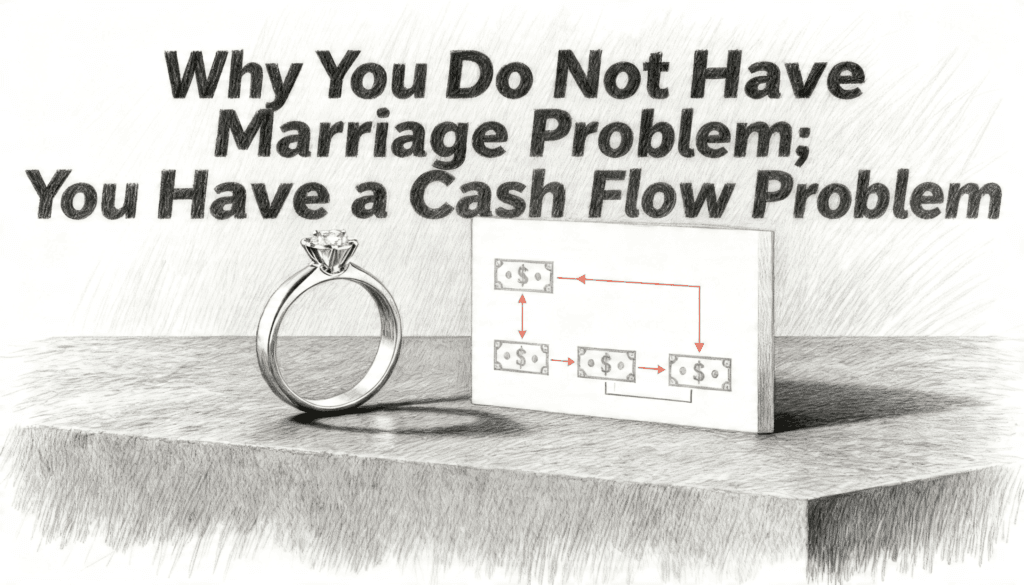
Couples therapists have a strange professional secret. A surprising number of the fights they referee are not really about what the couple thinks they are about. The argument starts with dishes or in laws or someone forgetting an anniversary, but if you sit with it long enough, the real engine humming underneath is almost always the same. Money. Or more specifically, the timing of money.
Notice the wording. Not the amount of money. The timing.
This is the part most people get wrong when they talk about finances and relationships. They assume rich couples fight less and poor couples fight more, and that the solution is somewhere on a spreadsheet titled “earn more.” But anyone who has watched a high earning couple implode over a credit card statement knows the income theory does not hold. Plenty of households pulling in serious money are quietly miserable, and plenty of modest households are unreasonably happy. The variable that actually predicts the temperature in the room is not net worth. It is cash flow.
The Household as a Small Business
Try this thought experiment. Imagine your marriage is a small business with two founders, shared assets, recurring expenses, and unpredictable revenue. If you ran that business the way most couples run their finances, you would be bankrupt by the second quarter. No founder would tolerate a partner who refuses to look at the books, makes surprise purchases without telling anyone, or treats a shared account like a personal one. And yet in marriages, this is considered normal. We call it “not being controlling.”
Every business that fails does so for one of two reasons. Either the model was broken from the start, or it ran out of cash at the wrong moment. The second reason is far more common. Profitable businesses go under all the time because the money coming in does not arrive on the same schedule as the money going out. The bills are due Tuesday. The check clears Friday. Three days of mismatch, repeated often enough, and the whole thing collapses.
Marriages work the same way. The model can be fine. You can love each other, want the same things, raise decent kids, share a sense of humor about your in laws. But if rent is due on the first and the paycheck lands on the third, and nobody talks about how that gap gets covered, you will fight. Not about love. About the third.
Why Timing Beats Amount
There is a concept in finance called the J curve. When you invest in something productive, things often get worse before they get better. You spend money up front, then you wait, and only later does the return show up. Couples experience J curves constantly. You move for a better job. You have a kid. You start a business. You go back to school. Each of these is, in financial terms, a deliberate cash flow crisis chosen on purpose because the long term math works.
The trouble is that the dip in the middle of a J curve feels exactly like failure. Your account balance is going down. Your stress is going up. If you have not agreed in advance that this is the plan, one partner starts to suspect the other of incompetence or recklessness. The fights that follow are not really disagreements about values. They are disagreements about which point on the curve you are currently standing on.
Couples who survive the dip tend to share one trait. They named it before they entered it. They said out loud, this year is going to be hard, here is roughly how hard, and here is when we expect it to turn. The naming does almost all the work. Couples who did not name it experience the same dip as a betrayal.
The Hidden Cost of Surprise
If you ask people what they want from a partner financially, most will say honesty or generosity or shared goals. These are nice answers. They are also wrong, or at least incomplete. The thing people actually want, whether they can articulate it or not, is the absence of surprise.
Surprise is the most expensive thing in any relationship. A surprise expense, a surprise debt, a surprise email from the IRS, a surprise admission that the credit card has been quietly bleeding for eight months. The dollar amount almost does not matter. A two hundred dollar surprise can do more damage than a twenty thousand dollar agreed upon expense, because the agreed upon expense came with a conversation and the surprise came with a sense of being played.
This is why couples who run a tight monthly check in tend to outperform couples who earn twice as much but never look at the numbers together. It is not the ritual itself that is magic. It is that the ritual makes surprise nearly impossible. You cannot ambush someone you spoke to on Sunday.
What Therapy Misses
The therapy industry, bless it, often treats money fights as symbolic. The argument about the credit card is “really” about control, or trust, or your mother. Sometimes this is true. Often it is not. Sometimes the argument about the credit card is really about the credit card, and treating it as a metaphor for childhood wounds is a clever way to avoid the boring work of actually opening the statement.
I am not against therapy. I am against the assumption that every concrete problem is a stand in for an abstract one. Sometimes the abstract problem is the stand in. Sometimes “I feel disrespected” is what your nervous system produces when it has watched the checking account drift toward zero for the third month in a row and nobody will sit down and talk about it. Fix the cash flow and a startling amount of the disrespect evaporates. Try to fix the disrespect while the cash flow is still broken and you will be in that office for years.
The Two Account Question
Should couples merge their finances or keep them separate? This is one of those questions that generates strong opinions and almost no useful data, because the answer is that the structure does not matter nearly as much as the visibility. A fully merged account where one partner has no idea what is in it is worse than two separate accounts where both partners share a monthly summary. Visibility is the variable. Architecture is decoration.
What actually matters is whether both people can answer three questions on any given Tuesday. What is coming in this month. What is going out this month. What is the gap, and who is responsible for closing it. If both partners can answer those questions without flinching, the marriage will survive almost any income level. If neither can, no income level will save it.
A Quick Detour Through Poker
Professional poker players talk about something called “bankroll management.” The idea is that even if you are the best player at the table, you will lose hands you should have won, because variance is a real thing. So you never sit down with money you cannot afford to lose, and you size your bets to the size of your bankroll, not to the size of your confidence.
Marriages need bankroll management too. Most couples size their lifestyle to their best month, not their average month, and certainly not their worst. Then a worst month happens, as worst months reliably do, and the lifestyle does not flex fast enough. The fight that follows looks like a fight about spending. It is actually a fight about sizing. You bet too big for the bankroll, and now someone has to fold something they did not want to fold.
The couples who handle variance well are not the ones who never have a bad month. They are the ones whose lifestyle was built with the bad month already priced in. Their fixed costs sit comfortably below their average income, which means a bad month is annoying instead of catastrophic. This is unsexy advice. It is also why their marriages last.
The Real Luxury
There is a kind of wealth that has nothing to do with how much you make. It is the wealth of not having to perform a calculation in your head every time your partner suggests dinner out. It is the wealth of saying yes to a weekend trip without doing the math on whether the car payment clears first. This is what cash flow buys you, and it is the only kind of money that directly purchases peace at home.
People chase income because income is legible. You can put it on a resume and a tax return. Cash flow is harder to brag about. You cannot mention at a dinner party that your fixed costs are forty percent of your take home, even though that single number probably predicts your marital happiness better than your title does. The things that actually protect a relationship are almost always the things that are boring to talk about.
What To Actually Do
If any of this is landing, the move is not to overhaul your life. It is to do one small unsexy thing. Pick a day each month, the same day every time, and sit down with your partner for twenty minutes. Look at what came in. Look at what went out. Look at what is coming up. Do not make decisions. Do not assign blame. Just look. The first few times will be uncomfortable because you are introducing visibility into a system that has been operating in the dark. After three or four sessions it becomes routine, and after a year you will not remember how you lived without it.
You will also notice something strange. The fights you used to have about other things will start to lose their charge. The dishes will still bother you. The in laws will still be the in laws. But the low hum of dread that used to color everything will quiet down, because the thing that was actually generating it has been brought into the light.
Most marriage problems are not marriage problems. They are timing problems wearing a costume. Take off the costume, look at the calendar, and a surprising amount of the conflict turns out to have an address, a due date, and a solvable arithmetic underneath it.
The romantic thing to say is that love conquers all. The honest thing to say is that love conquers most things, provided rent gets paid on time.