Table of Contents
The Panic of 1893: When Being Right About the Future Was Not Enough
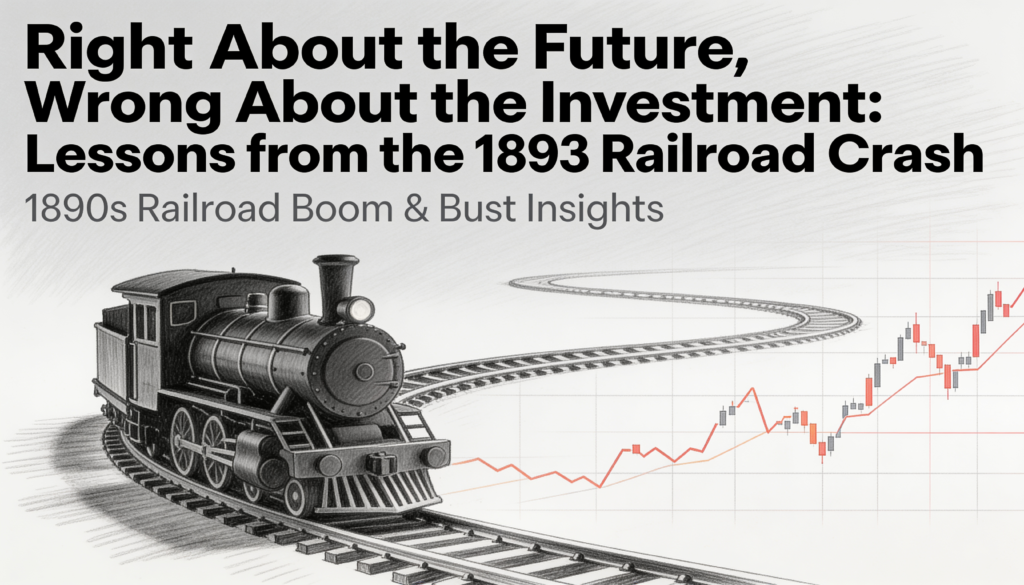
Railroads were the future, and every serious investor knew it. They still lost everything. The Panic of 1893 and its railroad crash wiped out hundreds of railroads, shuttered roughly 15,000 businesses, and pushed unemployment toward levels that would not be seen again until the Great Depression. Fortunes that looked permanent on Monday were fictional by Friday.
Here is the part that should keep modern investors awake at night: the people who got destroyed were not reckless gamblers. They were the smart money. They had done their homework, read the papers, followed the trend, and arrived at the perfectly reasonable conclusion that railroads were the backbone of the American economy. They were right about the future. They were simply wrong about their portfolios.
That gap between being right about the world and being right about your investments is one of the most expensive lessons in financial history. The Panic of 1893 is the clearest case study we have of how a correct thesis, fueled by overbuilding and leverage, becomes a disaster. It also shows what disciplined investors should have bought once the wreckage cleared. The lesson keeps repeating, generation after generation, because it is counterintuitive enough that each new wave of investors has to learn it the hard way.
The Consensus Was Correct, and That Was the Problem
What makes the railroad crash so instructive is that the thesis was not wrong. Railroads genuinely were transforming the economy. They were the infrastructure of modern commerce, the internet of their era, the network that stitched a continent together and made national markets possible. Every argument in favor of investing in railroads was essentially true.
The problem is that a true story and a good investment are not the same thing. When everyone agrees on a narrative, the price of the assets attached to that narrative inflates beyond what the underlying economics can support. Railroads were real. The revenues were real. But the capital pouring into the sector created overcapacity, redundant lines, and debt structures that only worked if growth never slowed down. When growth did slow, the math stopped working. Not because the technology failed, but because the financing had been built on optimism rather than mathematics.
A true story and a good investment are not the same thing. When everyone agrees on a narrative, the price of the assets attached to it inflates beyond what the underlying economics can support.
This is a pattern investors in 2000 would recognize. And investors in 2021. And probably investors in some future year that has not arrived yet. Consensus is not an advantage. When everyone already believes the story, the upside is already priced in, and what remains is mostly downside risk. The railroad investors of the 1890s were not contrarians. They were the mainstream. The mainstream got crushed.
The Overbuilding Trap: Too Much Track, Too Little Demand
By the early 1890s, America had laid far more railroad track than it needed. Companies built parallel lines to compete for identical routes. Towns that could barely justify one rail connection somehow had three. The logic was simple and self reinforcing: if railroads are the future, then more railroads must be better.
This is what happens when capital chases a correct thesis without discipline. The investment becomes disconnected from actual demand. You are no longer buying into a business. You are buying into a belief. And beliefs, however accurate, do not pay dividends.
The Leverage Problem: How a Correction Became a Catastrophe
What turned an ordinary correction into a national catastrophe was debt. Railroads were enormously capital intensive. Building track across a continent required vast upfront investment, and that money came largely from bonds. As long as revenues grew, the debt was manageable. When revenues flattened, the debt became a trap.
This is worth sitting with, because leverage is the single variable that converts bad investments into disasters. A bad investment without leverage is a disappointment. A bad investment with leverage is a crisis. The railroads did not merely lose money. They defaulted on bonds, which triggered bank failures, which froze credit markets, which strangled the broader economy.
A bad investment without leverage is a disappointment. A bad investment with leverage is a crisis.
The lesson is not that debt is evil. The lesson is that debt removes your margin for error. It turns a situation where you can afford to be patient into a situation where you cannot afford to be wrong. The cruel irony is that leverage feels most comfortable precisely when it is most dangerous, during the periods of easy growth when everything seems to be going right. Every major financial crisis in history has leverage somewhere near its center, not because borrowing is inherently reckless, but because it eliminates the room investors need to survive the inevitable surprises.
Jay Gould Understood What the Idealists Missed
If the railroad era has a villain, it is probably Jay Gould. He was a speculator, a manipulator, and by most accounts a thoroughly unpleasant man. He bought and sold railroads not because he believed in their mission but because he understood how markets actually worked. He played both sides. He profited from chaos.
The respectable investors of the era despised him. They saw themselves as builders investing in progress, while Gould was merely playing games with money. But here is the uncomfortable truth: Gould understood something the respectable investors did not. He understood that the market is not a machine for rewarding people who are right about the future. The market is a machine for pricing risk and sentiment.
Being right about where the world is going is only useful if you also understand how the market is going to get there, including all the panics, manias, and overcorrections along the way. You do not have to admire Gould to learn from him. The lesson is not that cynicism wins. The lesson is that idealism without pragmatism is expensive.
The Recovery No One Expected
Here is the part of the story that rarely gets told. After the crash, railroads did not disappear. They consolidated. The weak players went bankrupt, the strong players bought their assets at a discount, and the industry emerged leaner and far more profitable than before.
J. P. Morgan, who reorganized many of the failed railroads, essentially restructured an entire industry. The process was brutal. Bondholders took losses. Shareholders were wiped out. But the railroads themselves kept running. The tracks did not vanish. The demand for transportation did not evaporate. What changed was the ownership and the capital structure.
Selective Destruction, Not Random Destruction
This pattern repeats with remarkable consistency. The dot com crash did not kill the internet. It killed the companies burning cash without a business model. The survivors, the Amazons and the Googles, went on to become some of the most valuable enterprises in history. The destruction was not random. It was selective, and it selected for the qualities that actually matter in business: sound economics, manageable debt, and genuine demand for the product.
The crash did not end the railroad era. It cleaned out the excess and left behind a stronger industry. Destruction is often the prelude to creation.
The investors who bought after the crash, when the story was unfashionable and the assets were cheap, did extraordinarily well. That is the recurring reward of the cycle: the greatest opportunities appear in the rubble, not at the peak of the parade.
What the Panic of 1893 Teaches Modern Investors
Several lessons from the railroad crash apply directly to investing today, and they are all lessons that people would rather not hear.
- A great story is not a great investment. The narrative can be completely correct and you can still lose money, because the price already reflects the story or because the story attracts so much capital that it creates its own problems.
- Consensus is a cost, not an advantage. When everyone agrees on a thesis, the upside is already priced in. What remains is mostly downside risk.
- Leverage is the accelerant. Debt is what turns ordinary mistakes into catastrophes by removing the margin for error every investor eventually needs.
- Destruction is often the prelude to creation. The crash cleaned out the excess and left a stronger industry. Buying the unfashionable survivors afterward is where the real returns lived.
The Central Paradox of Investing
Telling someone to buy when everything looks terrible is easy advice to give and nearly impossible advice to follow. During the worst of the 1893 panic, buying railroad stocks would have felt like catching a falling knife. The newspapers were full of doom. Banks were failing. The smart people were selling.
This is the central paradox. The best opportunities arise precisely when they feel the worst, and the worst risks accumulate precisely when everything feels safe. The 1890s railroad boom felt safe. The post crash recovery felt terrifying. The returns were inversely correlated with the comfort level. The market does not reward you for being comfortable. It rewards you for being right at the times when being right feels wrong.
Do Not Get Railroaded
The phrase getting railroaded means being forced into something against your will. It is a fitting metaphor for what happened in the 1890s. No one forced those investors from the outside. They were forced by their own certainty, their own leverage, and their own inability to distinguish between a true story and a sound investment.
The railroads were real. The revolution was real. The losses were also real. The next time you find yourself looking at an investment where the future seems obvious, where the growth seems inevitable, and where everyone you respect agrees it is a sure thing, remember the railroads. Remember that being right about the destination does not mean you have bought the right ticket.
And remember that the most expensive words in investing have always been the same four: this time is different. It never is.