Table of Contents
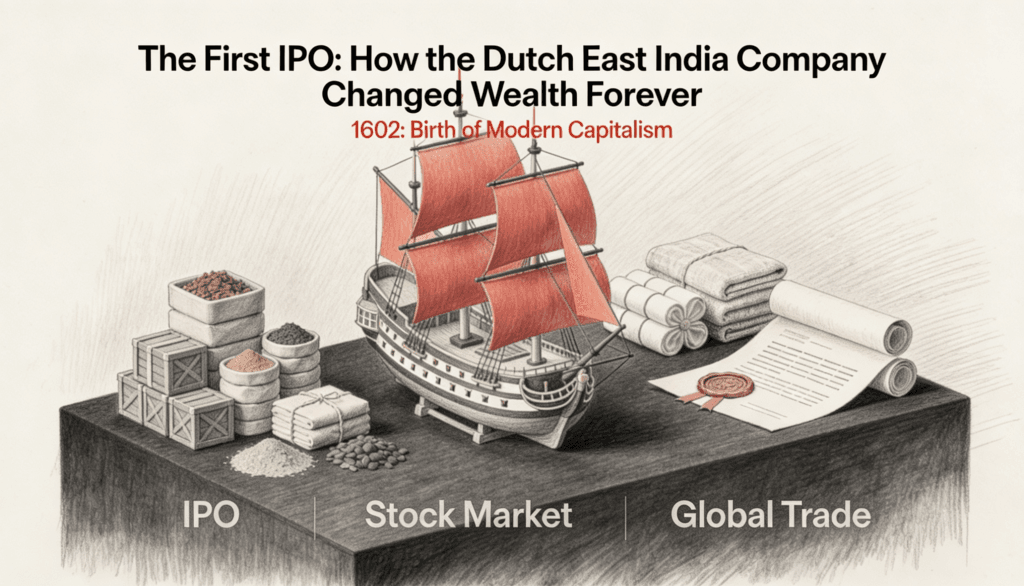
Before 1602, wealth was something you were born into or conquered. You inherited land, married into title, or took what you wanted with a sword. The idea that an ordinary person could buy a piece of a business and watch their money grow while they slept would have sounded like madness. Then the Dutch East India Company came along and made that madness the foundation of modern capitalism.
To understand why the first initial public offering was such a rupture in history, you have to understand what it replaced. And what it replaced was a world where money and power were practically the same word.
When Wealth Was a Thing You Could Touch
For most of human history, wealth meant something physical. Grain in a storehouse. Cattle in a field. Gold in a chest. Land beneath your feet. These were not abstract representations of value. They were value itself. If your barn burned down, you were not experiencing a market correction. You were ruined.
This might sound primitive, but it created a surprisingly stable logic. You could not inflate grain. You could not print more cattle. The physical constraints of wealth kept the system honest in ways that later financial systems would struggle to replicate. Of course, it also meant that building wealth required either backbreaking labor, inheritance, or violence. Often all three.
In medieval Europe, the Catholic Church added a theological layer to this arrangement. Charging interest on loans was usury, and usury was a sin. Money was not supposed to make more money. It was supposed to sit there, being money, until you spent it on something real. The idea that capital could reproduce itself, that you could lend someone ten coins and receive eleven back, struck many thinkers as something close to sorcery.
This was not just moral repulsion. It reflected a deep intuition about the nature of value. If money could multiply without anyone building anything or growing anything, where was the new value coming from? The answer, which took centuries to articulate, was that it came from the future. But we are getting ahead of ourselves.
The Problem With Ships
By the late 1500s, the Dutch Republic had a problem that was also an opportunity. The spice trade with Asia was enormously profitable, but it required enormous risk. A single voyage to the East Indies took years. Ships sank. Crews died. Pirates attacked. And even when everything went right, you had to wait an agonizing amount of time before seeing any return.
Individual merchants had been funding these voyages on their own or in small partnerships. This worked, but it was wildly inefficient. Every voyage was a separate bet. If your ship came back loaded with nutmeg, you were rich. If it did not come back at all, you were finished. There was no way to spread the risk across multiple ventures or multiple years.
The standard historical narrative says that the VOC (Vereenigde Oostindische Compagnie, or Dutch East India Company) was created in 1602 to solve this problem. That is true, but it understates the radicalism of the solution. What the Dutch actually did was invent a new relationship between people and money. One that we now take so completely for granted that we forget it had to be invented at all.
Selling Pieces of the Future
The VOC did something no organization had done before at scale. It sold shares to the general public. Not just to wealthy merchants or aristocrats, but to anyone with enough money to buy in. Servants bought shares. Widows bought shares. There are records of maids pooling their savings to purchase a small stake in the company.
Think about what this meant. For the first time, ordinary people could own a fraction of a massive commercial enterprise without managing it, without sailing on any ships, without knowing anything about the spice trade. They simply handed over money and received a piece of paper that entitled them to a share of future profits.
This was the birth of the passive investor. And it is worth pausing to appreciate how strange this concept really is. You are giving your money to strangers who will sail it to the other side of the world, use it to buy things you have never seen, bring those things back, sell them to people you will never meet, and then give you a cut. The entire arrangement runs on trust, legal infrastructure, and the assumption that the future will be at least somewhat like the present.
The Church had worried that lending money at interest was unnatural. The VOC took that unnaturalness and scaled it to an industrial level.
The Accidental Invention of the Stock Market
Having sold shares, the VOC immediately created a secondary problem. People who owned shares sometimes wanted to sell them. Maybe they needed cash. Maybe they had lost faith in the company. Maybe they simply wanted to take their profits and walk away.
So the Amsterdam Stock Exchange emerged, not as some grand planned institution, but as a practical necessity. People started trading VOC shares in the open air, then in coffeehouses, then eventually in a dedicated building. Prices went up and down based on news, rumor, fear, and greed. All the emotional infrastructure of modern markets was present from the very beginning.
Within a few years, Amsterdam had developed financial instruments that would look familiar to any modern trader. There were futures contracts, options, and short selling. There was insider trading. There was market manipulation. There was panic selling. Humans had invented a brand new arena for economic activity and immediately imported all of their oldest psychological weaknesses into it.
This is one of those patterns that repeats so reliably across history that it probably tells us something important about human nature. We do not build new systems and then become new people within them. We build new systems and then remain exactly who we have always been.
What the VOC Actually Changed
The standard story about the VOC emphasizes the financial innovation. Shares, stock markets, limited liability. These matter. But the deeper transformation was philosophical.
Before the VOC, wealth was fundamentally about the past. You were rich because of what your family had accumulated, what your ancestors had conquered, what had already been built or grown or mined. The VOC introduced the idea that wealth could be primarily about the future. A share was not a pile of spices sitting in a warehouse. It was a claim on spices that had not been harvested yet, on voyages that had not been made, on profits that existed only as projections.
This shift from backward looking wealth to forward looking wealth is arguably the most important conceptual change in economic history. It is the reason venture capital exists. It is the reason startups with no revenue can be valued at billions of dollars. It is the reason your retirement account is not a chest of gold coins buried in your backyard.
And like many revolutionary ideas, it contained a built in tension. If wealth is a claim on the future, then its value depends entirely on what you believe the future will look like. This makes wealth partially a matter of collective storytelling. Not fiction, exactly, but not pure fact either. Something in between. A shared agreement to act as if certain things will probably happen.
The Dark Machinery Behind the Innovation
It would be dishonest to discuss the VOC without acknowledging what funded all this elegant financial innovation. The company was granted a monopoly on Dutch trade in Asia, along with the power to wage war, negotiate treaties, establish colonies, and govern territories. It was, in modern terms, a corporation with its own military.
The wealth that flowed back to Amsterdam shareholders was extracted through forced labor, colonial exploitation, and occasionally outright violence. The nutmeg that made investors rich came from the Banda Islands, where the VOC orchestrated a near total depopulation of the indigenous people to secure its monopoly.
This is not a footnote to the story of modern investing. It is the foundation. The first stock market was capitalized, in part, by human suffering on an enormous scale. The clean abstraction of a share certificate was connected, by a very long chain of ships and soldiers, to something much less abstract.
This does not mean that stock markets are inherently exploitative. But it does mean that the origin story of passive investing is considerably darker than the version usually told in personal finance books.
What Survived and What Did Not
The VOC itself went bankrupt in 1799, done in by corruption, overextension, and the inability to adapt to changing conditions. In this, it established another enduring pattern. The company that invents a new way of doing business is rarely the company that profits from it in the long run.
But the infrastructure it created, the idea that businesses could sell ownership to the public, that those ownership stakes could be freely traded, that ordinary people could participate in large scale enterprise without running anything, this infrastructure outlasted the company by centuries. It is still the operating system of global capitalism.
The Amsterdam Stock Exchange became a model for London, which became a model for New York. The concept of the publicly traded corporation spread across the world and became so ubiquitous that we stopped seeing it as a concept at all. It became simply the way things work.
The Lesson That Keeps Teaching Itself
There is something almost comic about the distance between the VOC and a modern index fund. A 17th century trading company that fought wars and colonized islands, and a quiet financial product that your phone automatically invests in every month. They are separated by four centuries of refinement, regulation, and moral progress. But the underlying mechanism is the same. You give your money to an enterprise. The enterprise does things with it. You hope to get back more than you put in.
The Dutch did not invent greed or risk or the desire to get something for nothing. What they invented was a system that channeled these impulses into a structure. That structure has been refined countless times, regulated and deregulated, celebrated and condemned. But its basic architecture has not changed since a few merchants in Amsterdam decided to let the public buy in.
Every time you check a stock price on your phone, you are participating in a system that was designed to fund spice voyages. Every time you buy an ETF, you are doing what Dutch maids did when they pooled their wages for a share certificate. The technology has changed. The suits have changed. The human behavior has not changed at all.
That might be the most important lesson the first IPO has to teach us. Financial innovation does not change people. It just gives them new instruments to play the same old songs.