Table of Contents
There is a trader on every floor who makes everyone else uncomfortable. Not because he yells or throws things. The opposite. He is calm when calm should not be possible. The portfolio is down five percent in a morning and he is eating a sandwich. The market is in freefall and he is scanning for entries. Everyone else is sweating through their shirts and calling their spouses, and this person looks like he is waiting for a bus.
Wall Street has a name for people like this. They call them cold. Emotionless. Occasionally, and not always as an insult, they call them psychopaths.
But here is the strange part. The research increasingly suggests they might be right. And that it might be a compliment.
The Brain That Does Not Flinch
In the early 2000s, a neuroscience team at the University of Iowa ran an experiment that still haunts behavioral finance. They took three groups of people: normal healthy adults, patients with damage to the brain regions responsible for emotional processing, and a control group. They gave all of them a simple investment game. Each round, participants could invest or hold. The odds were structured so that investing every round was the mathematically optimal strategy.
The normal, emotionally healthy participants did what normal, emotionally healthy people do. They started well but after losing a round or two, they flinched. They sat out rounds they should have played. They let the sting of a recent loss override what the math was telling them. In other words, they were rational enough to understand the game but too human to play it correctly.
The brain damaged patients won. Convincingly.
They could not feel the anxiety that loss produces, so they kept investing. Round after round, no hesitation. The part of their brain that should have been screaming at them to stop was simply not there. And in this specific context, its absence was a superpower.
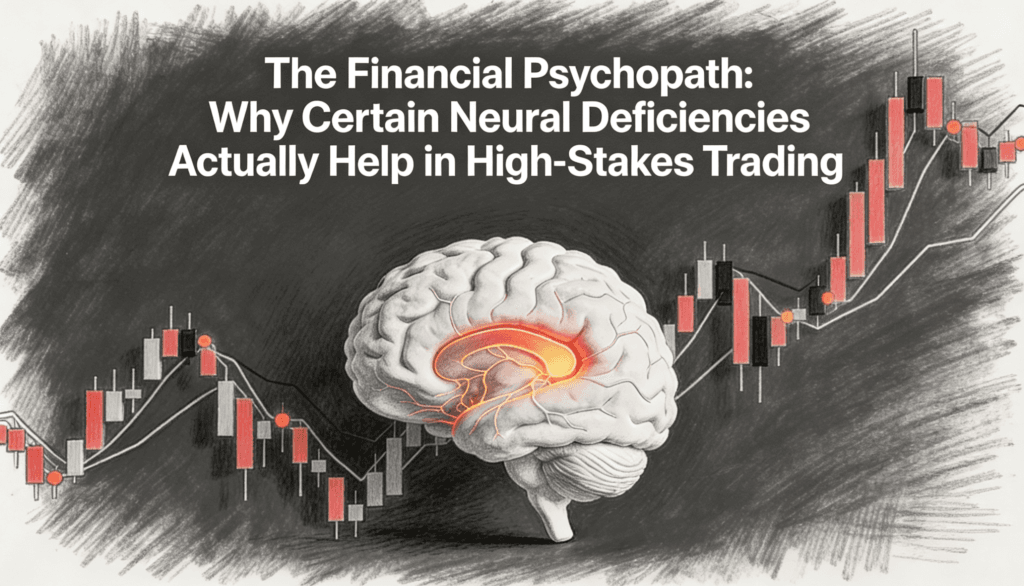
The researchers called them “functional psychopaths.” The term has stuck around longer than anyone expected, probably because it describes something traders have known intuitively for decades. The people who are best at this job are often the ones who are, in a very specific neurological sense, broken.
Why Fear Is Expensive
Let us talk about what fear actually costs in financial markets. Not philosophically. Practically.
When a normal brain encounters a loss, the amygdala fires. This is the same region that activates when you see a snake or hear a loud noise behind you at night. Your body does not distinguish between a predator in the bush and a red number on a screen. The physiological response is the same: cortisol spikes, heart rate increases, decision making narrows to fight or flight.
This is spectacularly unhelpful when you are managing a portfolio.
Fight or flight evolved to keep us alive in environments where threats were physical and immediate. A lion is chasing you. You run. Problem solved. But markets do not work like lions. Markets are probabilistic. The correct response to a drawdown is almost never to run. It is usually to sit still, or sometimes to add to your position. But your amygdala does not know that. Your amygdala thinks the red number is a lion.
So fear, in the context of trading, acts as a tax. Every time it forces a premature exit, a skipped opportunity, or a panic sell at the bottom, it extracts value. Over a career, this tax compounds. The cumulative cost of emotional interference in investment decisions is not small. It is enormous.
The traders who do not pay this tax have a structural advantage. Not because they are smarter. Because they are, neurologically speaking, less equipped to be afraid.
The Empathy Problem
Now here is where it gets morally uncomfortable, which means it is where it gets interesting.
Psychopathy, in the clinical sense, is not just about fearlessness. It is also about reduced empathy. And reduced empathy, it turns out, has its own perverse utility in financial markets.
Consider what happens during a market crisis. Prices collapse because people are selling. People are selling because they are scared. They are scared because other people are scared. Fear in markets is contagious. It spreads through trading floors, through group chats, through the panicked tone in a CNBC anchor’s voice. Empathy is the mechanism of transmission. If you can feel what other people feel, you catch their fear.
The trader who cannot feel what others feel is immune to the contagion. He does not absorb the panic. He watches it, studies it, and trades against it. This is not courage in the traditional sense. Courage requires feeling fear and acting anyway. This is something different. This is the absence of the feeling entirely.
There is an almost perfect parallel in epidemiology. During a viral outbreak, the people who are naturally immune do not need to be brave. They do not need to overcome anything. They simply cannot catch the disease. The psychopathic trader is immunocompromised in one sense but immune in another. He cannot catch the emotional virus that destroys portfolios.
The Checklist of Useful Dysfunction
Clinical psychopathy is measured on the PCL-R, a diagnostic tool developed by Robert Hare. It assesses about twenty traits. Here is the uncomfortable truth: a surprising number of those traits map directly onto what we would consider ideal trader characteristics.
Superficial charm. Useful for client management and raising capital. Grandiose sense of self worth. Necessary for the conviction to hold a position when the entire market disagrees with you. Lack of remorse. Essential for cutting losses without spiraling into self punishment. Shallow affect. Helpful for maintaining clarity during volatility. Failure to accept responsibility. Actually counterproductive, but the rest of the list more than compensates.
This is not to say that psychopaths make good human beings. They generally do not. But the question is not whether they are good. The question is whether specific cognitive deficiencies produce an advantage in a specific domain. And the evidence suggests yes.
It is similar to how certain genetic mutations that cause problems in everyday life become advantages in extreme environments. Sickle cell trait is harmful in general but protective against malaria. Psychopathic traits are harmful in relationships, in friendships, in the fabric of a decent society. But in the very specific arena of financial risk taking under pressure, some of those same traits become structural advantages.
The Meditation Shortcut
Here is the part that should make you think.
The entire mindfulness and meditation industry, which generates billions of dollars annually, is essentially trying to teach normal people to temporarily simulate what psychopaths do naturally. Stay present. Do not react emotionally. Observe your thoughts without attachment. Let go of outcomes.
Every meditation app on your phone is trying to get you to a state that certain neurologically atypical individuals reach by default. The psychopath does not need to meditate for twenty minutes to detach from a losing trade. He is detached already. He was born detached.
This is not an argument against meditation. It works, and the research supports it. But there is a deep irony in the fact that the highest aspiration of contemplative practice, the total non attachment to outcomes, is the baseline neurological state of someone most people would consider disordered.
The monks and the psychopaths arrive at the same destination. They just take very different roads.
The Ceiling Problem
Before anyone rushes to romanticize the cold blooded trader, there is a ceiling to this advantage. And the ceiling is important.
Psychopathic traits help with execution. They help with pulling the trigger, managing risk mechanically, and surviving drawdowns without emotional collapse. But trading is not only execution. It is also pattern recognition, relationship building, team management, and the ability to update your beliefs when you are wrong.
The same emotional flatness that protects a trader during a crash can prevent him from reading the room during a shift in market regime. The inability to feel what others feel is useful during a panic but catastrophic when the market is being driven by a narrative you need to understand emotionally to trade correctly. Memes, sentiment shifts, speculative manias. These are emotional phenomena. The trader who cannot access emotion cannot fully model them.
This is why the most dangerous traders are not the pure psychopaths. They are the ones who have enough emotional capacity to understand sentiment but enough detachment to not be captured by it. They can read the room and still disagree with it. They feel the fear and file it under “useful information” rather than “reason to act.”
This hybrid profile is rare. And it is probably not something you can train. You either have the wiring or you do not.
What This Means for the Rest of Us
Most people reading this are not psychopaths. Statistically, about one percent of the general population qualifies clinically, though the percentage is significantly higher in finance, law, and surgery. So what does any of this mean for the other ninety nine percent?
It means you should be honest about what you are competing against. When you panic sell at the bottom, you are not just competing against algorithms and institutions. You are competing against people whose brains literally cannot generate the panic you are feeling. That is the playing field.
It also means that the self help advice to “control your emotions” while trading misses the point. You are not failing to control your emotions because you lack discipline. You are failing because your brain is functioning correctly. The amygdala response is not a bug. It is a feature of healthy neurology. You are fighting millions of years of evolution every time you try to hold a position through a drawdown.
The practical takeaway is not to try to become a psychopath. It is to build systems that compensate for what your brain will inevitably do. Automated stop losses. Pre committed position sizes. Written trading plans created when you are calm that you follow when you are not. Rules that execute the strategy so your emotions do not have to.
You cannot rewire your amygdala. But you can build a cage around it.
The Uncomfortable Conclusion
Finance likes to tell stories about genius. The brilliant call. The visionary trade. The contrarian who saw what no one else could see. But much of what gets labeled as genius in markets might be better described as deficit. Not superior cognition but absent emotion. Not bravery but inability to feel fear. Not conviction but incapacity for doubt.
This does not make it less effective. It makes it less heroic. And that distinction matters because it changes how the rest of us should approach markets. We should stop trying to emulate the emotional profile of people who are neurologically exceptional and start building frameworks that acknowledge our own very normal, very inconvenient, very human brains.
The psychopath does not need a framework. He does not need a checklist or a breathing exercise or a rule about never checking his portfolio after lunch. He just is. And in the narrow, strange, morally neutral arena of high stakes trading, what he is happens to work.
The rest of us need to find another way. Preferably one that lets us sleep at night.