Table of Contents
You can walk into any country on earth, speak none of the language, understand nothing about the local customs, offend every cultural norm within the first five minutes, and still buy a coffee. Think about that. There is no prayer, no greeting, no handshake, no shared story that works as universally as handing someone money. Not one.
We have spent centuries arguing about what money is. Economists call it a medium of exchange, a unit of account, a store of value. These are fine definitions the same way saying water is two hydrogen atoms and one oxygen atom is a fine definition. Technically correct. Completely missing the point of what it feels like to be thirsty.
Money is not an economic instrument that accidentally took on religious qualities. It is a religious instrument that happens to do economic work.
The Church You Already Belong To
Every religion requires the same basic infrastructure. It needs a creation myth, a priestly class, sacred rituals, moral frameworks, and above all, shared belief. Not shared proof. Shared belief. The entire system runs on faith.
Now look at money.
The creation myth is straightforward. Central banks create currency from nothing. Not from gold, not from labor, not from anything you can touch. From authority. From the institutional equivalent of saying “let there be light.” The Federal Reserve does not dig money out of the ground. It speaks money into existence. If that is not a creation myth, nothing is.
The priestly class writes monetary policy. They meet behind closed doors, interpret sacred texts (inflation reports, employment data, yield curves), and then issue proclamations that move markets. The average person does not understand what quantitative easing actually means. They do not need to. They just need to trust that the priests know what they are doing. This is not meaningfully different from trusting that a cleric has correctly interpreted scripture.
The rituals are everywhere. Tax filing. Invoice processing. The daily checking of stock portfolios. The compulsive glance at your bank balance. These are not purely practical behaviors. They carry emotional and psychological weight far beyond their functional purpose. People feel guilty about debt the same way they feel guilty about sin. That is not a coincidence.
The Consensus Hallucination
Here is the part that makes people uncomfortable. Money works because we all agree it works. That is it. There is no deeper floor beneath that agreement. A hundred dollar bill has roughly four cents worth of material in it. The rest of its value is pure social consensus.
This is not a flaw in the system. This is the system.
Every few years, someone points this out as if they have discovered a scandal. They have not. They have discovered the operating principle of every shared human institution. Language works because we agree on what words mean. Laws work because we collectively pretend that a piece of paper signed by certain people in a certain building creates obligations that did not exist before. Marriage works because two people and a community decide it does.
Money is just the version of this trick that scaled globally.
What makes it remarkable is not that it is a collective fiction. What makes it remarkable is that it is the last collective fiction that almost everyone on the planet still buys into. Traditional religions are fragmenting. National identities are weakening. Political ideologies inspire less loyalty than they used to. But money? Money keeps adding believers.
The Conversion No One Remembers
You were converted to this religion before you could speak. No one asked your consent. No one handed you a pamphlet. You simply grew up inside a world where everything had a price, and by the time you were old enough to question it, the questioning itself felt absurd. Of course things have prices. Of course your time converts into currency. Of course your worth can be, at least partially, measured in numbers on a screen.
This is what makes money the most successful religion in human history. It does not need to evangelize. The environment itself is the sermon.
Consider how deeply the conversion runs. When someone asks “what do you do,” they are not really asking about your daily activities. They are asking where you sit in the economic hierarchy. Your answer is a confession of financial identity. When someone says they “cannot afford” something, they are often not stating a mathematical fact. They are expressing a moral position about what deserves their resources. The language of money is the language of values dressed up as arithmetic.
What Money Actually Ontologically Is
Strip away the economics jargon and you are left with something strange. Money is a technology for making promises between strangers. That is its ontological core. Not metal, not paper, not digits. Promises.
A dollar is a promise that someone, somewhere, will give you something for it later. A salary is a promise that your time was worth a specific amount. A price tag is a promise that this object and this number are somehow equivalent. None of these promises are guaranteed by physics. They are guaranteed by the same thing that guarantees any promise: the network of people who would be harmed if the promise broke.
This is why inflation feels like betrayal. It literally is. When prices rise faster than wages, the fundamental promise of the system (your work converts reliably into stuff) starts to crack. People do not experience this as an abstract macroeconomic adjustment. They experience it the way they would experience a priest caught lying. The fury is not proportional to the financial loss. It is proportional to the breach of faith.
And this explains something that economists have struggled with for decades. Why do people behave “irrationally” about money? Why do they hold losing stocks too long, sell winners too early, pay more for things labeled premium, and treat a dollar found on the street differently from a dollar earned at work?
Because they are not doing math. They are practicing religion. The “irrational” behaviors make perfect sense once you realize that money carries moral and emotional weight that has nothing to do with its numerical value. A dollar is never just a dollar. It is a dollar wrapped in a story about how it arrived, what it means, and what spending it says about who you are.
The Heretics and Their Interesting Problem
Every religion produces heretics, and the money religion is no exception. The most visible ones right now are the cryptocurrency evangelists, which is deeply ironic because they are not rejecting the money religion at all. They are starting a reformation.
The crypto argument is not that shared financial belief is a bad idea. The argument is that the wrong priests are running the church. Decentralize the priesthood, replace trust in institutions with trust in mathematics, and you get a purer form of the same faith. Martin Luther did not want to abolish Christianity. He wanted to cut out the middlemen. The Bitcoin whitepaper reads like a financial version of the 95 Theses if you squint hard enough.
The actual heretics, the people who genuinely try to exit the money religion, are far more rare and far less celebrated. They live in communes, practice radical gift economies, or attempt to build lives entirely outside monetary exchange. And almost all of them eventually come back. Not because their ideas were wrong, but because opting out of the dominant global religion turns out to be roughly as practical as opting out of gravity. You can do it briefly. You cannot do it permanently while remaining part of human civilization.
The Theology of Debt
If money is religion, then debt is its most sophisticated theological concept. Debt is not just owing someone. Debt is a relationship with the future mediated by moral obligation.
The German word for debt, Schuld, is the same word used for guilt. This is not a linguistic accident. For most of human history, the inability to repay debt was treated as a moral failing, not a financial one. Debtors went to prison. In some societies, they became slaves. The logic was not economic. It was theological. You made a sacred promise and broke it. You sinned.
We like to think we have moved past this, but we have not. Student loan discourse is never purely about interest rates and repayment schedules. It is about whether borrowers deserve relief. It is about whether they made a covenant they are morally bound to honor. The heat in these arguments comes from the theological layer, not the financial one. People are not arguing about spreadsheets. They are arguing about salvation.
The Interesting Paradox
Here is where it gets genuinely strange. Money is the most powerful religion on earth, and simultaneously, almost nobody thinks of it as one. This is not a weakness. This is its greatest strength.
The religions that announce themselves as religions can be questioned, doubted, rejected. You can leave a church. You can abandon a political ideology. You can decide that a particular moral framework no longer serves you. But you cannot easily reject something that does not present itself as a belief system in the first place. Money disguises itself as neutral infrastructure, the way air disguises itself as nothing. You do not argue with air. You breathe it.
This is why conversations about money are so often more emotionally charged than conversations about actual religion. When you question someone’s financial choices, you are not questioning a belief they consciously hold. You are questioning a belief so deep it does not feel like a belief at all. It feels like reality. And questioning someone’s reality is far more threatening than questioning their opinions.
So What Do You Do With This?
Recognizing that money functions as religion does not mean you should reject it. You should not try to stop breathing just because someone pointed out that air exists. But there is genuine value in seeing the water you swim in.
When you understand that your relationship with money is partly devotional, you stop being confused by your own behavior. You stop wondering why you feel guilty about spending but also guilty about earning too much. You stop being puzzled by why a raise feels like validation and a pay cut feels like punishment from the universe. These responses are not irrational. They are liturgical.
More practically, it means that every financial decision you make is partly a statement of faith. What you invest in, what you refuse to buy, what you consider “worth it” and what you consider “a waste,” these are not calculations. They are confessions. Your bank statement is, in a very real sense, a document of belief.
The most financially literate people are not the ones who understand compound interest the best. They are the ones who understand that money is never just money. It is identity, morality, social position, personal narrative, and collective myth, all compressed into a number.
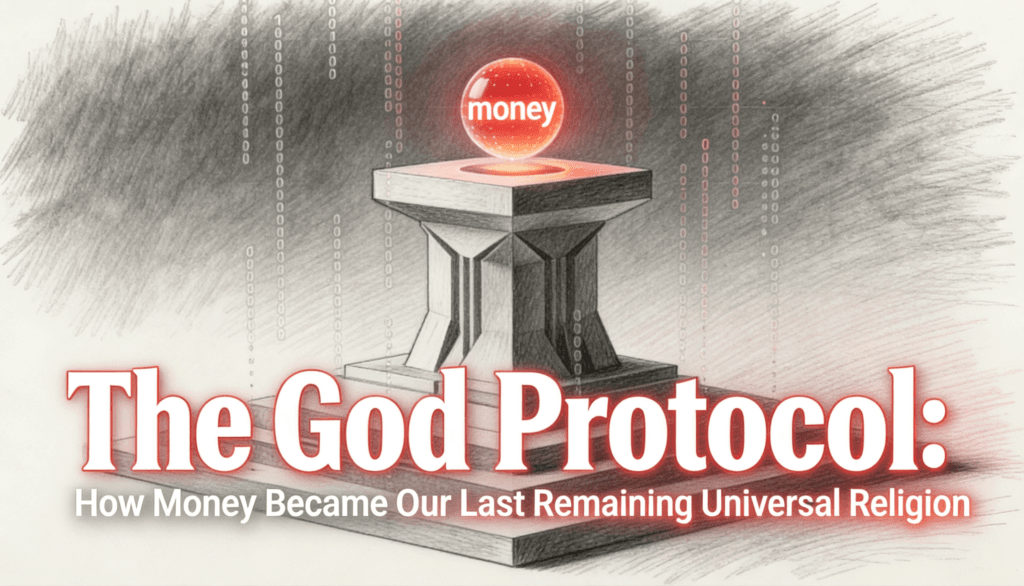
The God Protocol is not some future innovation. It has been running for thousands of years. You have been a faithful participant your entire life.
The only question is whether you want to keep practicing unconsciously or start understanding the religion you already belong to.