Table of Contents
There is a number that floats around American culture like a golden benchmark. One hundred thousand dollars. Say it out loud and it still carries weight. It sounds like you have made it. It sounds like the kind of salary where you stop checking your bank account before buying lunch.
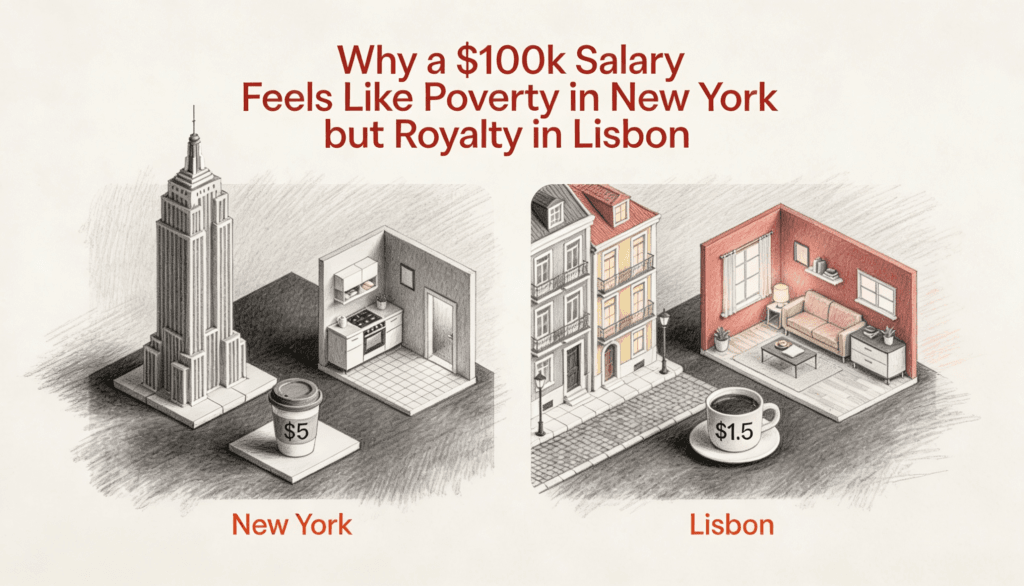
And yet someone earning exactly that in Manhattan is doing mental math at the grocery store, splitting a studio apartment with a friend they barely tolerate, and wondering how everyone else seems to afford brunch. Meanwhile, the same salary in Lisbon gets you a sunlit apartment in Chiado, dinners out four nights a week, and a savings rate that would make a Swiss banker nod approvingly.
Same person. Same work. Same deposit hitting the account on the first of the month. Completely different life.
This is not just a cost of living story. That part is obvious and boring. This is about something deeper. It is about how culture quietly programs what we believe money is for, how much of it we need, and what spending it is supposed to say about us.
The Invisible Architecture of Spending
Every city has an unspoken financial script. A set of assumptions about what a person at your income level should be doing with their money. In New York, that script is relentless. You are expected to keep up. The apartment should look a certain way. The wardrobe should signal competence. The social life requires a budget that would qualify as a small business expense report.
Nobody hands you this script. Nobody sits you down and says “you must spend forty percent of your income performing success for strangers.” It just happens. You absorb it through coworkers, dating apps, Instagram, and the particular shame of pulling out a packed lunch in a Midtown office where everyone else is ordering from Sweetgreen.
Lisbon operates on a different script entirely. Portugal has a cultural relationship with money shaped by centuries of boom and bust, empire and collapse, dictatorship and revolution. The result is a society where financial modesty is not a sign of failure. It is a sign of intelligence. Showing off wealth is not admired the way it is in New York. It is considered slightly embarrassing, like laughing at your own joke.
This difference is not trivial. It is the difference between a city that turns your salary into a treadmill and a city that turns it into a foundation.
The Hedonic Treadmill Has a Zip Code
Psychologists have a concept called hedonic adaptation. It is the tendency for humans to return to a baseline level of happiness regardless of what happens to them. Win the lottery, and within a year you are back to complaining about traffic. This applies to income too. A raise feels extraordinary for about six weeks before it becomes the new normal.
But here is what most discussions of hedonic adaptation miss. The speed of that treadmill is not fixed. It is set by your environment.
In a city like New York, the treadmill runs fast because the goalposts never stop moving. You get a raise and suddenly you notice your apartment is too small. You move to a better one and now your furniture looks cheap. You upgrade the furniture and realize your neighborhood is not quite right. Each improvement reveals a new inadequacy. The city is essentially an engine designed to make you feel almost there but never arrived.
In Lisbon, the treadmill runs slower because the culture does not fetishize constant upgrades. A good apartment is a good apartment. A neighborhood you love does not become inadequate because someone on social media lives somewhere fancier. There is a cultural ceiling on aspiration that Americans might find limiting but that actually functions as a psychological relief valve.
This is not about Lisbon being better. It is about recognizing that your environment is not a neutral backdrop to your financial life. It is an active participant. It is whispering in your ear constantly about what you need, what you deserve, and what you should be ashamed of not having.
What Americans Call Saving, the Portuguese Call Living
There is a fascinating inversion that happens when you compare saving cultures across these two cities. In New York, saving money is a discipline. It requires willpower, budgets, apps, spreadsheets, and the occasional Dave Ramsey podcast consumed like a sermon. Saving is something you do against the current. The city wants your money and you are trying to hold onto it through sheer force of character.
In Lisbon, and across much of Southern Europe, saving is not an act of resistance. It is simply what happens when your culture does not demand that you spend performatively. Dinner at home with friends is not a budget compromise. It is the preferred social format. A used car is not a statement about your net worth. It is a car. The savings happen almost passively because the cultural pressure to spend is so much lower.
This creates a paradox that should bother anyone who reads personal finance advice. Americans consume more financial literacy content than almost any other nationality. They have more budgeting tools, more investment apps, more retirement planning resources. And they still save less, carry more debt, and report more financial stress than people in countries with a fraction of those resources.
Maybe the problem was never a lack of information. Maybe it was always the environment.
The Restaurant Test
Consider something as simple as eating out. In New York, a dinner for two at a mid range restaurant will run you somewhere north of a hundred dollars with tip. This is not fine dining. The meal is fine. The experience is loud. You leave feeling lighter in the wallet and roughly the same in the soul.
In Lisbon, you sit outside at a tasca, order grilled fish that was swimming that morning, drink a bottle of wine that costs less than a cocktail in Brooklyn, and pay a bill that feels like a rounding error. The food is arguably better. The experience is undeniably more relaxed. And you walk away having spent a fraction of what the New York version demanded.
The interesting question is not why Lisbon is cheaper. That is just economics. The interesting question is why New York is so expensive and people still pay without questioning it. The answer is that they are not just buying food. They are buying membership. The restaurant is a venue for social performance. The price is the admission fee to a lifestyle that signals belonging.
In Lisbon, a restaurant is a place where you eat food.
The Status Game and Its Price Tag
Thorstein Veblen wrote about conspicuous consumption over a century ago. He observed that beyond a certain point, spending is not about acquiring useful things. It is about displaying social position. What Veblen understood, and what makes his work eerily relevant today, is that this behavior is not a personal flaw. It is a structural feature of competitive societies.
New York is perhaps the purest expression of Veblen’s theory still operating at full speed. The city runs on visible status markers. Your neighborhood, your gym, your coffee order, your stroller brand if you have kids. Every purchase is a signal, and everyone is reading everyone else’s signals all the time. The cognitive load alone is exhausting, never mind the financial cost.
Portuguese culture does not reward this game in the same way. Status exists, of course. Every society has hierarchies. But the markers are different. Family name, education, who you know, how you carry yourself in conversation. These are harder to buy. You cannot swipe a credit card to acquire social capital in Lisbon the way you can in Manhattan. Which means the pressure to spend your way into respectability is fundamentally lower.
This does not make Portugal a financial paradise. Wages are low, youth unemployment has been a chronic problem, and the housing market in Lisbon itself has been distorted by foreign investment and tourism. But the cultural relationship with money remains distinct in ways that genuinely affect quality of life at comparable income levels.
The Immigrant Paradox
Here is something that rarely gets discussed. Immigrants who move from modest income countries to high income cities often save at extraordinary rates in their first few years. Not because they earn so much, but because they are still running on their home culture’s financial script. They have not yet absorbed the local spending norms. They see a five dollar coffee and genuinely cannot understand who is buying it. Their internal calculator is still calibrated to a different economy and a different set of social expectations.
Over time, this advantage erodes. The longer you live in a consumption heavy culture, the more its script becomes your script. Your standards shift. Your needs expand. What felt like luxury starts feeling like baseline. This is hedonic adaptation again, but the cultural version. And it works in both directions. Move from New York to Lisbon and you might spend the first few months in delighted disbelief at your purchasing power before gradually adjusting to local rhythms.
The lesson here is that your financial behavior is far less personal than you think. You did not independently arrive at your spending habits. They were installed by your environment, reinforced by your social circle, and maintained by a constant stream of cultural signals you barely notice.
What This Actually Means for Your Money
None of this is an argument to move to Lisbon, though you could do worse. It is an argument to become conscious of the script you are running. To ask yourself which of your financial decisions are genuine preferences and which are cultural programming you never agreed to.
Because the most dangerous financial belief is not “I do not earn enough.” It is “this is just what things cost.” That belief makes spending feel inevitable when it is actually optional. It makes lifestyle inflation feel like growing up when it is actually growing sideways.
The person earning a hundred thousand dollars in New York and the person earning the same in Lisbon have identical resources. They do not have identical choices because their environments present different menus. But once you recognize the menu is arbitrary, you can start ordering differently.
You do not have to move continents to do this. You just have to notice the script. Notice when you are spending to solve a problem versus spending to perform a role. Notice when an upgrade is genuine improvement versus environmental peer pressure wearing a convincing disguise.
The gap between poverty and royalty on the same salary is not about exchange rates or rent prices. It is about the stories your city tells you about what your money is for. And the most financially powerful thing you can do is realize that you do not have to believe them.