Table of Contents
There is a quiet war happening in finance, and most investors do not even realize they have already picked a side.
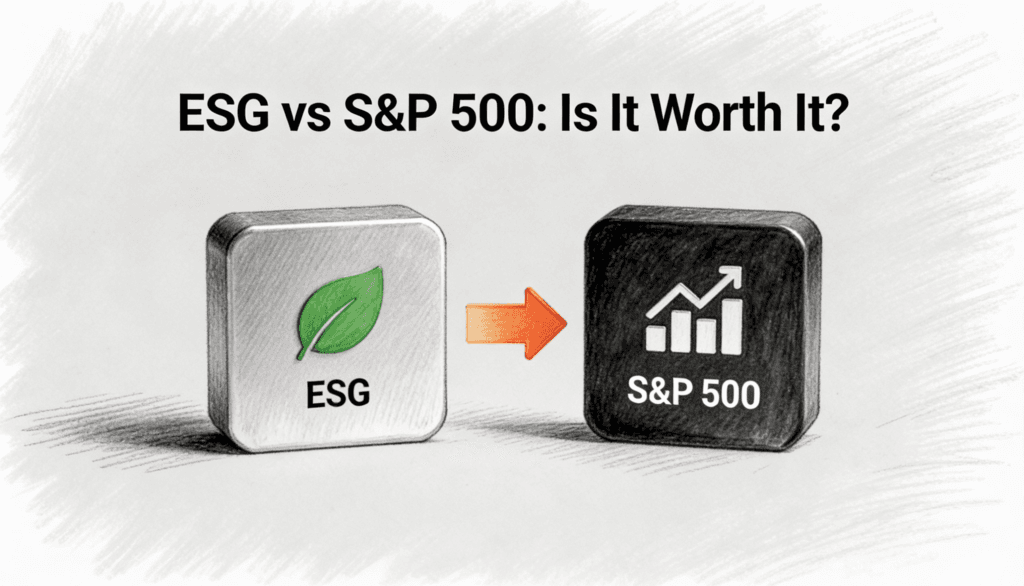
On one end sits the S&P 500, the default choice, the index so dominant that “just buy the index” has become the investing equivalent of “drink water and get some sleep.” On the other end sits ESG investing, the idea that your money should care about something beyond making more of itself. Environmental. Social. Governance. Three letters that promise you can do well by doing good.
But can you?
This is not really a question about returns, even though everyone treats it like one. It is a question about what we believe markets are for, what we think money should do while it sits in an account growing, and whether virtue and profit can share a room without one of them sneaking out the window.
The Default Setting
The S&P 500 does not need much introduction. It is 500 of the largest publicly traded companies in the United States, weighted by market capitalization. It is boring in the way that oxygen is boring. You do not think about it until it is gone.
For decades, the logic has been clean and almost inarguable. Broad diversification. Low fees. Exposure to the engine of American capitalism. The S&P 500 is not a strategy so much as an admission that most strategies fail. It is what you buy when you stop pretending you can outsmart everyone else.
And it has worked. Not every year, not without stomach turning drawdowns, but over long periods it has delivered returns that most active managers would sell their corner offices to match.
So when someone walks up and says “but have you considered an ESG fund instead,” the burden of proof is enormous. You are not just asking investors to try something different. You are asking them to leave the thing that already works.
What ESG Actually Does
ESG funds come in many flavors, but the core idea is filtration. You take the universe of investable companies, run them through screens based on environmental impact, social responsibility, and governance quality, and what comes out the other side is supposedly a cleaner portfolio.
Some funds exclude entire industries. No oil. No tobacco. No weapons manufacturers. Others use a scoring system, keeping companies that rank well on ESG metrics and underweighting those that do not. A few try to actively engage with companies, using shareholder power to push for change from the inside.
The pitch is seductive. You get market returns, maybe even better ones, while simultaneously not funding the things that keep you up at night. Your portfolio becomes a mirror of your values rather than a contradiction of them.
But here is where the story gets interesting, and also where it gets messy.
The Performance Question Nobody Answers Cleanly
Ask whether ESG outperforms the S&P 500 and you will get a different answer depending on who you ask, which time period they cherry pick, and what they had for breakfast.
During certain stretches, ESG funds have kept pace with or even beaten the broader market. This tends to happen when technology stocks are surging, because ESG portfolios are often overweight in tech and underweight in energy. When oil prices crater and software companies soar, ESG looks like genius. When the cycle reverses, as it did when energy stocks roared back, ESG suddenly looks like a principled way to underperform.
The honest answer is that ESG and the S&P 500 are more similar than either side wants to admit. Most ESG funds hold many of the same companies. Apple, Microsoft, and Amazon tend to show up in both. The overlap can be striking, sometimes north of 80 percent. You are paying a slightly higher fee for a portfolio that often looks like the one you already had, just with a few names crossed out.
This is the part that should make thoughtful investors pause. If the portfolios are nearly identical, the performance difference is going to be marginal in either direction. You are not really choosing between two investment philosophies. You are choosing between two nearly identical shopping carts, one of which removed a few items and slapped a different label on the bag.
The Philosophical Layer Nobody Talks About
Here is where it gets more interesting than any return comparison ever could.
ESG investing rests on an assumption that is worth examining carefully: that companies which behave well will eventually be rewarded by the market for their good behavior. That sustainability is not just morally correct but financially smart. That governance quality and environmental responsibility are, in the long run, proxies for better management and lower risk.
This might be true. But it might also be a story we tell ourselves because we want it to be true.
Markets do not have a conscience. They have a price mechanism. And that mechanism is remarkably good at one thing: reflecting what buyers and sellers collectively believe a company is worth right now. Not what it should be worth in a just world. Not what it deserves to be worth. What it is worth given all available information and all prevailing sentiments.
The Greenwashing Problem
This is not a hypothetical concern. It is the central tension of the entire ESG movement.
When a major oil company rebrands itself with a green logo and publishes a glossy sustainability report, is that progress or theater? When a tech giant scores well on ESG metrics while operating factories with questionable labor conditions, does the score mean anything?
ESG ratings themselves are wildly inconsistent. Different rating agencies can look at the same company and arrive at completely different conclusions. One might give a company top marks while another flags it as problematic. Unlike credit ratings, where there is broad agreement on what constitutes creditworthiness, ESG ratings lack a shared definition of what “good” even means.
This is not a flaw that will be fixed with better data. It is a feature of trying to quantify something that resists quantification. Goodness is not a number. Responsibility is not a score. And when you try to make them into one, you create an industry of consultants and rating agencies whose job is to produce the appearance of precision where none exists.
Who Actually Benefits
Here is a question that does not get asked often enough: who captures the value created by the ESG movement?
If ESG funds charge higher fees than plain index funds, and the underlying holdings are largely the same, the primary beneficiary is the fund manager. They collect more revenue for a product that is only marginally different. The investor pays a premium. The companies in the portfolio behave more or less the same whether they are in an ESG fund or not. And the fund company gets to market itself as part of the solution.
This is not to say ESG is a scam. It is not. But it is worth noticing that the financial industry has a long history of taking genuine human concerns, packaging them into products, and selling them back to us at a markup. We saw it with socially responsible investing in the 1990s. We see it now with ESG. The packaging changes. The dynamic does not.
The Case for the S&P 500 Being ESG Enough
Here is a contrarian thought worth sitting with.
The S&P 500 already provides a form of natural selection. Companies that destroy value, mismanage their governance, or fail to adapt to changing consumer preferences eventually shrink or fall out of the index entirely. The index rebalances. The worst performers get replaced. What remains, over time, tends to be companies that figured out how to survive in a world that is slowly demanding more responsibility.
This is not a moral argument. It is a mechanical one. The market cap weighting of the S&P 500 means your money automatically flows toward companies that are growing and away from companies that are shrinking. If the world truly punishes bad actors, and there is some evidence it does, the index handles this on its own without anyone needing to apply a filter.
It is slower. It is messier. It lacks the satisfying clarity of saying “I do not own oil stocks.” But it might be more honest about how change actually happens: gradually, unevenly, and driven more by consumer behavior and regulation than by portfolio construction.
So Is It Worth It?
The answer depends entirely on what you mean by “worth it.”
If you mean financially, the evidence is inconclusive. ESG will not make you rich and will not make you poor. It will probably deliver returns that are close to the S&P 500, minus a small fee differential, with slightly different sector exposures that will help you in some years and hurt you in others.
If you mean psychologically, that is a different calculation entirely. There is real value in not dreading the contents of your own portfolio. If excluding certain industries helps you sleep at night and stay invested during downturns, that behavioral benefit might be worth more than any fee difference. The best investment strategy, after all, is the one you actually stick with.
If you mean morally, then the question becomes whether owning shares of a company makes you responsible for its behavior. This is a debate philosophy has not settled and finance certainly will not. But it is worth noting that selling your shares does not make a company change. It just means someone else now owns them. Divestment is a statement. It is not, by itself, a mechanism of change.
The Real Answer
The uncomfortable truth is that the ESG versus S&P 500 debate generates far more heat than it deserves. The differences are smaller than the marketing suggests. The certainty on both sides is louder than the evidence supports. And the real factors that determine your investment success, your savings rate, your time horizon, your ability to not panic during a crash, have almost nothing to do with whether your fund has three extra letters in its name.
If ESG investing aligns with how you see the world and you understand you are paying slightly more for a portfolio that is only slightly different, go ahead. There is nothing wrong with that choice.
If you would rather buy the broad index, keep your costs low, and express your values through how you spend, vote, and live rather than how you invest, that is equally valid.
The trap is believing that either choice is dramatically more virtuous or more profitable than the other. It is not. And the energy spent debating it might be better directed at the things that actually move the needle: earning more, spending less, investing consistently, and letting time do the heavy lifting.
In the end, the market does not care about your intentions. It only knows your actions. And the most important action any investor can take is also the least glamorous one.
Just keep showing up.