Table of Contents
We love to talk about destinations. Set your goals. Pick your number. Decide what you want and reverse engineer the path. The entire financial planning industry is built on this assumption: that the endpoint is what matters, and the route is just a detail.
But what if the route is the whole story?
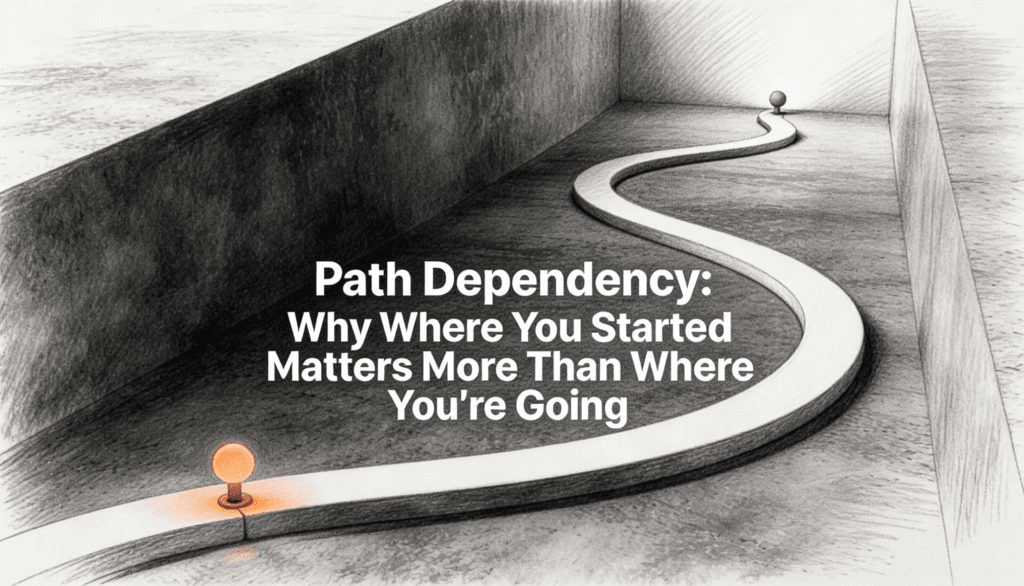
Path dependency is the idea that outcomes are not just shaped by decisions, but by the order in which things happen. The same set of events, rearranged, produces a completely different result. This is not a minor footnote in the theory of risk. It is possibly the most underappreciated force in investing, and in life.
The Coin Flip That Ruins Everything
Imagine two investors. Both earn an average return of 7% per year over 30 years. On paper, they are twins. In reality, one retires comfortably and the other runs out of money. The difference is not skill, strategy, or even luck in the total sense. It is when the luck showed up.
The first investor got terrible returns early, while still adding money, buying cheap shares by the truckload. The bad years were a gift in disguise. The second investor got those same terrible returns late, while withdrawing money, selling shares at the worst possible time. Same average. Wildly different lives.
This is path dependency in its purest form. The final number on a spreadsheet tells you almost nothing if you do not know the sequence that produced it. Averages are a lie we tell ourselves to sleep better at night.
Why Order Creates Meaning
There is a reason this concept feels unintuitive. We are trained to think in terms of totals and averages. School teaches us to add things up, divide by the count, and call it understanding. But reality does not average out. Reality compounds. And compounding is violently sensitive to sequence.
Think about it outside of finance for a moment. A career is path dependent. Getting fired at 25 is a learning experience. Getting fired at 55 is a crisis. The event is identical. The position in the sequence changes everything.
Relationships work the same way. Trust built slowly and broken once is not the same as trust broken early and rebuilt slowly. The math of human connection does not care about averages either. It cares about when things happened and in what order.
Survivorship Bias Wears a Path Dependent Costume
Here is where things get uncomfortable. Most of the investing success stories we admire are deeply path dependent, and their protagonists rarely acknowledge it.
Warren Buffett started investing at 11. He was born in the United States. He came of age during a period of extraordinary economic expansion. He had access to mentors most people could not dream of meeting. None of this diminishes his skill, which is immense. But rearrange the sequence. Place the same mind in a different country, a different decade, a different starting position. The outcome changes. Maybe dramatically.
We do not like hearing this because it threatens the narrative of pure meritocracy. Skill matters. Of course it does. But skill operates within a sequence of events it did not choose, and that sequence quietly shapes the ceiling and floor of what skill can achieve.
This is not an argument for fatalism. It is an argument for humility.
The Startup Analogy
Silicon Valley accidentally discovered path dependency and called it something else: timing.
The same product launched two years earlier fails because the market is not ready. Launched two years later and the market is already saturated. The product did not change. The sequence did.
Resistance to this idea is strong in entrepreneurial culture because it undermines the founding myth. We want to believe that great products win regardless. But Friendster had the concept before Facebook. Yahoo had search before Google. Being right is necessary. Being right at the right point in the sequence is what actually pays.
Investors in startups understand this instinctively even if they would never use the term path dependency. They talk about market timing, readiness, and macro tailwinds. These are all just ways of saying that where you enter the sequence determines whether genius looks like genius or looks like a cautionary tale.
Risk Is Not a Number
Modern finance loves to quantify risk. Standard deviation. Value at risk. Beta. Sharpe ratios. These tools are useful but they share a common blind spot: they treat risk as a property of the asset rather than a property of the journey.
A volatile stock is not inherently risky. It is risky for someone in a particular position, at a particular point in their financial life, with a particular sequence of needs ahead of them. Risk is relational. It exists in the interaction between an asset and a life unfolding in real time.
This is why two people can hold the exact same portfolio and face completely different levels of actual risk. One is 30 with a stable income and decades of contributions ahead. The other is 65 with a pension shortfall and medical bills arriving on schedule. The portfolio is identical. The risk is not even in the same universe.
The Irreversibility Problem
Path dependency matters most when decisions are irreversible. And in investing, more decisions are irreversible than we like to admit.
Selling a position during a crash to meet expenses is irreversible. That capital is gone. The recovery happens without you. Taking on leverage at the wrong point in a cycle is irreversible in the sense that the margin call does not care about your long term thesis. Delaying investment by a decade because you were paying off debt is irreversible. You do not get those compounding years back.
Reversible mistakes are just lessons. Irreversible mistakes are path alterations. They do not just set you back. They put you on a different path entirely, with a different set of available futures.
So What Do You Actually Do?
If path dependency is real and powerful, which it is, then the standard advice of just pick good investments and hold them is incomplete. It is not wrong exactly. But it ignores the dimension that matters most.
A few things follow logically.
First, buffers matter more than returns. Having cash reserves, flexible spending, or alternative income sources does not show up in a backtest, but it changes your path. It means you do not have to sell at the worst time. It means a bad sequence of returns is painful rather than catastrophic. The boring stuff, the emergency fund, the conservative allocation in early retirement, is actually the most path aware strategy available.
Second, flexibility is the best hedge against sequence risk. The ability to adjust spending, delay retirement by a year, take on part time work, or shift asset allocation in response to early returns is enormously valuable. It is the opposite of a rigid plan. Rigid plans assume a predictable sequence. Flexible plans assume the sequence is unknowable, which it is.
Third, humility about forecasting is not weakness. It is the only rational response to a path dependent world. You cannot predict the order in which returns will arrive. You cannot know whether the next decade will be the one that makes or breaks your plan. Acknowledging it, is engineering.
The Deeper Point
Path dependency challenges one of the most comforting assumptions in finance: that time heals all wounds. Given enough time, the thinking goes, returns revert to the mean, markets recover, and patience is always rewarded.
But patience is a luxury that depends on your position in the sequence. The person who needs money now cannot afford to wait for the mean to revert. Time heals wounds only if you are still standing when the healing begins.
This is ultimately a philosophical point as much as a financial one. We are not abstract agents optimizing across infinite timelines. We are specific people, in specific positions, facing specific sequences of events we did not choose and cannot predict. The path is not a detail of the journey. The path is the journey.
Where you are going matters. But where you started, and what happened along the way, and in what order, matters more than almost anyone wants to admit.
The destination is a fantasy until the path makes it real. And the path, unlike the destination, is the part you actually have to live through.