Table of Contents
There is a moment in every investor’s life when the textbook stops making sense. For an entire generation, that moment arrived in September 2008.
Before the crisis, most people who put money into markets operated under a fairly simple assumption: the system works. Banks lend, businesses grow, stocks go up over time, and if something breaks, smart people in suits will fix it before dinner. The 2008 financial crisis did not just prove that assumption wrong. It proved something far more unsettling. The smart people in suits were the ones who broke it.
What followed was not merely a financial event. It was a psychological one. And the aftershocks are still shaping how people think about money, risk, and trust almost two decades later.
The World Before the Crack
To understand what changed, you have to understand what people believed before it all fell apart.
The pre-2008 investor lived in a world of comfortable logic. Diversification protected you. Credit ratings meant something. Real estate was the safest long term bet you could make. And the largest financial institutions in the world were, by definition, stable. They had to be. They were too important not to be.
This was not naive thinking. It was the consensus view of Nobel Prize winning economists, central bankers, and regulatory agencies. The efficient market hypothesis was not just an academic theory. It was a cultural attitude. Markets were rational. Prices reflected reality. And if you just stayed the course, time would reward you.
Then Lehman Brothers filed for bankruptcy, and the course disappeared.
The Moment Psychology Broke
The collapse of Lehman Brothers in September 2008 was not the beginning of the crisis. The rot had been building for years in the subprime mortgage market, in the exotic financial instruments that sliced and repackaged bad debt until nobody could tell what anything was actually worth. But Lehman was the moment when abstraction became terror.
Here was the fourth largest investment bank in the United States, a 158 year old institution, and it was simply gone. Not restructured. Not rescued. Gone.
The message was clear, even if nobody wanted to hear it: if Lehman could fail, anything could fail.
What happened next was something economists still struggle to model. It was not a rational repricing of assets. It was a collective nervous breakdown. The stock market did not just decline. It convulsed. Credit markets froze entirely. Banks stopped lending to each other, which is a bit like hospitals refusing to share blood supplies during a plague. The system that was supposed to be too sophisticated to collapse turned out to be too interconnected to survive a single point of failure.
And investors watched it all happen in real time, on screens, on cable news, in the value of their retirement accounts.
The Bailout Paradox
Then came the part that really rewired people’s brains.
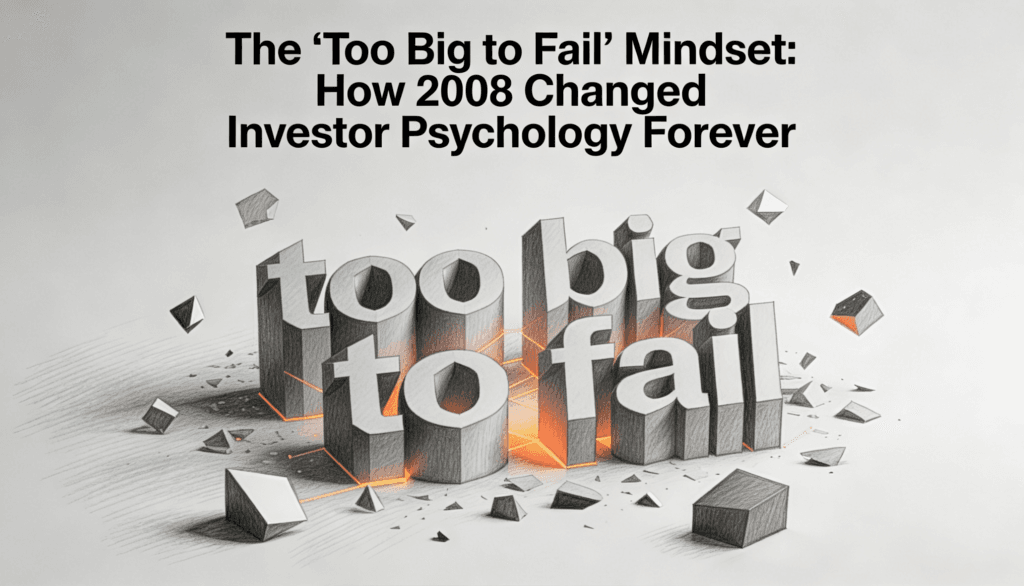
The government stepped in. It rescued AIG. It injected capital into the major banks. It created programs with acronyms nobody could remember to buy toxic assets that nobody could value. The message, delivered with varying degrees of panic by Treasury secretaries and Federal Reserve chairs, was this: these institutions are too big to fail. Letting them collapse would destroy the economy. So we will save them.
And it worked. In the narrowest sense, the bailouts prevented a complete systemic meltdown. The financial system survived.
But the psychological cost was enormous, and it is a cost we are still paying.
The bailouts created a paradox that sits at the heart of modern investor psychology. On one hand, they proved that the system was fragile enough to need saving. On the other hand, they proved that it would be saved. And those two truths pull investors in completely opposite directions.
If the system is fragile, you should be cautious. If the system will always be rescued, you should be aggressive. Both conclusions are logical. Both are supported by evidence. And trying to hold them in your head at the same time is enough to make anyone a little irrational.
The Birth of Moral Hazard as a Feeling
Economists have a term for what happens when someone is protected from the consequences of their own risk taking. They call it moral hazard. Before 2008, this was a concept you encountered in insurance textbooks. After 2008, it became something people felt in their stomachs.
The bailouts taught a lesson that no amount of regulatory reform has been able to unteach. The lesson is this: if you are large enough and connected enough, the rules are different for you. Risk is not really risk if someone else absorbs the downside.
This is not a cynical interpretation. It is a description of what actually happened. The banks that took the most reckless bets were the ones that received the most public money. Their executives, with a few exceptions, kept their jobs and their fortunes. Meanwhile, millions of ordinary people lost their homes.
The psychological impact of watching this unfold was profound. It created a split in investor behavior that persists to this day. One group concluded that the game was rigged and withdrew from markets entirely, or moved into alternative assets like gold and later cryptocurrency, seeking shelter from a system they no longer trusted. The other group concluded that the game was rigged in a way they could exploit. If the government would always backstop the biggest players, then the rational move was to ride alongside those players and trust that the safety net would hold.
Both groups were responding to the same event. Both were being perfectly logical. And both were making decisions driven more by psychology than by analysis.
The Fed Put and the New Religion
Out of the ashes of 2008 arose a concept that has arguably done more to shape modern investing than any balance sheet or earnings report. Traders call it the Fed Put.
The idea is simple. The Federal Reserve, having demonstrated its willingness to intervene aggressively during the crisis, has effectively placed a floor under asset prices. If markets fall far enough, the Fed will cut rates, buy bonds, inject liquidity, do whatever it takes to stop the bleeding. This is not a formal policy. Nobody at the Federal Reserve has ever promised to do this. But investors believe it. And in markets, belief is its own kind of reality.
The Fed Put has turned central banking into something resembling a secular faith. Investors do not just analyze economic data anymore. They parse every word of every Federal Reserve statement like theologians studying scripture, looking for signs of dovishness or hawkishness, mercy or judgment.
This is a genuinely strange development if you step back and think about it. The entire edifice of modern capitalism is supposed to rest on free markets and price discovery. Instead, a significant portion of investment decision making now rests on trying to guess what a small committee of appointed officials will do next.
The Trauma Response Portfolio
One of the most interesting and least discussed consequences of 2008 is how it changed the emotional relationship people have with their own money.
Before the crisis, investing was something most people could treat as background noise. You set up your 401k, chose a target date fund, and checked it once a quarter. The assumption was that the long term trend was your friend, and that short term volatility was just weather.
After 2008, volatility stopped feeling like weather. It started feeling like a warning.
There is a concept in psychology called hypervigilance. It describes a state of heightened alertness that often follows a traumatic experience. The person who lived through a house fire checks the stove five times before leaving. The investor who lived through 2008 checks their portfolio every time a headline mentions the word recession.
The Irony of Safety
Perhaps the deepest irony of the too big to fail mindset is what it has done to the concept of safety itself.
Before 2008, safety in investing meant government bonds, blue chip stocks, and savings accounts. These were boring, reliable, and universally recommended. After 2008, a funny thing happened. The institutions that were supposed to be safe turned out to be the most dangerous. And the assets that were supposed to be risky, like buying stocks at the bottom of a panic, turned out to be the opportunity of a lifetime.
The S&P 500 bottomed in March 2009. Anyone who bought at that moment and simply held on would have seen their investment grow more than fivefold over the next decade. But almost nobody did, because almost nobody felt safe enough to try.
This is the cruel arithmetic of crisis investing. The best time to buy is always the moment when buying feels most insane. And the people best positioned to act on that insight are almost never the ones who lived through the trauma. They are the ones who watched it from a distance, with enough emotional detachment to see opportunity where others saw only danger.
What We Carry Forward
Nearly two decades later, the 2008 crisis continues to function as a kind of psychological operating system for investors. It runs in the background, shaping decisions in ways people do not always recognize.
It shows up in the popularity of passive investing, which is partly a strategy and partly an admission that nobody really knows what anything is worth. It shows up in the obsession with central bank policy, which reflects a deep seated belief that markets are no longer self correcting. It shows up in the appeal of alternative assets, from Bitcoin to farmland, which speaks to a desire to own something that exists outside the traditional financial architecture.
And it shows up in a fundamental ambivalence about the system itself. Most investors today operate with a kind of double consciousness. They participate in markets because they feel they have no better option. But they do not fully trust those markets, and they suspect that the next crisis is not a question of if but when.
This is not necessarily unhealthy. A certain amount of skepticism is appropriate when dealing with a system that nearly destroyed itself within living memory. The problem is that skepticism, left unchecked, becomes its own form of bias. The investor who is always bracing for the next 2008 will miss the opportunities that arise in the meantime. And the investor who assumes the government will always step in will take risks that no safety net can cover.
The real lesson of 2008 is not that the system is broken or that it is safe. The real lesson is that it is both, simultaneously, and that navigating that contradiction is the actual work of investing. Nobody said it would be comfortable. But then again, nobody who lived through September 2008 expected comfort from markets ever again.