Table of Contents
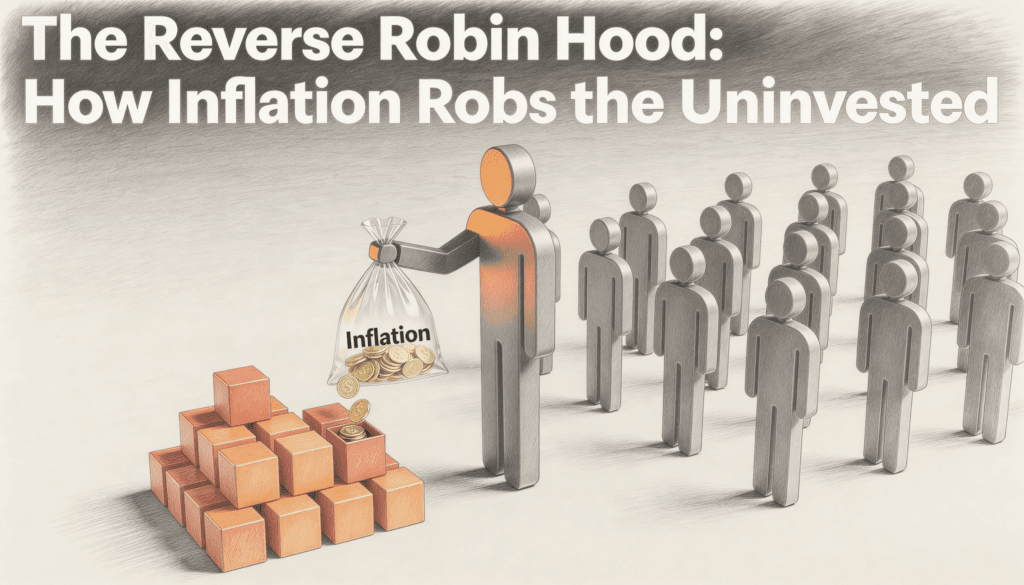
There is a quiet heist happening in every economy on the planet. No one wears a mask. No one breaks a window. The victim does not even realize they have been robbed until years later, when they try to buy something and discover their money has lost its purchasing power. The thief is inflation. And unlike the folklore hero who stole from the rich to give to the poor, inflation does the exact opposite. It takes from those who hold cash and hands the spoils to those who hold assets.
This is not a glitch in the system. It is the system.
The Savings Trap
We grow up hearing the same advice. Save your money. Put it away for a rainy day. Be responsible. And there is nothing wrong with the spirit of that message. Discipline matters. But the advice contains a fatal omission. It never mentions that saving alone is a losing strategy.
A dollar saved in 2004 buys roughly sixty cents worth of goods today. The person who followed the rules, who clipped coupons and avoided debt and deposited money faithfully into a savings account, watched their purchasing power evaporate in slow motion. Meanwhile, the person who bought a modest index fund with that same dollar 10x-ed their money. Same starting point. Same dollar. Wildly different outcomes.
The uncomfortable truth is that saving without investing is like filling a bathtub with the drain open. You can keep the faucet running, but the water level never rises the way you expect.
Who Gets Punished
Inflation does not hit everyone equally. This is the part that turns a monetary phenomenon into a sociological one.
People with assets, such as real estate, stocks, or businesses, tend to see the value of those assets rise alongside inflation. Often faster than inflation. Their wealth is not sitting still. It is riding the same wave that erodes everyone else.
People without assets, those who keep their wealth in a checking account or under a mattress, absorb the full force of rising prices with no hedge, no buffer, and no upside. They are standing on the beach while the tide comes in. The water does not care whether they know how to swim.
This creates a dynamic that most people do not talk about in polite company. Inflation functions as a wealth transfer mechanism. Not by design, exactly. But certainly by outcome. The rich get richer not because of some conspiracy, but because their money is parked in vehicles that benefit from the same forces that punish cash holders. It is structural, not personal. Which somehow makes it worse.
The Invisible Tax
Governments do not call inflation a tax. That would be politically inconvenient. But it behaves like one. When new money enters the system and prices rise, the people holding old money lose value. They did not agree to this. No one voted on it. There was no ballot measure that said: “Shall we reduce the purchasing power of your savings by three percent this year?”
And yet it happens. Reliably. Year after year.
What makes this particularly interesting from a sociological lens is who bears the burden. Traditional taxes, whatever their flaws, at least attempt some progressive structure. Higher earners pay higher rates, in theory. Inflation does not bother with such formalities. It is perfectly regressive. The person earning minimum wage and the billionaire both face the same rising grocery prices. But the billionaire barely notices, because groceries represent a microscopic fraction of their wealth. For the minimum wage worker, groceries might represent a quarter of their income.
The irony is sharp. The mechanism that is supposed to signal a healthy, growing economy quietly punishes the people who can least afford to be punished.
Financial Literacy as Class Divider
Here is where it gets sociologically rich. The knowledge gap around investing is not random. It follows class lines with eerie precision.
Children in wealthy households grow up hearing dinner table conversations about portfolios, returns, and market cycles. They absorb financial fluency the same way they absorb table manners. It is ambient. Effortless. They do not even realize they are learning something that other people will never be taught.
Children in lower income households hear different conversations. They hear about bills. About making rent. About what happens when the car breaks down. These are survival conversations. They are valid and real. But they do not include a module on compound interest.
The result is a population split into two groups. One understands that money must be put to work or it dies slowly. The other believes that keeping money safe means keeping it still. Both groups are acting rationally within their own information environment. But only one group is correct.
This is where inflation becomes more than an economic concept. It becomes a sorting mechanism for social class. Not the only one. But a remarkably efficient one.
Why People Still Do Not Invest
If the math is so clear, why do millions of people still keep their money in cash? This is where sociology matters more than spreadsheets.
First, trust. Financial institutions have not exactly covered themselves in glory. The 2008 crisis showed ordinary people that the system could collapse, that banks could fail, that retirement accounts could be cut in half overnight. Telling someone who watched that happen to “just invest” is a bit like telling someone who survived a plane crash to “just fly more.”
Second, access. For decades, investing required minimum balances, brokerage fees, and relationships with financial advisors who were not interested in managing small accounts. The barriers were real. They have come down significantly in recent years, but the cultural memory of exclusion lingers.
Third, and most importantly, immediacy. When you are living paycheck to paycheck, the idea of locking money away for decades feels absurd. You do not need your money to grow by eight percent annually. You need it next month. For rent.
This is the cruelest dimension of the inflation problem. The people most damaged by it are the least equipped to do anything about it. Not because they are foolish. Because they are trapped.
The Homeownership Illusion and Revelation
Real estate offers a fascinating case study in this dynamic. Homeownership has long been sold as the cornerstone of middle class wealth. And statistically, it has been. But not for the reasons most people think.
The common narrative is that homes are good investments. In reality, the actual appreciation of residential real estate, adjusted for inflation, maintenance, taxes, and insurance, is remarkably modest. What makes homeownership powerful is not the return. It is the forced savings mechanism and the leverage.
When you take a mortgage, you are essentially making a leveraged bet against inflation. You borrow money at a fixed rate. Inflation erodes the real value of your debt. Your payments stay the same while your income (hopefully) rises. The house itself is almost beside the point. The financial magic is in the debt structure.
This is counterintuitive to the point of being uncomfortable. The person who borrows to buy a house is often better positioned against inflation than the person who diligently saves cash to buy one outright. The saver is playing defense against an opponent that never stops scoring.
What This Means for Society
Zoom out far enough and the pattern becomes clear. Inflation, in the absence of widespread investment access and education, is a stratification engine. It does not create inequality from scratch. But it accelerates existing inequality with mechanical reliability.
The wealthy invest. Their assets grow. They use those assets as collateral to borrow cheaply. They invest that borrowed money. The cycle compounds.
The unwealthy save. Their savings shrink in real terms. They pay higher interest rates when they borrow. They use debt for consumption, not investment. A different cycle compounds.
Over one year, the difference is negligible. Over a decade, it is noticeable. Over a generation, it is a canyon. And over multiple generations, it looks less like an economic outcome and more like a caste system with better marketing.
The Way Forward Is Boring
The solutions to this are not glamorous. They never are. Financial education in schools. Lower barriers to investment. Automatic enrollment in retirement plans. Policies that make it easier for people at the bottom to participate in asset ownership.
None of this is revolutionary. None of it makes for exciting political rhetoric. But the alternative is a system that continues to move wealth upward through a mechanism so quiet that most people do not even recognize it as a transfer.
Robin Hood at least had the decency to be obvious about it. He wore the tights. He announced his intentions. Inflation does its work in silence, in decimal points, in the slow erosion of numbers that look the same but buy less. It is the most polite form of theft ever invented.
And the people it hurts most are the ones who thought they were being responsible.