Table of Contents
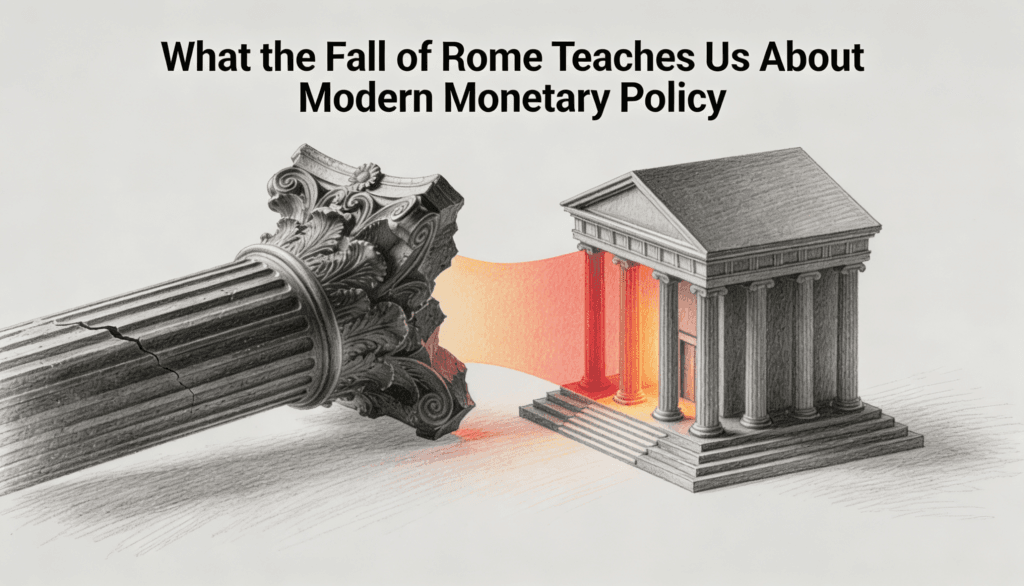
There is a strange comfort in believing that empires fall because of barbarians at the gates. It is dramatic. It is cinematic. It gives us someone to blame, a moment to point at, a date to circle in history books. But the truth about Rome is far less satisfying and far more relevant to anyone holding cash, bonds, or a 401(k) today. Rome did not fall because of swords. It fell, in large part, because of coins. And the men who debased those coins were not villains in horned helmets. They were respected leaders solving what they considered urgent problems, one small compromise at a time.
This is the part of the story that should make a modern investor sit up straight.
The Slow Theft Nobody Noticed
In the early days of the Roman Empire, the silver denarius was a serious piece of money. It contained almost pure silver, it was trusted across the known world, and merchants from Britain to Syria accepted it without hesitation. It functioned the way a good currency is supposed to function, as a quiet promise that the value you earned today would still be there tomorrow.
Then the bills started arriving.
Wars needed soldiers. Soldiers needed pay. The empire kept expanding, which meant more borders, more legions, more bread for the citizens of Rome who had grown accustomed to free grain and free entertainment. Emperors faced a problem every government eventually faces. The expenses were real and immediate. The revenues were limited and politically painful to increase. Raising taxes makes citizens angry. Cutting spending makes them angrier. So Rome found a third path, the path of least resistance, the path that has been walked by every struggling government since.
They quietly reduced the silver content in the coins.
At first it was barely noticeable. A coin that was once almost pure silver became slightly less so. Then less again. By the time of Emperor Gallienus in the third century, the denarius contained almost no silver at all. It was essentially a copper coin with a thin silver wash, the ancient equivalent of a gift card that loses value every time you check the balance. The face of the emperor was still on it. The official value was still declared. But the substance was gone.
Here is the part that is almost funny if it were not so tragic. The Romans themselves did not always understand what was happening. They knew prices were rising. They knew their savings bought less. They blamed merchants for greed. They blamed hoarders. They blamed foreigners. Emperor Diocletian eventually issued the famous Edict on Maximum Prices, threatening death to anyone who charged more than the official rates. Merchants responded by simply not selling. Shelves went empty. The black market flourished. The edict became a monument to the eternal lesson that you cannot legislate away the consequences of bad money.
The barbarians eventually did show up, of course. But by then Rome was already hollow. Its currency had been debased for generations. Its middle class had been quietly impoverished. Its trust in institutions had eroded. The sack of Rome was less an attack and more a confirmation.
The Modern Echo Nobody Wants to Hear
Now let us be careful here. History does not repeat itself with the precision of a clock. The United States is not Rome. The euro is not the denarius. Central bankers are not emperors, and we no longer shave silver off coins because our coins barely have metal worth shaving. The mechanism has changed. The principle has not.
When a central bank creates new money to fund government deficits, when interest rates are held artificially low for years to make borrowing cheap, when balance sheets expand from billions to trillions in response to every crisis, something is happening that would be familiar to any Roman who lived through the third century. The unit of account is being quietly diluted. The promise is being slowly broken. The face on the bill is still the same. The substance is something else.
The difference is that modern debasement is dressed in much better clothing. It comes with academic papers, elegant terminology, and television appearances by men in good suits who speak calmly about transitory pressures and well anchored expectations. The Romans had to physically melt down coins and add base metal. We have spreadsheets. The process is cleaner.
What makes this lens so useful for an investor is that it cuts through the noise. Most financial commentary treats inflation as a weather event, something that arrives mysteriously, hangs around for a while, and eventually departs if you are patient. The Roman lens tells you something different. Inflation is almost never an accident. It is a choice. It is the choice that comes when a government has commitments it cannot fund through honest means and must therefore quietly transfer wealth from savers to itself. It is the most ancient form of taxation, and it is the only tax that has never required a vote.
The Counterintuitive Part
Here is something that surprises people. The Roman debasement did not feel like a crisis while it was happening. For long stretches, it felt like prosperity. Coins were plentiful. The government could pay its soldiers and feed its citizens. New monuments were built. Public spectacles continued. To the average Roman walking through the forum, things seemed fine, or at least not obviously broken.
This is the trap. Currency debasement is not a sudden collapse. It is a long, slow process that often looks like growth from the inside. Asset prices rise. People feel wealthier. Stocks and real estate climb to new highs. The economy hums along on cheap credit. It is only later, sometimes much later, that you realize the rising prices were not signs of prosperity but symptoms of a measuring stick that was shrinking.
This explains one of the strangest experiences of recent decades. Many people work harder, earn more in nominal terms, and somehow feel financially less secure than their parents did on a single income. They are not imagining it. The measuring stick has been changing under their feet. A dollar in 1970 and a dollar today share a name and almost nothing else. The face is the same. The substance is something else.
What Romans Did With Their Money
When trust in the currency began to crumble, Romans behaved in ways that should look familiar. They started hoarding the older, purer coins. They buried them in jars. Archaeologists are still digging these up across Europe, silent monuments to ancient anxieties. They invested in things that held value regardless of what the emperor declared, land, livestock, jewelry, anything tangible that could not be debased by decree.
This was not financial sophistication. It was instinct. The same instinct that today drives people toward gold, toward real estate, toward businesses with pricing power, toward anything that cannot be created out of thin air by a committee. The Roman who buried silver coins and the modern investor who buys productive assets are responding to the same ancient signal. When the unit of account becomes unreliable, you stop counting in it and start owning the things it used to measure.
The cruel irony is that those who trusted the system most were hurt worst. The Romans who held their wealth in coin, who believed the official value on the face, who did what their government told them to do, were the ones who watched their savings dissolve. The cynics, the hoarders, the ones who quietly distrusted the system, preserved their wealth. There is a lesson there that no investment textbook will state quite so bluntly. In an age of currency debasement, faith in official promises is a costly form of optimism.
Why This Matters Right Now
We live in an unusual moment. Government debt levels across developed nations have reached heights that would have seemed impossible a generation ago. Interest payments alone consume increasing portions of national budgets. The political appetite for higher taxes or lower spending appears, charitably, limited.
Faced with this arithmetic, governments have a small number of options. They can grow their way out, which requires productivity gains that have stubbornly refused to materialize. They can default, which is politically and economically catastrophic. Or they can do what Rome did, what every cornered government in history has done, and quietly let the currency do the work that politicians will not.
This is not a prediction of disaster. Empires can debase their currencies for a long time before anything dramatic happens. Rome managed it for centuries. The point is not that collapse is imminent. The point is that the gentle, persistent erosion of purchasing power is not a bug in the system but a feature, and any investor who fails to account for it is essentially holding a denarius and trusting the face value.
The fall of Rome is usually told as a story of military defeat, of decadence, of the moment when the barbarians finally broke through. But the real story is older and quieter. It is the story of a great civilization that lost faith in its own money, one small debasement at a time, until the coin in your hand no longer matched the promise on its face.
There is no thunderclap moment in this kind of decline. There is only the slow accumulation of small choices, each one defensible on its own, each one making the next one easier. The emperors who started the debasement were not trying to destroy Rome. They were trying to save it. They were solving today’s problem with tomorrow’s purchasing power, which is the most human form of accounting and also the most dangerous.
For the modern investor, this is the lesson worth carrying. The greatest financial risk is rarely the one announced in headlines. It is the one that happens so gradually that you barely notice it, the one that comes dressed as normality, the one that erodes value while everyone agrees that things are fine. Rome did not fall in a day. It fell over centuries, one shaved coin at a time.
The face on the currency was always the same.
That was the trick. That has always been the trick.