Table of Contents
There is a particular kind of frustration that belongs only to traders who follow technical indicators religiously. You watch gold climb. The Relative Strength Index flashes 75, then 80, then 85. Every book you have ever read, every YouTube guru you have ever tolerated, every chart course you paid too much for, all of them whispered the same gospel into your ear. Overbought means reversal. Overbought means short. Overbought means the party is ending and the smart money is leaving through the back door.
So you act on it. You short gold. And gold, with the casual indifference of a cat knocking a glass off a table, keeps climbing.
This is not a bug in your understanding. It is a feature of how the gold market actually works, and it reveals something far more interesting than a broken indicator. It reveals that most retail traders are using a map of the wrong country.
The Problem With Oscillators in a Trending World
The RSI was designed by a brilliant engineer named J. Welles Wilder Jr. in the late 1970s. He built it to measure the velocity and magnitude of price changes, and to flag moments when an asset had moved too far too fast in either direction. In theory, beautiful. In practice, also beautiful, but only when applied to markets that behave like rubber bands. Markets that stretch and snap back. Markets that range.
Gold is not always that kind of market. Gold has long memory. Gold trends. And when gold decides to trend, it does so with the persistence of a relative who has decided to tell you about their cruise. The RSI, faithfully doing its job, will scream overbought for weeks. Months even. Traders who short every overbought signal in a bull market for gold are essentially betting against the tide because their bathtub said the water was high.
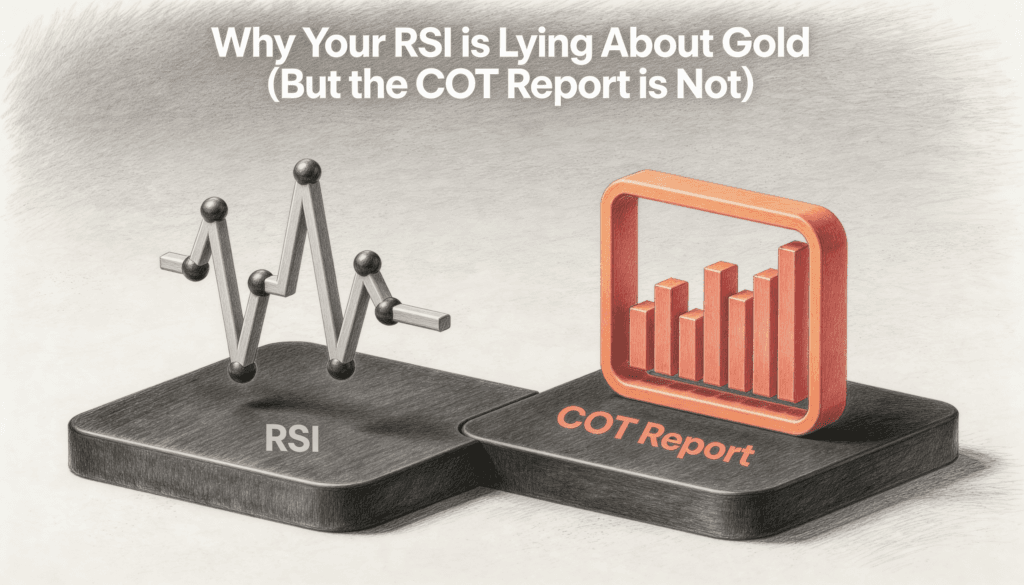
The deeper problem is philosophical. The RSI measures price. It does not measure conviction. It does not measure who is buying and who is selling. It does not know whether the marginal buyer is a hedge fund running a momentum strategy, a central bank quietly accumulating reserves, a jewelry manufacturer hedging next quarter, or a retail trader who just saw a TikTok about inflation. The indicator treats all dollars as equal. The market does not.
Enter the Commitment of Traders Report
Every Friday afternoon, the Commodity Futures Trading Commission publishes something called the Commitment of Traders report. It is unglamorous. It comes out in a format that looks like it was designed during the Carter administration. Most retail traders ignore it because it does not blink, flash, or appear on a chart with pretty colors.
This is a mistake of roughly biblical proportions.
The COT report tells you who is positioned where in the futures market. It breaks participants into categories. Commercials, which are the producers and users of the actual physical commodity. Large speculators, which are mostly hedge funds and managed money. And small speculators, which is the polite institutional term for you and your friends.
Think about what this means. The RSI tells you that price went up a lot. The COT report tells you that the people who actually mine gold are dumping futures contracts onto hedge funds while retail traders pile in late. Or, conversely, that miners are quietly covering their hedges while hedge funds capitulate. These are completely different stories, and only one of them is useful for predicting what happens next.
The Smart Money Paradox
Here is where things get interesting and slightly counterintuitive. The conventional wisdom is that you should follow the smart money. Find out what the institutions are doing and do the same. This sounds reasonable until you look at the gold market and realize that in commodities, the smart money is often wrong at the extremes, and the dumb money is sometimes the dumbest precisely when it feels the smartest.
Commercial hedgers, the people who produce and consume gold, are not actually trying to predict price. They are trying to lock in margins and manage business risk. A gold miner who sells futures at $4,400 an ounce is not making a bet that gold will fall. They are guaranteeing they can pay their workers and keep the lights on. This makes their positioning a brilliant signal precisely because it is unemotional. When commercials are extremely short, it often means prices have run far enough that producers are eagerly locking in current levels. When commercials are unusually long, something has spooked them about future supply or they see value.
Large speculators are the opposite. They are emotional in the most sophisticated way possible. They run trend following systems, they chase momentum, they pile into winners and abandon losers. When you see managed money positioning at historical extremes on the long side, you are not looking at smart money confirming a trend. You are looking at the last wave of conviction buying before the trend exhausts itself.
The irony is delicious. The category called large speculators is treated by retail traders as the institutional class to follow. In reality, at market turning points, they are the herd. The actual smart positioning, the unemotional commercial hedging data, is hiding in plain sight, ignored because it does not fit the romantic narrative of following the big players.
Why This Matters More for Gold Than for Most Things
Gold is a strange asset. It does not produce earnings. It does not pay dividends. It does not grow. You cannot do a discounted cash flow analysis on a bar of metal. This means that gold pricing is almost entirely a function of sentiment, positioning, and macroeconomic narrative. There is no fundamental anchor pulling it back to fair value, because gold does not have a fair value in any traditional sense.
This is exactly why positioning data is so much more powerful for gold than it is for, say, a tech stock. When you are looking at a company, you can argue about price to earnings ratios, revenue growth, margin expansion. There is something real to hold onto. With gold, the question is almost entirely about who owns it, who wants to own it, and at what price they will change their mind. The COT report is essentially the only honest answer to that question that updates weekly.
Compare this to what your RSI is telling you. The RSI is telling you that gold has gone up a lot. Yes. Thank you. You have eyes. You can see the chart. The information content of an overbought RSI reading in gold is roughly equivalent to a weather report that informs you it has been raining for the last hour. True, but not predictive.
The Quiet Lesson About Information
There is a broader investing lesson buried in this discussion, and it is one that applies to every market, not just gold. The most popular indicators are popular precisely because they are easy. They display on charts. They flash colors. They have round numbers like 70 and 30. They feel like science.
Information that is easy to access and easy to interpret is information that has already been priced in. If everyone is looking at the same RSI on the same chart with the same default settings, then any edge that signal once had has been arbitraged into oblivion. You are not getting a trading edge from a tool that is included in every charting platform on Earth. You are getting confirmation bias dressed up as analysis.
The COT report, by contrast, is genuinely inconvenient. It comes out at an awkward time. It is not on your chart. You have to actually read it, interpret the categories, compare current positioning to historical extremes, and think about what the data means in context. Most traders will not do this. This is the entire reason the information remains valuable. The friction is the feature.
How to Actually Use the Thing
I promised not to drown you in numbers, so I will keep this practical. The most useful way to think about the COT report is not as a precise buy or sell signal but as a context check. Before you trust any other indicator, including the beloved RSI, ask yourself one question. What is the positioning telling me about who is on which side of this trade?
If gold is rallying and the RSI is overbought, that alone tells you nothing useful. But if gold is rallying, the RSI is overbought, large speculators are at historical extreme long positioning, and commercials are aggressively short, now you have a story. The story is that the trend is mature, the easy money has been made, and the marginal buyer is the most emotional participant in the market. That is a real signal. That is something you can act on with conviction.
The reverse pattern is even more valuable because nobody wants to act on it. When gold has been falling for months, the RSI is oversold, sentiment is miserable, financial media is publishing obituaries for the metal, and the COT shows commercials going aggressively long while managed money is at extreme short positioning, you are looking at the kind of setup that builds generational gains. It feels terrible to act on it. That is why it works.
The Final Irony
The cruelest joke in all of this is that retail traders did not need to spend years backtesting technical strategies, paying for premium charting software, or watching hours of trading education to find an edge in gold. The edge was always there, published every Friday, for free, by a government agency. The information is public. The methodology is public. The only barrier is attention.
Markets reward people who are willing to look where others will not. The RSI is where everyone looks. The COT report is where almost nobody looks. This is not because the RSI is better. It is because the RSI is easier. And in markets, easy is almost always the most expensive thing you can do.
Your RSI is not lying to you, exactly. It is telling you the truth about a question that does not really matter, while the question that matters is being answered in a dusty report that you have probably never opened. The difference between traders who consistently make money in gold and traders who consistently donate to it is not intelligence, capital, or luck. It is the willingness to read something boring on a Friday afternoon while everyone else is staring at a colorful chart.
Gold does not care about your indicators. It cares about who owns it. Maybe it is time you did the same.