Table of Contents
There is a strange ritual that happens every few weeks in Washington. A group of economists sit around a polished table, debate the state of the world, and then announce a number. That number, the federal funds rate, gets reported on television as if it were a weather forecast for the financial system. Most people nod, change the channel, and go back to worrying about their rent.
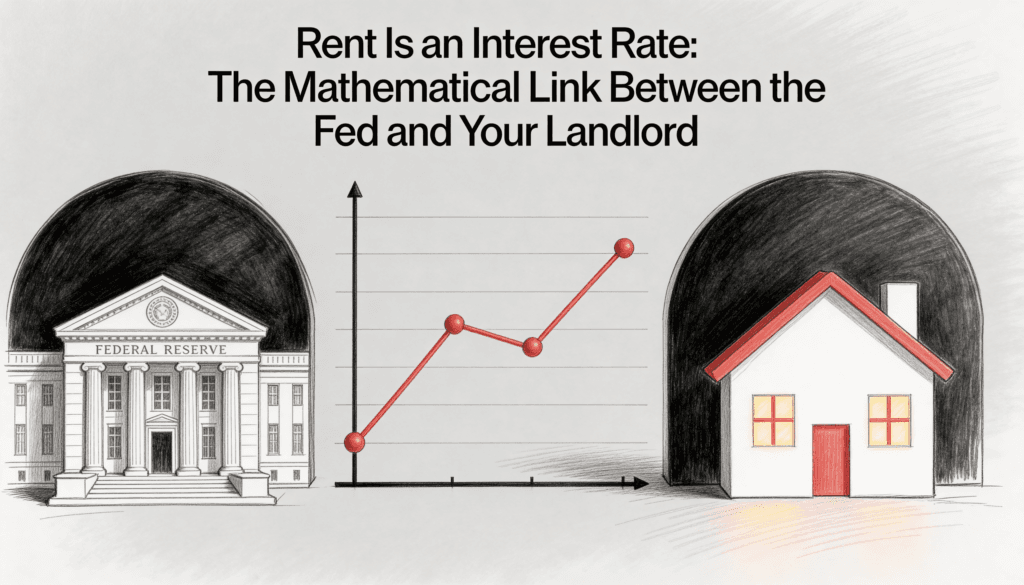
What almost nobody tells you is that these two things are the same conversation. Your landlord and the Federal Reserve are speaking the same language. They are both quoting you a price for time. The only difference is that one of them wears a suit and the other one texts you about a broken dishwasher.
Once you see rent as an interest rate, the whole financial world starts to look less like a collection of separate markets and more like a single organism breathing in and out. And the breath, it turns out, is interest.
The Hidden Identity of Rent
Think about what rent actually is. You hand someone money each month for the privilege of using something you do not own. That is the entire transaction. The thing happens to be a roof, four walls, and a parking spot, but the structure of the deal is identical to a bond, a loan, or a savings account. Someone has capital tied up in an asset, and they want a return on it. You are paying that return.
The landlord is not really renting you a kitchen. The landlord is renting you the use of capital that has been parked inside a kitchen. The capital could have been somewhere else. It could have been in Treasury bonds, in an index fund, in a vacation home in a different city. It chose to be in your apartment. For that choice to make sense to the owner, the rent must compete with whatever else that money could have done. This is called the opportunity cost, and it is the quiet engine running underneath every lease ever signed.
When you start to see it this way, the monthly rent stops being a fixed feature of life and starts looking like a quote on a financial instrument. The landlord is the issuer. You are the buyer. The yield is the rent divided by the value of the property. And yields, as anyone who has ever owned a bond will tell you, do not exist in isolation.
The Fed Sets the Floor of the World
The Federal Reserve has one main lever. It can make money expensive or cheap. When it makes money cheap, every other price in the economy has to rearrange itself around that new reality. When it makes money expensive, the rearrangement happens again, in reverse.
Imagine the financial system as a marketplace where every asset is shouting its yield. Treasury bonds shout one number. Corporate bonds shout a higher one because they carry more risk. Stocks shout a different one based on their dividends and growth. And buildings, those quiet brick objects sitting on street corners, shout a number too. That number is the rent they generate divided by what they cost.
The Fed sets the volume on the whole marketplace. When the Fed cuts rates, Treasury yields drop. Suddenly, every other asset looks more attractive in comparison, so money floods into them, prices rise, and yields fall to match. When the Fed raises rates, the opposite happens. Treasuries become competitive again, money flows out of riskier assets, prices fall, and yields rise to lure capital back.
Real estate is not exempt from this gravity. It is just slower to respond. A landlord cannot reprice an apartment every Tuesday the way a bond trader can. Leases are sticky. Tenants have memories and feelings. But over time, the math wins. It always does.
Why Your Rent Went Up After Easy Money
Here is the part that feels counterintuitive. When the Fed lowered rates aggressively for over a decade, many people assumed this would make life easier. Cheap borrowing, after all, sounds like a gift. And for some people it was. But the same conditions that made mortgages affordable also made buildings into one of the most attractive places to park large amounts of capital.
When safe assets like government bonds pay almost nothing, big investors do not just sit on their hands. They go hunting for yield. They look at the world and ask, where can I still earn a real return. Real estate becomes one of the most obvious answers. Pension funds, insurance companies, private equity firms, and overseas investors all start treating residential buildings the way they used to treat boring corporate bonds. Steady cash flow. Modest risk. A hard asset that probably will not vanish overnight.
This buying pressure pushes property prices up. And once property prices rise, the math of being a landlord changes. To justify owning a building that now costs significantly more, you need to collect more rent. The yield has to make sense. The capital sitting in those walls has to earn enough to be worth keeping there instead of moving somewhere else.
So rent goes up. Not because your landlord is greedy in some unusual personal way, though some certainly are, but because the financial system is doing what it always does. It is bringing every yield into alignment with every other yield. Your apartment is having a quiet conversation with a Treasury bond, and you are paying the cost of the translation.
The Slow Echo of Rate Hikes
The reverse process is messier and slower, which is why so many people get confused by it. When the Fed raises rates to fight inflation, you might expect rents to follow Treasury yields straight up, then come back down once the cycle ends. Reality does not cooperate.
Higher rates make mortgages more expensive. People who would have bought a house decide to keep renting instead. Demand for rentals goes up just as new construction becomes harder to finance, because building anything requires borrowing money. So supply tightens. Rents climb even though the original intention of the policy was to cool things off.
Eventually, the cooling does arrive. Job markets soften. Some people move in with family. Some landlords accept that they cannot find tenants at the prices they want. But this takes years, not months. Meanwhile, your rent is doing the thing it does, which is responding to an interest rate environment from eighteen months ago while your salary responds to the one from yesterday.
The Quiet Logic Behind Cap Rates
Real estate professionals already know all of this. They just speak in code. They use a term called the cap rate, which is essentially the yield on a building. It is the net income from the property divided by the property value. A four percent cap rate means the building generates a four percent return on its price each year before financing.
Now ask yourself, what determines whether a four percent cap rate is good or bad. The answer is what else four percent could earn elsewhere. If Treasury bonds pay one percent, then four percent on a building looks generous, and investors will bid the price up until the cap rate compresses to maybe three. If Treasury bonds pay five percent, then four percent on an illiquid building with a leaky roof looks ridiculous, and investors will demand a higher yield, which means lower prices or higher rents or both.
This is the whole game. Cap rates are interest rates wearing different clothes. Every landlord, whether they know it or not, is running a small bond fund. The bond happens to have plumbing.
What This Means for the Tenant
Most people experience rent as a personal negotiation. They feel the price as something specific to their building, their city, their relationship with their landlord. And on a human level, that is true. The signed lease is between two specific people.
But the price floating around inside that lease has very little to do with either of them. It is the product of a global hunt for yield. It carries the fingerprints of central bank decisions, demographic trends, capital flows from countries you have never visited, and the simple arithmetic of opportunity cost. The rent is local. The forces shaping the rent are not.
This realization is liberating in one important way. It means your rent is not a measure of your worth or your landlord’s character. It is a price that emerged from a system, the same way the price of wheat emerges from weather, war, and a thousand decisions in other countries. You are not arguing with your landlord. You are negotiating, indirectly, with the entire architecture of global capital.
It also means that when interest rates change, you should pay attention, even if you have no plans to buy anything or take out a loan. The rate environment is the weather you are renting in. A storm coming in from Washington will reach your kitchen eventually.
A Small Piece of Practical Wisdom
There is one habit that becomes useful once you accept all of this. When you read a financial headline about the Fed raising or cutting rates, ask yourself a simple question. What other prices in my life are quietly tied to this number. Your mortgage if you have one. Your credit card. The rate on your savings account. The cost of financing a used car. The yield your retirement portfolio is hunting for. And yes, the price of the room you sleep in tonight.
This is not a doom exercise. It is a map. The more clearly you can see the connections, the harder it becomes to feel ambushed by financial reality. You will not always be able to act on what you see, but understanding alone changes your relationship with the numbers on your bills. They stop being random and start being legible.
Money has a temperature, and the Fed is the thermostat. Most of the prices in your life are responding to the setting, even when nobody mentions it. Rent is just one of the more honest ones, because it cannot hide behind clever accounting. It arrives every month, plain and unavoidable, and tells you exactly how the financial system is feeling about itself.
The next time you write that check, or watch that automatic transfer leave your account, you can think of it as something more than a bill. You are paying a coupon on a bond you do not own, issued by a landlord who is competing with the Treasury, in a market that takes its cues from a small room in Washington where someone just adjusted a number. The whole machine is humming through your bank account. The wonder is not that rent is an interest rate. The wonder is that anyone ever convinced you it was something else.