Table of Contents
Two Founders, Two Philosophies, One Question About Money
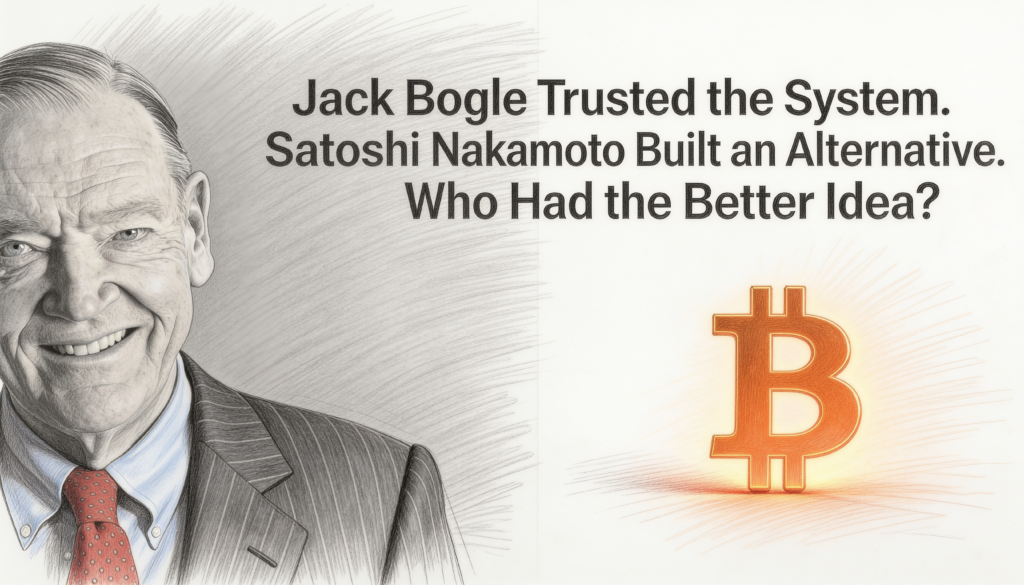
There is a question that splits the investing world more cleanly than almost any other. Do you trust the system, or do you not? It sounds like a question about politics, yet it is actually the question that separates the Bogleheads from the Bitcoiners, two of the most devoted financial communities on the internet. Both have founders they revere. Both have books they treat like scripture. Both believe they have discovered the right way to build wealth across a lifetime.
And yet, if you placed them in a room together, they would struggle to agree on what money even is. This is not a simple argument about which asset delivers better returns. It is a disagreement about something far deeper, something that reaches into the foundations of modern finance. The real question underneath everything is whether the institutions that run our economy deserve your trust or your suspicion.
To understand why Jack Bogle versus Satoshi Nakamoto remains such an enduring debate, you have to look past the price charts and study the founding logic of each movement. One man trusted the system enough to fix it from the inside. The other built an alternative because he believed the system could not be fixed at all. Both were responding to the same frustration. They simply reached opposite conclusions.
The Church of the Index: How Jack Bogle Built a Religion of Patience
The Bogleheads take their name from Jack Bogle, the man who created the first index fund for ordinary investors at Vanguard in the 1970s. His idea was so plain, so unremarkable on its surface, that Wall Street openly laughed at it. Why would anyone want to simply own everything in the market and accept average returns? As it turned out, average was the entire point.
Bogle’s insight was never really about markets. It was about people. He understood that the biggest threat to your wealth was not a recession, or inflation, or a disappointing earnings report. The biggest threat was you. Your urge to tinker. Your confidence that you knew something the market did not. Your willingness to pay someone in an expensive suit to manage your money, even though the data showed again and again that most professionals could not beat a coin flip over the long run.
The Boglehead philosophy rests on a kind of institutional faith. It assumes the economy will grow. It assumes corporations will earn profits. It assumes markets will rise over time. You do not need to understand the machinery. You only need to sit in the vehicle and resist the temptation to jump out.
The Boglehead believes the single greatest financial skill is the ability to do nothing while everyone around you is doing something.
There is something almost spiritual about this trust. It does not require you to understand monetary policy or read a single earnings call transcript. It requires patience and discipline, which, to be honest, are far harder to maintain than they sound. Bogle built a movement around the radical idea that boredom is a competitive advantage, and that the people who win are usually the ones who stop trying to be clever.
The Quiet Rebellion Inside Bogle’s Idea
What many people forget is that Bogle was furious at Wall Street for most of his career. He called the mutual fund industry a machine that extracted wealth from investors and handed it to managers. He viewed the financial system as exploitative, wasteful, and tilted against ordinary savers. His solution was not to abandon the system but to strip it down. Remove the middlemen. Buy the whole market. Pay almost nothing in fees. Ignore the noise.
So the man who became the patron saint of trusting the system was, at his core, a deeply skeptical reformer. That contradiction matters, because it explains why his followers often miss the rebellious spirit that started everything.
The Church of the Protocol: Why Satoshi Nakamoto Walked Away
On the other side stands the Bitcoin community. Their founding figure is Satoshi Nakamoto, a pseudonym for someone, or some group, whose real identity remains unknown to this day. Where Bogle stood on stages, gave interviews, and published books, Satoshi posted a whitepaper in 2008, helped launch the network, and then quietly vanished.
If the Bogleheads built a philosophy on trusting the system, the Bitcoiners built one on the conviction that the system is broken. Their core argument runs something like this. Central banks print money. Governments run deficits. The purchasing power of your savings erodes year after year. The rules of the game get rewritten whenever it suits those in charge. Traditional finance tells you to invest and trust the process, but the process is designed by the very people who benefit from it.
Bitcoin was created to be an alternative. A monetary system with rules that no one can change. A fixed supply of twenty one million coins. No central authority. No printer waiting in the background. Where Bogle urged investors to trust the institutions, Satoshi quietly suggested they replace them.
The Bogleheads removed the middlemen from the system. The Bitcoiners tried to remove the system itself.
This is the philosophical heart of the Satoshi worldview. It does not ask you to time the market or pick winners. It asks you to question the foundation that every other financial decision rests upon. For people who already feel let down by banks and governments, that question lands with enormous force.
A Founder Who Refused to Be Worshipped
There is a strange beauty in the fact that Satoshi disappeared. By removing himself, he made it impossible to turn Bitcoin into a cult of personality, at least in the way that financial gurus usually operate. The idea had to stand on its own. In that sense, Satoshi and Bogle share something unexpected. Both wanted to build something that did not depend on any single person being in charge. Bogle wanted a fund that needed no star manager. Satoshi wanted money that needed no central bank.
The Irony Both Sides Miss About Each Other
Here is what makes this clash so fascinating. Both communities were born from the same frustration, the feeling that ordinary people are getting a raw deal from the financial establishment.
Bogle spent his life raging against the fee structures of Wall Street. He believed the financial industry was rigged against the small investor, and his answer was to stay inside the system while cutting out the people who feasted on it. Buy the whole market. Pay nearly nothing. Let time do the work.
Bitcoiners carry the same anger but reach for a different prescription. They do not want to reform the system. They want to exit it entirely. The financial industry is not merely charging too much, they argue. It is fundamentally flawed at the level of money itself. A monetary system where one entity can expand the supply of money at will, they say, is not a system worth trusting. It is a system worth leaving behind.
So one group says the game is rigged, yet you can still win if you stop paying the dealers. The other says the game is rigged, so the only sane move is to stop playing entirely.
The deeper irony cuts both ways. The Bogleheads, who trust the system, were created by a man who profoundly distrusted Wall Street. And the Bitcoiners, who distrust the system, have built an ecosystem increasingly crowded with the same speculation, leverage, and hype they originally set out to escape. Both movements carry the seeds of their own contradictions, which is exactly why neither side ever feels completely settled.
A Question of Time Horizon and Temperament
There is a useful way to understand these two communities that has almost nothing to do with finance. Think about how people relate to large institutions in the rest of their lives.
Some people believe that democracy is messy, imperfect, and frustratingly slow, yet ultimately the best system we have. They do not admire every politician or every policy. They simply believe that the system, given enough time, corrects itself. These are the Bogleheads of the wider world.
Other people believe that large institutions inevitably grow corrupt, self serving, and impossible to repair from within. They conclude that the only honest response is to build parallel systems from scratch. These are the Bitcoiners of the wider world.
Neither group is wrong in the abstract. Both are placing a bet about the future based on how they read the past. The Boglehead looks at the last century of stock market returns and sees a system that, despite wars, pandemics, crashes, and political upheaval, kept compounding wealth for anyone who stayed invested. The Bitcoiner studies the same century and sees currencies that lost most of their purchasing power, financial crises caused by institutional recklessness, and bailouts that rewarded the very people who created the mess.
Same history. Different lessons. That single sentence explains most of the disagreement between these two camps.
This is also why temperament matters as much as evidence. The person who naturally trusts institutions reads the data optimistically. The person who naturally distrusts them reads the same data as a warning. The numbers do not settle the argument. They simply confirm what each side already feels.
What Each Side Gets Right
The Bogleheads are right about human behavior. Most people are genuinely poor investors. They buy when things feel exciting and sell when things feel frightening. They chase trends, follow gurus, and mistake luck for skill. The Boglehead solution of buying everything, paying almost nothing, and ignoring the daily news is, for the vast majority of people, one of the best financial decisions they will ever make. It is not glamorous. Yet glamour is expensive, and it is rarely worth the price.
The Bitcoiners are right about incentives. The people who run monetary systems have an enormous incentive to expand the money supply, and they regularly do. The purchasing power of the dollar has declined steadily for more than a century. This is not a conspiracy theory. It is the openly stated policy of every major central bank in the world. Inflation targets are not an accident. They are a deliberate design choice. If you find that arrangement uncomfortable, Bitcoin offers a genuine alternative. Whether it is a good alternative is a separate question, but the critique itself is entirely valid.
The Common Ground Almost Nobody Admits
Both philosophies actually agree on the most important behavioral truth in all of investing. You should choose a long term position and then refuse to be shaken out of it. The Boglehead says hold your index fund through every crash. The Bitcoiner says hold your coins through every brutal drawdown. The underlying discipline is remarkably similar, even though the asset and the worldview could not be more different.
What Each Side Gets Wrong
The Boglehead blind spot is the quiet assumption that the next century will resemble the last one. Index investing works beautifully in a world where the economy grows, property rights are enforced, markets remain relatively free, and currencies stay stable enough to measure value. These conditions have held for most of recent history. But treating them as natural laws rather than political achievements is a subtle and important mistake. The Boglehead who says simply buy a total market fund and wait is making a large bet on institutional stability, and most of them never acknowledge that they are betting at all.
The Bitcoin blind spot is volatility and adoption. A store of value that can drop seventy percent in a single year demands a very particular kind of faith. The Bitcoin community often frames this as a feature, arguing that you need a long time horizon and unshakable conviction. But that is essentially the same argument the Bogleheads make about stocks. Hold on. Do not panic. Trust the process. The Bitcoiner who mocks the Boglehead for blind faith is, in many cases, practicing a different flavor of exactly the same thing.
Faith in the index and faith in the protocol are still both faith. The honest investor admits which kind they are carrying.
The Deeper War Beneath the Spreadsheets
Strip away the forums, the podcasts, and the spreadsheets, and this clash comes down to something fundamental. It is about whether you believe existing systems can be trusted to protect your wealth across a lifetime.
The Boglehead answers yes. Not because the system is perfect, but because the alternatives, trying to outsmart it or escape it, usually make things worse. The Bitcoiner answers no. Not because they enjoy risk, but because they believe the system itself is the deepest risk of all.
This is why the debate generates so much heat and so little resolution. Both sides are answering different questions. The Boglehead is asking what the most reliable way to grow wealth is. The Bitcoiner is asking what wealth even is in the first place. You can answer one question without ever touching the other, and most people do exactly that.
There is an old idea in philosophy called the Ship of Theseus. If you replace every plank of a ship one at a time, is it still the same ship? The Boglehead would say yes, because the structure endures. The Bitcoiner would say it depends entirely on who is doing the replacing and whether you ever agreed to it.
The financial system keeps replacing its planks. New regulations, new policies, new money created from nothing. The Bogleheads do not mind, because the ship still floats and still carries them forward. The Bitcoiners mind a great deal, because they never signed off on the renovation and never trusted the carpenters.
Where Ordinary Investors Actually Live
Both make a fair point, and neither holds the full picture. Somewhere between these two churches, most ordinary investors are simply trying to figure out where to put their next paycheck. They do not care about philosophy. They care about results. They want a roof over their family and a retirement that does not collapse.
The most honest answer might be the least tribal one. You can respect Jack Bogle for teaching an entire generation to stop sabotaging themselves, and you can respect Satoshi Nakamoto for forcing the world to ask harder questions about money. Trusting the system and questioning the system are not opposites so much as two tools for two different jobs. A thoughtful investor can hold a little of both without surrendering completely to either camp.
That is probably why neither side will ever fully win this argument, and why both will keep having it for as long as money exists. One man trusted the system and built a better way to live inside it. The other distrusted the system and built a door out of it. The better idea may depend less on who was right and more on which future actually arrives.