Table of Contents
There is a particular kind of trader who looks at the world like a plumber. Money, to him, is water. It pools in places where rates are low, and it wants to flow toward places where rates are high. His job is to open the valve, manage the pressure, and pocket the difference. He does not build anything. He does not invent anything. He just stands between two pipes and listens to the hum.
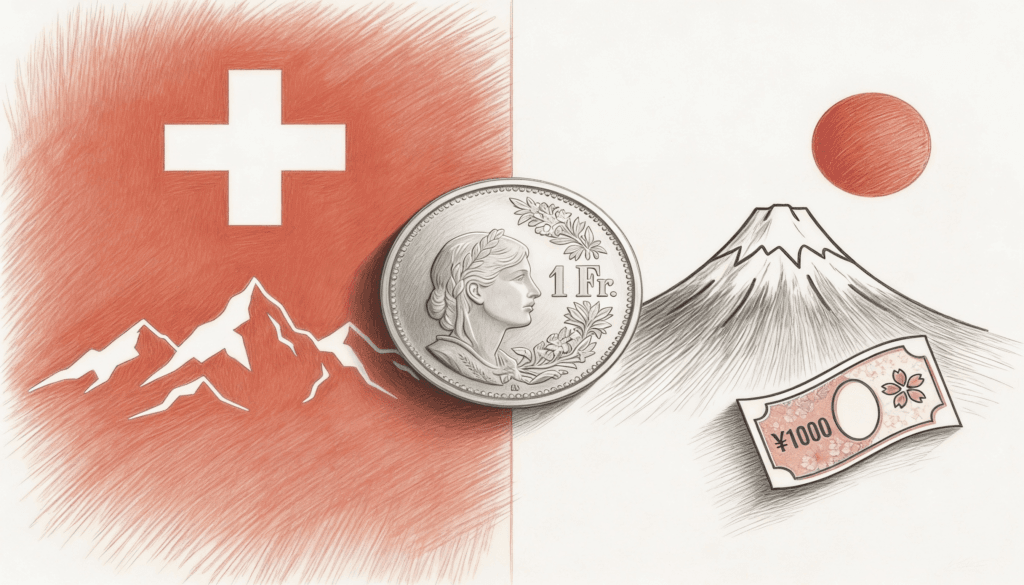
This is the carry trade in its purest form. Borrow cheap in one currency, lend dear in another, and live off the spread. For decades it has been one of the most reliable money makers in global finance, which is strange when you think about it, because on paper it should not work at all. The textbooks insist that if Japanese rates are near zero and Brazilian rates are in the double digits, the Brazilian real must be expected to fall against the yen by roughly the difference. Otherwise everyone would do the trade, and the imbalance would correct itself. This is called uncovered interest rate parity, and it is one of those elegant ideas that markets routinely ignore for years at a time before suddenly remembering it exists, usually at three in the morning, usually with great violence.
So we have a puzzle. A trade that should not be profitable is profitable. A free lunch in a discipline that claims free lunches do not exist. What is actually going on here? And more importantly, what does it tell us about whether global macro investing creates value in the world or simply rearranges it?
The Plumber and the Architect
It helps to start with a basic distinction. There are roughly two ways to make money in markets. You can fund something productive, an oil rig, a software company, a bridge, and share in the returns it generates. Or you can position yourself cleverly between other people and capture the gap. The first is the architect. The second is the plumber.
Most retail investors, when they imagine investing, picture the architect. They think of Warren Buffett buying a piece of a railroad or a soft drink company and watching it compound for forty years. This story has a moral arc. Capital meets enterprise, enterprise creates goods, goods create profits, profits reward patience. Everyone wins. Even the language of equity investing has this quality. You own a share. You are a part owner. You are participating.
Global macro has none of this warmth. Nobody owns a piece of the yen. When a hedge fund shorts the Turkish lira against the dollar, no factory gets built. No worker gets trained. No customer gets a better product. The trade is a pure bet about which way a price will move, and the profit comes from being on the right side when other people are on the wrong side. It is finance reduced to its skeleton, which is perhaps why it makes people uncomfortable. There is no story to soften the math.
And yet the carry trade in particular has an oddly noble cover story attached to it. The story goes like this. Capital is scarce in emerging economies. Investors in rich countries have savings they do not need urgently. By moving money from Tokyo to Sao Paulo, the carry trader is helping allocate global capital more efficiently. He is the connective tissue of a globalized financial system. He is, in his own way, doing God’s work, just with a Bloomberg terminal instead of a hammer.
There is some truth to this. But it is also the kind of truth that is mostly told by people who profit from it being believed.
What the Carry Trade Actually Pays You For
If the carry trade were really just clever plumbing, it would be safe and modestly profitable. It is not. It is highly profitable for long stretches and then catastrophically unprofitable in short bursts. Carry trades have a payoff pattern that resembles a person walking up a slow staircase, pausing on each landing to admire the view, and then occasionally falling down the entire flight at once. This pattern has a name in the literature. It is sometimes called picking up nickels in front of a steamroller. The metaphor is unkind but accurate.
So what are you really being paid for when you do the carry trade? You are being paid to absorb tail risk. You are being paid to be the person holding the wrong currency at the wrong moment when global liquidity suddenly contracts and everyone simultaneously decides they want to be in dollars or yen or anything that feels solid. The high interest rate in the emerging market is not a free gift. It is compensation for the fact that one day, with little warning, the music will stop and you will be the one without a chair.
This reframes the whole question of value creation. The carry trader is not really lending capital to productive enterprises in distant lands. He is selling insurance. The premium he collects looks like interest, but functionally it is what an insurance company collects when it underwrites a policy that almost never pays out, until the day it does. From this angle the carry trade is genuinely useful. Someone needs to bear the risk of sudden currency collapses, and risk that is borne by willing professionals is risk that is not borne by unwilling civilians. That is a service. It is not a glamorous service, but it is a service.
The catch is that the carry trader rarely understands his own job this way. He thinks he is being smart. He thinks he is collecting yield. He does not think of himself as an insurance company until the claim arrives, at which point he tends to discover that he has been writing policies on hurricanes without keeping any reserves. This is how blow ups happen. Not from a failure of intelligence, but from a failure of self knowledge.
The Question Nobody Asks at Dinner Parties
Here is where it gets interesting, and where the question in the title actually starts to bite. If global macro is essentially the business of bearing risks that other people do not want to bear, then it sits in a strange middle zone between value creation and value transfer. It does not build anything. But it does redistribute risk, and the redistribution of risk is, by most economic accounts, a real service with real social value.
Think about what would happen if no one did the carry trade. Emerging market governments and companies would find it harder to borrow at any price. Volatility in currency markets would be higher, not lower, because nobody would be on the other side of the trades that exporters and importers want to do. Pension funds in slow growing rich countries would have fewer ways to reach for the returns they need to meet their obligations to retirees. The world would not end. But it would be slightly worse, in ways that are diffuse and hard to see.
This is the awkward truth about a great deal of modern finance. Its contribution to the world is real but invisible, and its costs are visible and concentrated. When a bank collapses, everyone notices. When a bank quietly facilitates ten thousand small business loans over a decade, nobody writes an article about it. Global macro is the same. The gains are spread thinly across the system. The losses arrive all at once and tend to come with photographs of stressed traders.
So when someone asks whether global macro creates value, the honest answer is that it creates a particular kind of value that humans are very bad at perceiving. It smooths things. It absorbs shocks. It transfers risk from those who cannot bear it to those who can, or at least to those who think they can, which from a systemic perspective amounts to almost the same thing right up until the moment when it does not.
The Moving Truck Theory
There is still the other half of the question, the one about whether macro just moves value around without adding to it. And here I think the answer has to be partly yes, and there is no shame in saying so.
A great deal of macro trading really is a zero sum activity. When one hedge fund makes ten million dollars shorting sterling, somebody else lost ten million dollars being long sterling. The total stock of wealth in the world has not changed. It has just shifted from one ledger to another. Multiply this across millions of trades a day and you have a vast industry that, at the level of pure profit and loss, is essentially a moving truck. Wealth goes in one door and comes out another, with a healthy commission charged for the ride.
The interesting question is not whether this is happening, because obviously it is, but whether the moving truck still earns its keep in other ways. And here I think it does, though more modestly than its practitioners like to claim. Markets need participants who care intensely about prices being right. They need people who will stay up at night thinking about whether the Indonesian rupiah is overvalued. The information that gets baked into prices through this kind of obsessive attention is a public good. It tells everyone else what things are worth. It allows the architect investors, the ones building real businesses, to make decisions with some confidence about exchange rates and borrowing costs and capital flows.
The macro trader does not know he is producing this public good. He is just trying to make money. But the byproduct of his selfishness is information, and information, like risk transfer, is one of those quiet services that civilization depends on without quite noticing.
A Verdict, of Sorts
So does global macro create value, or just move it? The honest answer is that it does both, and the proportions vary depending on where you stand and what kind of mood you are in. On a good day macro is a useful piece of infrastructure that absorbs risk, generates information, and lubricates the international flow of capital. On a bad day it is a casino where intelligent people transfer money to each other while telling themselves a flattering story about market efficiency.
The carry trade is the perfect emblem of this duality. It looks like easy money. It is, most of the time, easy money. Then occasionally it is a catastrophe. The traders who survive long enough to talk about it tend to be the ones who never confused the easy money phase with genuine value creation. They knew they were being paid to bear a risk. They sized their positions accordingly. They went home before the steamroller arrived.
The traders who do not survive tend to be the ones who believed their own marketing. They thought they were doing something clever. They thought the spread was free. They confused the absence of an immediate disaster with the absence of risk, which is one of the oldest mistakes in finance and probably also in life.
If there is a lesson here for the rest of us, it is probably this. Be suspicious of any activity that looks like it creates value but cannot quite explain how. Sometimes the explanation is that it is creating value in a way that is too subtle to see. Sometimes the explanation is that it is not creating value at all, just moving it, and you are about to find out from which pocket. Telling the difference is most of the game.
And in global macro, as in most things, the people who do best are the ones who can hold both possibilities in their head at once without flinching.