Table of Contents
Why a Carry Trade Screening Checklist Separates Survivors From Casualties
The carry trade has buried more confident traders than almost any strategy in the currency world, and it does so quietly, then all at once. You borrow money where it costs almost nothing, you park it where it pays handsomely, and you collect the difference while you sleep. A child could explain the mechanics. Yet entire hedge funds have unwound positions so violently that central banks were forced to intervene like adults breaking up a playground fight.
The gap between how simple the carry trade sounds and how dangerous it actually behaves comes down to one thing: a disciplined carry trade screening process. Amateurs treat the carry trade as a yield play. Professionals treat it as an insurance contract they happen to be sitting on the wrong side of. Same instrument, two entirely different mental models, and only one of them keeps you in business.
This article gives you a repeatable checklist of seven red flags to screen before you open any carry position. Think of it as a preflight inspection. Run through every item, every time, and you will catch the failures that destroy careers before they destroy yours.
The carry trade does not punish you for being wrong about direction. It punishes you for failing to screen for the storm that was always coming.
Red Flag 1: The Interest Rate Differential Looks Too Generous to Ignore
Newcomers fixate on the spread. If the Japanese yen funds at almost nothing and the Mexican peso pays handsomely, that interest rate differential looks like cash lying on the sidewalk. Pick it up. Repeat. Get rich.
The professional sees something colder. That spread is compensation for risk that has simply not arrived yet. Markets behave like ruthless accountants, not charities. When a currency pays you eight percent more than another, the collective judgment of millions of traders is whispering that something unpleasant is statistically expected to happen. It might be inflation. It might be political turmoil. It might be a quiet capital flight that becomes a loud one.
Imagine a job posting offering triple the going salary for what appears to be ordinary work. A wise person does not assume the employer is unusually generous. A wise person assumes there is a reason nobody else has taken the job. The carry trade rewards that exact suspicion.
How to Screen This Flag
Before you trade, ask why the differential exists. Pull the inflation trajectory of the high-yield country, the trend in foreign reserves, and the recent direction of capital flows. A differential that is widening because inflation is accelerating is a warning, not an invitation. The headline rate is page one. The real story is buried on page twelve, and your job is to read all the way through.
Red Flag 2: Volatility Is Rising or Already Elevated
There is a phrase that drifts around trading desks: carry trades go up by the stairs and down by the elevator. It sounds folksy until you live through it. A position can accumulate tidy gains for eighteen months and then surrender all of them, plus more, in three trading sessions.
Volatility is the entire game, not a footnote to it. When global markets are calm, capital flows comfortably toward higher yields. The moment fear arrives, that capital does not walk back to safety. It sprints. And when everyone sprints through the same doorway at once, the doorway itself becomes the catastrophe.
Amateurs compute an annualized yield and feel clever. Professionals divide that same return by volatility and watch the trade lose its shine immediately. A modest return earned smoothly is a serious achievement. A high return earned through knuckle-whitening drawdowns is a lottery ticket dressed in a suit.
How to Screen This Flag
Check the implied volatility on the relevant currency options and compare it to its own twelve-month range. Watch the VIX and broad risk indices as a backdrop. When volatility is cheap and stable, carry tends to work; when it is rising, the same trade becomes a coiled spring pointed at your account. If volatility is climbing while you are considering entry, treat that as a hard stop on the screen.
Red Flag 3: Liquidity Looks Abundant Today
Currency markets carry a peculiar property that everyone acknowledges and almost nobody internalizes until it bites. Liquidity is generous precisely when you do not need it and stingy precisely when you do.
During calm periods you can move millions in and out of emerging market currencies with barely a ripple. Spreads are tight, brokers are happy, everything functions. Then a regional bank wobbles, or a central banker says something ambiguous on a Thursday afternoon, and the very trade that filled in seconds now takes hours and costs a fortune to exit. Sometimes it cannot be exited at all without a haircut that erases accumulated carry.
Liquidity is a fair-weather friend. It shows up for the celebration and vanishes the moment the building catches fire.
How to Screen This Flag
Treat liquidity as a question rather than an assumption. Who else holds this trade? How crowded is the exit? If the music stops, are you closer to the door or pressed against the back wall? Examine average daily volume, the depth of the order book, and how the pair behaved during the last risk event. The fact that you can enter easily today tells you nothing about whether you can leave tomorrow.
Red Flag 4: The Funding Currency Has a Safe-Haven Personality
Most retail traders research the high-yielding currency with great care. They study the country, examine inflation, and read the central bank. Then they grab whatever low-yielding currency they can borrow in almost as an afterthought, as though it were a neutral container.
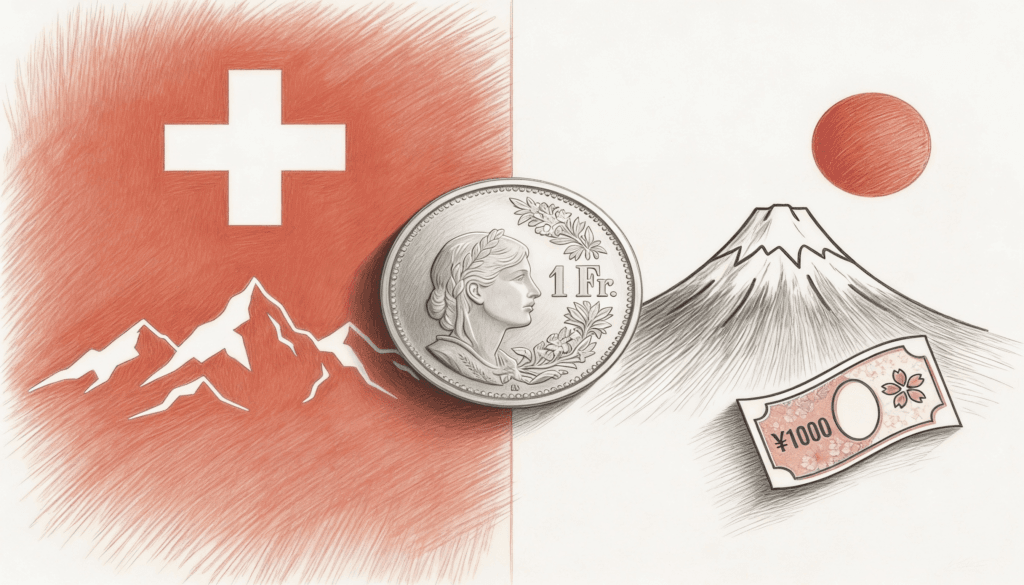
That instinct is backward. The funding currency has moods, triggers, and a habit of appreciating violently at the worst possible moment. The Japanese yen and the Swiss franc earned their reputation as funding currencies for sound reasons, but the same features that make them cheap to borrow also make them safe havens during stress. When global investors get frightened, they rush back into these currencies. Your funding leg appreciates while your asset leg depreciates, and you get squeezed from both ends like a tube of toothpaste.
How to Screen This Flag
Study the funding currency at least as carefully as the target, and arguably more. Map how it has behaved during past episodes of market panic. The very stability that makes a funding currency attractive in calm times is exactly what destroys you when conditions change. The thing you are short can hurt you in ways the thing you are long never will.
Red Flag 5: You Are Treating Central Banks as Predictable Partners
A comfortable fantasy circulates through financial commentary: central bankers are predictable. They have dual mandates, they publish forecasts, they speak in measured tones, so surely a careful reader can anticipate their next move.
In reality, central banks operate under constraints that have nothing to do with keeping carry traders comfortable. A central bank in a small open economy might cut rates to protect employment even as capital flees. Or it might hike rates aggressively to defend the currency and crush the local economy in the process. Neither outcome is friendly to a trader who assumed yields would politely stay put.
The professional accepts a humbling truth. You are not in a relationship with the central bank. You are exposed to its decisions the way a farmer is exposed to rainfall. You can study patterns, you can prepare, but you cannot negotiate.
How to Screen This Flag
Read policy statements looking for surprises rather than confirmation, then ask what happens to your position if the surprise breaks the other way. Mark the meeting calendar for both currencies. A carry position held blindly into a central bank decision is a coin flip with leverage attached.
Red Flag 6: You Believe Your Carry Positions Are Diversified
This is perhaps the most overlooked red flag and the one that turns sophisticated portfolios into smoking craters. Traders often hold multiple carry positions across different pairs to diversify. The logic feels airtight. Different countries, different economies, different stories. If one trade goes wrong, the others should hold.
Then comes the morning when every single one of them moves against you at once, and you discover that diversification was a costume those trades were wearing rather than a property they ever truly possessed. Carry trades share a hidden common factor: they all depend on global risk appetite. When investors feel optimistic, capital chases yield and every carry trade tends to win together. When fear returns, capital flees yield and every carry trade tends to lose together.
Carry correlation behaves like a dinner party where every guest appears independent until the lights go out, and then you realize they were all sitting on the same fragile bench.
How to Screen This Flag
Build your portfolio assuming that during a crisis correlations rise toward one. Stress test what happens if all your carry positions move against you simultaneously, because that is the scenario that actually arrives. Historical correlations measured during calm markets are the exact numbers that betray you under stress. Size your aggregate exposure for the bad day, not the average one.
Red Flag 7: Your Time Horizon Does Not Match the Strategy
The final red flag determines whether the carry trade is even appropriate for you, and it has nothing to do with the trade itself. It has everything to do with how long you can sit still.
Carry trades generate returns slowly. The differential drips in over months and years, while the risk of a sharp adverse move concentrates into rare but devastating episodes. That asymmetry carries a brutal implication. To earn the long-term return, you must survive every short-term storm. You cannot tap out when the storm hits and tap back in afterward, because by then prices have already moved and the carry has already been collected by the people who held on.
This demands a time horizon that many traders simply do not have, either psychologically or financially. If you need the money in two years, you cannot absorb a five-year drawdown even when the strategy carries positive expected returns over a decade. And yes, drawdown measured in years, not percentages.
How to Screen This Flag
Build carry positions only with capital that has nowhere else it urgently needs to be. The professional funds the trade with patient money. The amateur funds it with cash earmarked for life events and then liquidates at the worst possible moment because the rent is due or the children need braces. The mathematics of the trade is identical for both people. The outcome is opposite, and the only variable that changed was the holder.
Turning the Seven Red Flags Into a Repeatable Screening Process
The seven red flags above are not a reading list to admire once and forget. They form a checklist you run before every position, in the same order, with the same discipline, the way a pilot inspects an aircraft before takeoff. Skip an item and you are gambling that this particular flight will be the lucky one.
Your Pre-Trade Screening Sequence
- Differential: Why is the spread this wide, and what risk is it paying you to absorb?
- Volatility: Is implied volatility cheap and stable, or rising into your entry?
- Liquidity: How crowded is the exit, and how did this pair trade during the last panic?
- Funding currency: Does my short leg behave like a safe haven that will spike against me?
- Central banks: What policy surprises are possible, and what do they do to my position?
- Correlation: If every carry trade I hold moves against me at once, do I survive?
- Time horizon: Is this capital patient enough to outlast the worst plausible drawdown?
Any single red flag should slow you down. Two or three flags raised at the same time should keep you flat. The screen exists to keep you out of the trades that look most attractive precisely because they are most dangerous.
A Closing Thought on Survival and Discipline
The carry trade is often described as picking up pennies in front of a steamroller. The metaphor is famous because it is accurate, but it misses something. The steamroller rarely ruins traders. What ruins them is the assumption that they can step off the road quickly enough when they finally see it coming.
What separates professionals from amateurs is not sharper forecasts or fancier tools. It is a fundamentally different relationship with uncertainty. The professional assumes the steamroller will arrive at an unknown time and builds the position around that assumption from the very first day. The amateur assumes the steamroller is somebody else’s problem right up until the moment it is not.
Every one of the seven red flags is really a single underlying discipline wearing seven different outfits. Pay attention to what could go wrong, not only to what could go right. Size positions for the worst plausible outcome rather than the average one. Treat liquidity, volatility, correlation, and time horizon as living things that change behavior under pressure, not as static numbers resting comfortably in a spreadsheet.
The carry trade is not without merit. It has produced genuine wealth for patient and careful operators across generations. But it does not surrender that wealth cheaply. It charges a kind of intellectual tax, paid in vigilance and humility. The traders who refuse to pay that tax end up paying a far larger one to the market instead. And the market, unlike the central bank, never publishes a schedule.