Table of Contents
The Debate That Refuses to Die (And Why Both Sides Are Lying to You)
Two investors meet at a dinner party. One owns a total stock market index fund and has never thought about it for more than twenty minutes a year. The other owns four rental properties and thinks about them every single day. By dessert, they are arguing about which one of them is richer in thirty years, and both of them are absolutely certain they will win.
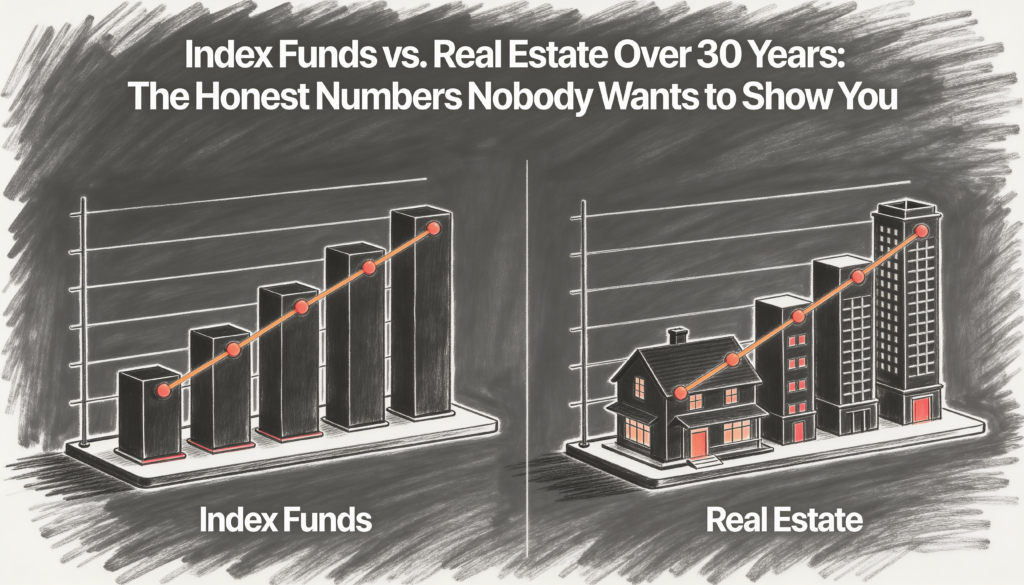
Here is the uncomfortable truth nobody at that table wants to admit. The question of index funds vs. real estate over 30 years is mostly a trap, and the trap is far more interesting than the answer either side keeps shouting. They are both right. They are both wrong. And the reason for both has almost nothing to do with the historical return numbers they keep hurling at each other across the cheese plate.
The index fund crowd, often shaped by the Bogleheads philosophy, treats investing like a religion of simplicity. Buy the whole market. Pay almost nothing in fees. Do not look at it too often. Wait. The real estate crowd treats investing like a craft. Find the deal. Run the numbers. Negotiate, renovate, collect rent, repeat. One side believes wealth is best built by doing almost nothing. The other believes it is best built by doing almost everything. Both sides have thirty year track records they love to cite, and both sides quietly ignore the parts of the story that make them look bad.
This article is going to show you the honest numbers, the real leverage math, the tax drag that nobody reads, and the maintenance costs that vanish from every glossy projection. By the end, you will understand why the winner is not the asset class you expected. It is you.
The Problem With the Spreadsheet
Every article comparing stocks to real estate over thirty years eventually reaches for the same move. Historical returns. Average annual gains. The S&P 500 did this, median home prices did that. And in doing so, every one of those articles tells you almost nothing useful about your actual life.
Let us start with the real figures, because they matter. Historically, the S&P 500 delivered an average annual total return of roughly 10 percent before inflation and around 7 percent after inflation, with dividends reinvested. That means a single lump sum of 100,000 dollars, left completely untouched, would have grown to somewhere near 1.7 million dollars over thirty years at the nominal rate.
Real estate tells a different story depending entirely on how you measure it. US home prices have appreciated at roughly 3 to 5 percent annually over long stretches. That number alone sounds underwhelming compared to the stock market. But raw home price appreciation is the wrong measure, because almost nobody buys real estate with cash. They buy it with leverage, and leverage changes everything.
Why Average Returns Describe Nobody
These numbers describe populations, not individuals. They describe what happened to money in the abstract, not what happens to people who manage money while also managing their careers, their health, their marriages, and their tendency to panic at exactly the wrong moment.
The spreadsheet comparison is like comparing two diets by listing the calories. Technically accurate. Practically useless. Because nobody eats according to the spreadsheet, and nobody invests according to it either.
The average index fund investor, according to research from the analytics firm DALBAR, has historically underperformed the index itself by a wide margin, sometimes by three or four percentage points a year, simply because of bad timing. They buy high, sell low, and call it strategy. The average real estate investor underperforms their own pro forma projections too, because the projections almost always forget the broken water heater, the two months of vacancy, and the special assessment from the homeowners association. Averages are honest about money and dishonest about humans.
The Leverage: The Most Powerful and Most Misunderstood Tool
Real estate investors love leverage, and they should. It is the single most powerful tool available to ordinary people for amplifying returns. You put down 20 percent. The bank gives you the rest. If the property appreciates 5 percent in a year, your actual return on invested capital is 25 percent, because you are earning the gain on the entire property value while having only committed a fraction of the cost.
Let us run honest numbers. Imagine you buy a 300,000 dollar rental property with a 60,000 dollar down payment. If the property appreciates at 4 percent annually, it gains 12,000 dollars in value in year one. That 12,000 dollars represents a 20 percent return on your 60,000 dollars of actual cash, before you even count rent. Layer in rental income that covers the mortgage and produces modest cash flow, then add the steady reduction of your loan balance paid down by your tenants, and the leveraged return on a real estate investment can genuinely reach the mid teens or higher in a healthy market.
Leverage Is a Volume Knob, Not a Direction Selector
What gets far less airtime is that leverage amplifies everything, not just gains. It amplifies losses. It amplifies stress, which does not show up on any spreadsheet but absolutely shows up in your decision making when a tenant has not paid rent for two months and the furnace just died in January.
If that 300,000 dollar property drops 20 percent in a recession, you have lost your entire 60,000 dollar down payment on paper, and you still owe the bank the full mortgage. The index fund investor who watched the market fall 20 percent lost 20 percent, painful but survivable. The leveraged real estate investor lost 100 percent of their invested capital in that same drop. Leverage is mathematics, and mathematics is indifferent to which direction you were hoping things would go.
The index fund investor, meanwhile, has no leverage, no tenants, no furnaces, and no two in the morning phone calls. Their wealth building tool is patience. That is the entire toolkit. And patience turns out to be an extraordinarily difficult thing to maintain across three decades. Every crash, every correction, every doomsday headline is a test of whether you can do literally nothing while your net worth appears to evaporate on a screen.
What You Are Actually Choosing
The real question behind this debate is not which asset class performs better. It is what kind of investor you are willing to become, and what you are willing to give up to become that person.
The total stock market index requires you to be psychologically comfortable with abstraction. Your wealth is a number on a screen. It rises and falls based on the collective behavior of millions of people you will never meet. You cannot touch it, improve it, or influence it in any way. For some people, this is liberating. For others, it is unbearable.
Real estate requires you to be comfortable with complexity instead. Tenants, taxes, insurance, maintenance, local regulations, interest rates, property management, vacancies, eviction law. The returns can be spectacular. But they are not returns on capital alone. They are returns on capital plus time plus skill plus emotional endurance.
The Restaurant Owner Who Forgets to Pay the Chef
The real estate investor is not simply investing money. They are running a small business, and many of them never account for their own labor when calculating returns. That is a bit like a restaurant owner bragging about profit margins while forgetting to pay the chef, who happens to be the same person.
When you compare a total stock market index fund to a real estate portfolio and declare a winner, you are comparing a vending machine to a restaurant. One asks you to press a button. The other asks you to show up every day. Both can feed you, but calling them equivalent is a strange use of the word.
Consider the real cost of that labor. A landlord managing three units might spend five to ten hours a month on average, and far more during turnover or repairs. Across thirty years, that is potentially thousands of hours of work that never appears in the return calculation. If you hire a property manager to reclaim that time, you typically surrender 8 to 12 percent of gross rent, which quietly erodes the very leverage advantage that made real estate attractive in the first place. There is no free lunch. There is only labor you pay for or labor you perform yourself.
The Tax Chapter Nobody Reads
There is a section of this debate that is both critical and boring, which is exactly why most people skip it and then wonder why their actual returns look so different from the projections.
Real estate offers tax advantages that index funds simply cannot match. Depreciation lets you reduce taxable income on paper even while the property is appreciating in reality. The Internal Revenue Service allows residential rental property to be depreciated over 27.5 years, meaning you can deduct roughly 3.6 percent of the building value every year against your rental income. This is one of the few legal ways to tell the tax code that your asset is worsening while you privately know it is improving.
The 1031 Exchange and the Deferral Game
The 1031 exchange provision lets you defer capital gains almost indefinitely by rolling profits from one property directly into another. These are not loopholes. They are intentional features written into the tax code, and they meaningfully change the thirty year outcome. An investor who exchanges properties strategically can compound gains for decades without ever paying capital gains tax along the way, and under current rules, heirs may receive a stepped up basis that can erase much of the deferred liability entirely.
The index fund investor, by contrast, lives in a simpler but less generous tax environment. You get taxed on dividends each year, even when reinvested. You get taxed on capital gains when you sell. Retirement accounts like a 401k or a Roth IRA help enormously, and the long term capital gains rate of 15 to 20 percent is gentler than ordinary income, but the advantages are modest compared to what the tax code offers property owners.
If this sounds like a system designed to reward people who own buildings over people who own shares of companies, that is largely because it is. The tax code was not written by indexers. It was written, in large part, by and for people who own real estate.
The Maintenance Costs That Vanish From Every Projection
Here is where the honest numbers separate from the fantasy numbers. Most real estate projections quietly assume the property maintains itself, and it never does.
Financial planners commonly recommend budgeting 1 to 2 percent of a property value annually for maintenance and repairs. On a 300,000 dollar property, that is 3,000 to 6,000 dollars a year, every year, whether you spend it or not. Roofs last twenty to thirty years and then cost thousands to replace. Water heaters fail. HVAC systems die. Then there is the silent killer of returns, the vacancy. A national vacancy rate of even 7 percent means that, on average, your property earns nothing for roughly three weeks of every year while the mortgage, taxes, and insurance keep arriving with brutal punctuality.
Add property taxes, which average around 1 percent of home value nationally but climb far higher in some states, plus landlord insurance, plus the cost of advertising and screening tenants, plus the occasional eviction that can cost thousands in legal fees and lost rent. Stack these against the index fund, whose total ongoing cost might be a fund expense ratio of 0.03 percent and nothing else, and the picture sharpens considerably.
Real estate is not a passive investment wearing the costume of one. It is an active business that occasionally lets you forget it is a business, right up until the moment the basement floods.
None of this means real estate loses. It means the true return is the gross return minus a long list of expenses that the enthusiastic version of the story conveniently omits. When you subtract maintenance, vacancy, taxes, insurance, and management from leveraged appreciation and rent, the honest net return often lands close to what a patient index fund investor earns, with vastly more effort attached.
The Hidden Variable: You
There is a concept in chaos theory called sensitive dependence on initial conditions. Small differences at the start produce wildly different outcomes over time. Investing across thirty years works exactly this way, except the most important initial condition is not your starting capital or your chosen asset class. It is your temperament.
If you are the kind of person who will check your portfolio every morning and sell during a crash, the total stock market index will not save you. If you are the kind of person who will under maintain your properties and ignore rising vacancy until it becomes a crisis, real estate will not save you either. The thirty year outcome depends less on what you buy and far more on who you are while you own it.
The Comfort Nobody Wants to Surrender
This is the part both communities find genuinely uncomfortable. The index fund community wants to believe that behavior does not matter because the system is designed to be behavior proof. It is not. The real estate community wants to believe that hustle and deal finding can overcome any market condition. It cannot. Both communities are protecting a story about themselves, and the story is more flattering than the data.
So Who Actually Wins Over 30 Years?
Over thirty years, a disciplined index fund investor and a disciplined real estate investor will both build substantial wealth. The decisive word in that sentence is not index and it is not real estate. It is disciplined.
If you forced both strategies into a perfectly controlled experiment where each investor behaved optimally for three decades, real estate would likely produce higher total returns, because the combination of leverage and tax advantages is genuinely powerful. A leveraged property that quietly compounds at a mid teens internal rate of return will eventually pull ahead of a 10 percent index fund. The math favors the landlord in the laboratory.
But we do not live in laboratories. We live in a world where pipes burst, markets crash, divorces happen, tenants disappear, and people make emotional decisions with alarming regularity.
The Quiet Advantage of Simplicity
The total stock market index has one advantage that is almost impossible to overstate. It is easy to execute. Not easy to hold emotionally, but trivial to operate. You do not need skill, connections, local market knowledge, or a plumber on speed dial. You need an internet connection and the ability to refrain from panic. That is a meaningful edge across thirty years, because simplicity reduces the surface area for mistakes, and mistakes are what actually destroy returns.
The Quiet Advantage of Tangibility
Real estate has an advantage that is equally hard to overstate. It is tangible. People hold onto things they can see and touch far longer than things that exist as digits on a screen. This psychological anchor against selling might be worth more than any tax advantage or leverage benefit combined. You are far less likely to sell your duplex during a downturn than to dump your index fund position at midnight, not because it is rational, but because you cannot liquidate a building from your phone in a moment of fear.
So the honest answer is not which asset builds more wealth in a vacuum. The honest answer is which asset you are personally more likely to hold for thirty years without doing something foolish. For some people, that is the silent, leveraged, tax advantaged property they will never panic sell. For others, it is the boring index fund they can ignore for decades. The numbers favor real estate in theory and favor index funds in practice for most ordinary humans, and the deciding factor is the person in the mirror.
That is exactly the answer neither side wants to hear, which is usually a reliable sign that it happens to be true.