Table of Contents
The Three Layers of Code Running Every Financial Decision You Make
You make hundreds of financial decisions every year and every single one of them runs on three layers of code you have never read. The price you accept for your work, the interest you pay on a loan, the moment you decide to save rather than spend, all of it executes on a system you operate daily without ever opening the hood. We treat money the way most people treat their phone. It works, so why look inside?
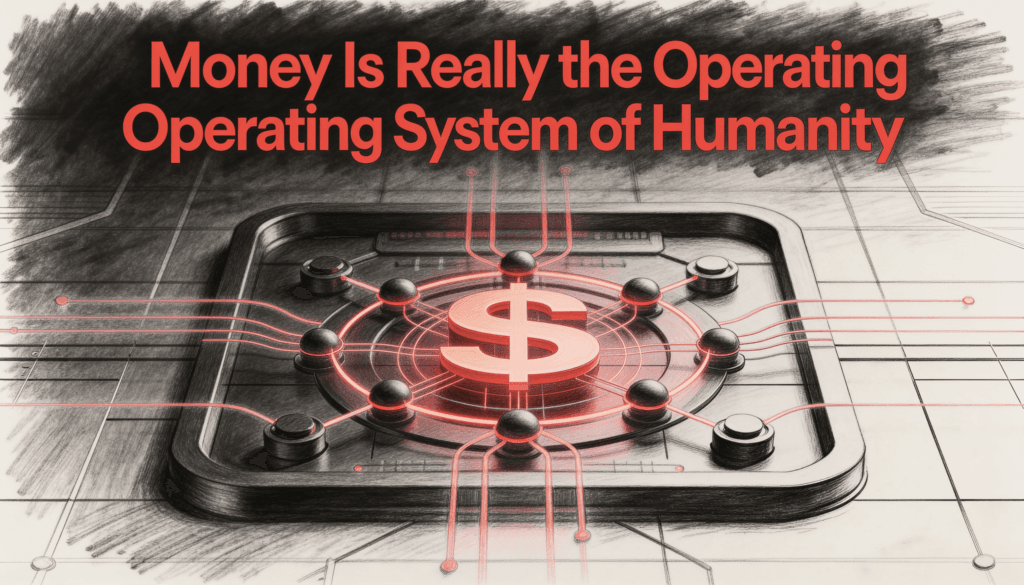
But money is infrastructure, not a thing. It is not the paper in your wallet, not the digits on your banking app, not gold, not Bitcoin. Those are interfaces. The actual system underneath has components, dependencies, and failure modes, exactly like any operating system an engineer would recognize. And once you can see the architecture, almost every financial decision you make starts to look different, because you finally understand what is actually executing when you press the button.
Here is the blueprint. Money runs on three layers simultaneously: trust, measurement, and time. Most of the confusion people carry about money comes from mixing these layers up or, more often, from never knowing they were separate in the first place. We are going to take them one at a time. For each layer, the same three questions apply: what does this layer actually do, what breaks when it fails, and what does understanding it change about your decisions?
The Trust Layer: Why Money Has Value at All
The trust layer is the foundation. Nothing else in the system functions without it. When you accept payment for your work, you are not trusting the paper or the bank. You are trusting that the entire network of strangers who participate in this system will accept that same token from you later. The token is just a marker. The thing that gives it weight is the network standing behind it.
This answers a question people usually treat as philosophy. Why does money have value? It is not mysterious and it is not magic. Value exists because the network holds. A 100 dollar bill is worth 100 dollars for one reason only: millions of people you will never meet have agreed, mostly without ever discussing it, to accept it. That is not unique to money. It is how every network works. A phone number is worthless unless the network routes calls to it. A passport is worthless unless other governments honor it. Money is the same. The moment the network doubts, the value evaporates.
Money has value because the network holds. The instant enough participants stop believing the token will be accepted by the next person, it stops being money and becomes a piece of decorated paper. There is no underlying substance to fall back on. The belief is the substance.
This is why this layer feels so abstract until it breaks. And when it breaks, you feel it instantly.
Why Inflation Feels Like Betrayal, Not Math
On paper, inflation is mathematics. Prices rise, your money buys less, the numbers adjust. But almost nobody experiences inflation as mathematics. People experience it as a violation, and the trust layer explains exactly why.
When you saved money, you entered an unspoken contract with the network. You handed over real value, your labor, your hours, your skill, in exchange for tokens that promised to hold that value. Inflation breaks that promise quietly and without your consent. You did everything right. You earned, you saved, you waited. And the system reached into your account and removed value while the number on the screen stayed exactly the same. That is not a math problem. That is a breach of the agreement that made you trust the system in the first place.
This is also why hyperinflation does not merely impoverish a country, it traumatizes it. When the network fails completely, people do not just lose money. They lose the ability to plan, to save, to believe that effort today will mean security tomorrow. The trust layer is the deepest layer because everything human about money depends on it.
What This Changes About Your Decisions
Once you see the trust layer clearly, several common worries become legible. When someone says they do not trust the stock market, they are talking about this layer. When people pile into gold or property during instability, they are not being irrational. They are quietly searching for a token whose network they trust more than the one issuing their currency. And when you decide how much cash to hold versus how much to put into assets, you are really making a judgment about which networks you trust to hold their promises over time. That is the decision underneath the decision.
The Measurement Layer: The Insane Math That Civilization Requires
The second layer is measurement. Money serves as a unit of account, a common scale that lets you compare things that have nothing in common. This is the layer doing the strangest work in the entire system, and it is so familiar that almost nobody notices how strange it is.
Consider the problem it solves. How do you compare an hour of a surgeon’s time with a barrel of crude oil and a painting by a living artist? These things exist in completely separate categories. One is a unit of skilled human labor, one is a physical commodity pulled from the ground, one is a unique cultural object that will never exist twice. There is no natural way to line them up. They share no property you could measure against a ruler.
The measurement layer forces them onto a single number line anyway. The surgeon’s hour is 400 dollars. The barrel of oil is 80 dollars. The painting is 50000 dollars. Suddenly three things with nothing in common can be ranked, traded, and exchanged with precision. This is extraordinarily useful and also slightly insane. The idea that human labor, a raw commodity, and a work of art can all be placed on the same scale is one of the strangest conventions our species has ever normalized. We do it a hundred times a day and never blink.
Money is the only language in which a cheeseburger, an hour of brain surgery, and a national park can be spoken in the same sentence and compared directly. The translation is artificial. It is also the only reason a complex economy can function at all.
What Breaks When the Measurement Layer Fails
The measurement layer fails in a specific way. It fails when people mistake the number for the value. The number is a translation, and like every translation, it leaves out almost everything interesting about the original. A map is not the territory. A menu is not the meal. The price of something is not the value of something.
This is why some of the most valuable experiences in a human life have no price tag at all. A conversation with a close friend, watching a child solve a problem for the first time, the quiet after a storm. It is not that the system has failed to price these things. It is that they sit outside the map entirely. The territory of human value is far larger than the measurement layer can ever capture, and trouble begins the moment you forget that.
We say a person is worth 3 billion dollars, as if a human being could be summarized in a figure. We say someone earning a high salary is doing well in life, as if the measurement layer had any opinion on whether their life is good. It does not. It measures price. It is silent on worth. Confusing the two is the most common malfunction in the entire system.
What This Changes About Your Decisions
When you understand the measurement layer, you stop letting the price tag make your decisions for you. A house costs 300000 dollars. That number tells you the price. It tells you nothing about whether living there will make your daily life better. A job pays 200000 dollars. That number is real and it matters, but it cannot tell you whether the work will hollow you out. The measurement layer gives you data. It was never built to give you judgment. The most expensive errors people make are usually the result of asking the price tag a question it cannot answer.
The Time Layer: The Time Machines Hiding in Plain Sight
The third layer is the one almost everyone misses entirely, and it is the most powerful of the three. Money is a technology for moving value through time. This single capability is responsible for nearly everything we call finance.
Think about what saving actually does. When you save money, you take value you created today, value from your labor this week, and you transport it into the future. The energy you spent already is preserved in a token and sent forward to a version of you that does not exist yet. A savings account is a time machine that moves value forward.
Borrowing does the reverse. When you take out a mortgage, you reach into your own future, into the income you have not yet earned, and you pull that value into the present so you can buy a house today. A mortgage is a time machine that moves value backward. The bank simply rents you the use of the machine, and the rent is called interest. Bonds, credit cards, pensions, insurance, every one of these is a device for relocating value across time. Crude devices, sure. But time machines nonetheless.
Every financial product you have ever used is a machine for moving value across time. Savings move it forward, loans pull it back, and interest is simply the price of operating the machine in either direction.
What Breaks When the Time Layer Fails
The time layer breaks in two directions, and both are painful. When you pull too much value from your future self through debt, you arrive in that future to find it already spent. The future were was counting on that income, and a past version of you already took it. This is the trap of consumer debt. You are not borrowing from a bank so much as borrowing from yourself, and the version of you who has to repay never got a vote.
It also breaks in the other direction. When the trust layer fails through inflation, the time layer fails with it, because value you tried to send into the future arrives shrunken or worthless. The machine carried your value forward as promised, but the network quietly drained it in transit. This is why the three layers are not independent. A failure in one ripples through the others.
What This Changes About Your Decisions
Once you see the time layer, the debate between saving and spending stops being a moral question about discipline and becomes a clear engineering question. Every financial choice is really a negotiation between three people: the you of the past who earned, the you of today who is deciding, and the you of the future who will live with the result. Debt is a message you send to your future self. Saving is a gift. Interest is the toll on the route between them. Frame your decisions this way and the abstractions collapse into something almost physical. You are not just managing money. You are managing the relationship between three versions of yourself across time.
The Bug in the Operating System and How to Work Around It
Every operating system ships with bugs. Money is no exception, and its central bug is not something that can be patched, because it is built into the architecture itself. Here it is, stated plainly: the system measures everything and values nothing.
Money can tell you that a house costs 300000 dollars. It cannot tell you whether that house will make you happy. It can tell you a job pays a high salary. It cannot tell you whether that job is worth your life. This is not a flaw introduced by mistake. It is a direct consequence of what the measurement layer was designed to do. Money was built to compare and to count. It was never built to judge. Expecting money to tell you what matters is like expecting a thermometer to tell you whether to go outside. It gives you a reading. It has no opinion on what you should do with it.
Here is the practical part, and it is the only instruction in this entire piece that you can act on tonight. The people who navigate money well do not try to fix this bug. They know it cannot be fixed. Instead, they run a second operating system alongside the first one.
That second system is a written set of values, made specific enough to actually function as code. Not a vague feeling that family matters or that you want to be happy. Something concrete. A rule that says you will not take a job that requires more than a certain number of hours, no matter what it pays. A rule that says a purchase only counts as worthwhile if it buys you time or skill, or status. A decision made in advance about how much is enough, so the measurement layer cannot keep moving the goalposts on you forever.
People who handle money well do not run only the money operating system. They run a second system on top of it, made of written and specific values, and they let that second system decide which programs the first one is allowed to execute.
Without that second system, the money operating system becomes the only one running your life, and it will optimize relentlessly for the one thing it can measure: more. More income, more assets, more numbers climbing. It will never tell you to stop, because stopping is a value judgment, and value judgments are exactly the function it does not have. The number will always have room to grow, and the system will always quietly suggest that growing it is the point.
So read the code. Understand that money runs on trust, that it holds value only because the network holds, that it measures everything onto one insane and necessary scale, and that it moves your value across time between three versions of yourself. Then build the second system, write it down, and put it in charge. Money is the most powerful tool humanity has ever engineered. It works best when you remain the one deciding which programs to run.