Table of Contents
The Pump and Dump Never Died. It Just Got a New Vocabulary.
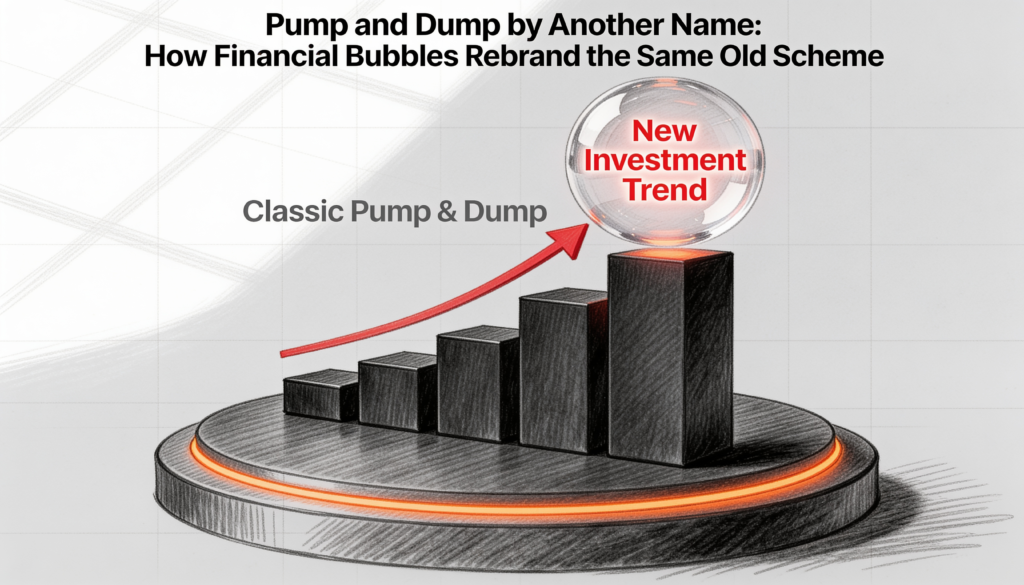
There is a reliable pattern in financial markets that has nothing to do with price charts or earnings reports. Every few years, someone invents a new word, and that word does the work of separating people from their money. A pump and dump is one of the oldest tricks in finance: buy something cheap, talk it up, sell it to the people you just convinced, and walk away before the floor falls out.
The mechanics have not changed since the 1700s. What changes, every single time, is the language wrapped around the scheme. And that language is not an accident or a side effect. It is the actual product. When you understand that a pump and dump survives by rebranding rather than reinventing, you start to see the same skeleton wearing different costumes across centuries of financial history.
This article takes that idea seriously. We will examine why new words work so well, why the anatomy of a bubble never changes, why even rational people climb aboard, and why regulation always arrives a vocabulary cycle too late. By the end, you should be able to recognize the next pump and dump before it has a name you have heard.
The Name Is the Technology
Here is something worth sitting with. In most pump and dump operations, the narrative does more work than the asset. The thing being sold barely matters. What matters is the story, and the story always needs a word that did not exist five years ago.
In the late 1990s, the word was “dot com.” A company did not need revenue. It needed a URL. The presence of a website was treated as a business model, and anyone who questioned this was told they did not understand the future. Companies with no customers were valued like established utilities. The underlying mechanic was ancient. Early investors needed later investors to bid the price higher. The word, though, was new, and the newness was doing the heavy lifting.
Then came “subprime.” That was not a scam word on its face, but it was a piece of vocabulary that allowed an enormous amount of risk to sound like a boring technical category. Calling a loan “subprime” made it sound like a slightly less good version of something safe. It was not. But language has a way of sanding down sharp edges. If you call a dangerous thing by a dull name, people stop flinching.
More recently, we got “tokenomics.” Before that, “yield farming.” Before that, “ICO.” Each one described a variation on the same theme. New money comes in, old money goes out, and the word makes it feel like progress instead of recycling.
How to Spot the Trick in the Vocabulary
A useful test is to translate any new financial term into plain language and ask what is actually happening to the money. A “liquidity bootstrapping event” is, stripped of its costume, a method of selling a new asset to early buyers. “Staking rewards” frequently means that new deposits fund the returns paid to earlier depositors. The translation does not always reveal fraud, but it reliably reveals whether the value comes from production or from the arrival of the next buyer.
Why New Words Work So Well on the Human Brain
There is a concept in psychology called novelty bias. Humans are wired to pay more attention to things that feel unfamiliar. This is useful when you are scanning a savanna for threats. It is far less useful when you are evaluating a financial instrument that someone invented last month.
New vocabulary exploits this bias perfectly. When you hear a word you do not recognize, your brain shifts into learning mode. You become a student. And students, by definition, defer to teachers. The person explaining the new word to you holds temporary authority, and that authority is often enough to skip the part where you ask whether any of this actually makes sense.
This is why every cycle needs its own language. You cannot sell someone a pump and dump if you call it a pump and dump. But you can sell them a sophisticated sounding “decentralized yield protocol” with very little resistance at all.
You cannot sell a pump and dump by calling it a pump and dump. So the scheme buys itself a new name, and the name is the only innovation it ever needed.
The vocabulary serves another purpose too. It creates in groups and out groups. If you knew what “staking” meant in 2021, you were in. If you did not, you were out. Nobody wants to be out. So people learn the words, repeat the words, and eventually defend the words, all without noticing that the underlying structure is the same one that separated fools from their money in the South Sea Bubble of 1720.
The Costume Changes, but the Body Does Not
Strip away the language from any cycle and the anatomy is almost comically consistent. The same three stages appear every time, and learning to recognize them is the closest thing investors have to an early warning system.
Stage One: A Real Innovation
There is always a genuine kernel of something that works. The internet was real. Blockchain technology is real. This matters because it gives the new vocabulary a place to root itself. You cannot build a convincing new word on nothing. You need just enough substance to make the jargon feel earned.
Stage Two: The Innovation Gets Overstretched
The innovation gets stretched far beyond what it can actually do. The internet was transformative. That did not mean every website was a business. Distributed ledgers have real applications. That does not mean every token is an investment. The new vocabulary papers over the gap between what the technology genuinely does and what the promoters need you to believe it does.
Stage Three: Early Participants Make Real Money
This is the part that makes the whole thing resilient to criticism. What people miss is that early profits in a pump and dump are not evidence that it is legitimate. They are a feature of the design. The early returns are the marketing budget. Every visible winner becomes a free advertisement that pulls in the next wave of buyers, whose money pays the next round of visible winners.
The Surprisingly Rational Participant
Here is where it gets uncomfortable. A lot of people inside these schemes are not stupid. Some of them know exactly what they are participating in. They simply believe they will get out in time.
This is not irrational in the way most commentary suggests. If you understand the structure of a pump and dump and you enter early enough, you can make money. The problem is that everyone thinks they are early. Everyone thinks they will be the one to sell before the collapse. This is the same logic that makes every poker player at the table believe they are above average.
Finance has a name for this. It is called the greater fool theory, but even that framing is too generous. It implies there is one fool at the end. In practice, there are thousands. And they were not foolish when they entered. They were making a calculated bet that enough people would arrive after them. Sometimes that bet pays off, often enough to keep the pattern alive.
Pump and dumps do not survive because people are gullible. They survive because the incentive structure rewards participation right up until the precise moment it does not, and nobody rings a bell at the top.
This is the truly uncomfortable part. The scheme is not powered by stupidity. It is powered by a rational calculation that simply cannot be true for everyone at once. The exits are real, but they are narrow, and the door only fits the people who moved first.
Regulation Always Speaks Last Year’s Language
There is a mismatch that makes this cycle almost inevitable. Regulators, by design, are reactive. They write rules about the thing that just happened. The next scheme, by definition, will not look like the last one. It will carry a different name.
This is not a failure of regulation so much as a structural limitation. You cannot outlaw a word that does not exist yet. By the time “ICO” entered the regulatory vocabulary, the market had already moved on to “DeFi.” By the time rules began to catch up with DeFi, the action had shifted to something else with an equally clean acronym.
The result is a permanent lag, and that lag is not a bug in the system. It is the window through which every new cycle climbs. Anyone waiting for regulators to flag the next pump and dump in advance is waiting for the impossible, because the regulator cannot name a thing that has not yet been named by the people building it.
What Investors Can Do Instead
Since the rules will always trail the scheme, protection has to come from the investor rather than the agency. Three questions cut through most of the jargon. First, where do the returns actually come from, and does that source survive if no new buyers arrive? Second, who profits from convincing you, and what do they hold that they need you to buy? Third, is the asset producing value, or merely changing hands at higher prices? When the honest answers point toward the arrival of new buyers, you are likely looking at a pump and dump regardless of what it is called.
Why “This Time Is Different” Is Always the Same
The four most expensive words in investing, according to Sir John Templeton, are “this time is different.” What makes the phrase so durable is that it is occasionally true. Sometimes things genuinely are different. The internet really did change commerce. Mobile computing really did create new categories of business.
The problem is that the phrase gets borrowed by every scheme that needs a shield against skepticism. When someone says “this time is different” about a new token, a new platform, or a new financial product, they are making an implicit argument. They are saying that the old rules no longer apply. And the new vocabulary is offered as the evidence. If we have invented new words for it, the logic runs, it must be a new thing.
But language is cheap. Creating a new word costs nothing. And the return on investment for a well chosen piece of jargon is extraordinary. A single term can move billions of dollars by making the future sound like it has already been decided and you are simply late to the party.
The Honest Question Nobody Wants to Ask
If every generation falls for the same scheme wearing different clothes, what does that say about markets? One reading is purely cynical. People are greedy and gullible, and nothing will ever change. But that reading is too simple and probably wrong.
A more interesting reading is that pump and dumps are the dark reflection of something genuinely valuable. The same optimism that funds real innovation also funds fraud. The same willingness to bet on the future that built Silicon Valley also built every crypto rug pull. You cannot have one without risking the other.
This does not make fraud acceptable. But it does suggest that the instinct behind it is not stupidity. It is misplaced hope. And hope, unlike greed, is not something you can regulate out of existence.
The vocabulary will keep changing. The next cycle will bring a word none of us have heard yet, and it will sound intelligent, and it will describe something old, and a great many people will believe it anyway. Not because they are fools, but because the distance between innovation and imitation has always been measured in language. And language, as it turns out, is the cheapest thing to manufacture and the most expensive thing to see through.