Table of Contents
There is a particular kind of madness that takes hold in boardrooms and earnings calls every quarter. It sounds like this: “Our strategy is to grow revenue by 20% year over year.” Everyone nods. The slide advances. Nobody asks the obvious question.
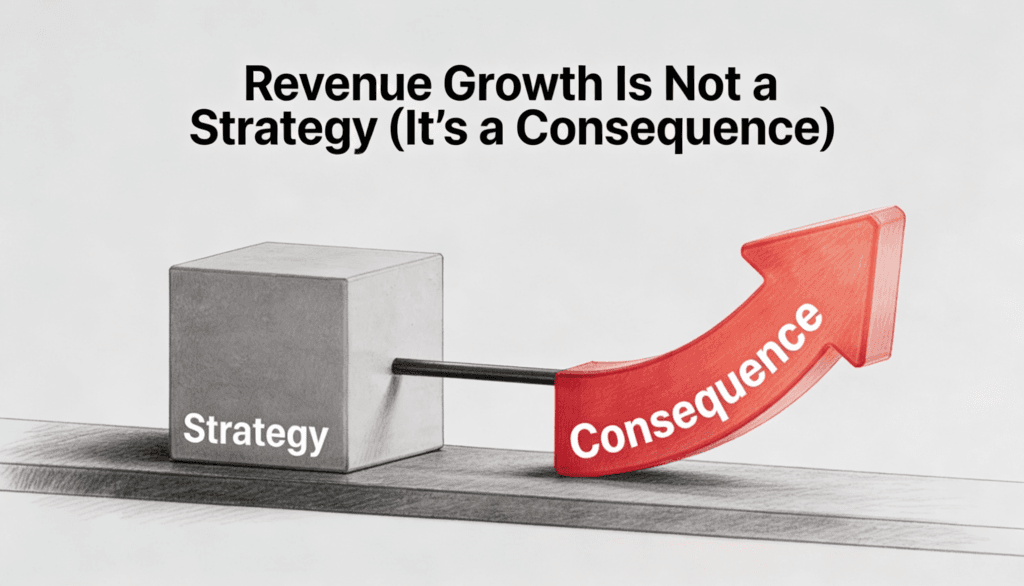
What if revenue growth is not something you do, but something that happens to you when you do other things well?
This distinction matters more than it seems. Confusing a consequence for a strategy is like confusing a fever for a disease. You can treat the fever all you want. The underlying infection does not care about your Tylenol.
The Confusion at the Center
Most companies, when pressed on their strategy, will eventually point to a revenue target. Grow the top line. Expand into new markets. Increase average order value. These are not strategies. These are desires dressed up in spreadsheets.
A strategy is a coherent set of choices about where to play and how to win. It involves trade offs. It requires saying no to certain opportunities so you can say yes to others with more conviction. Revenue growth, by contrast, requires saying yes to everything and hoping the math works out.
This is not a minor semantic argument. The difference between a strategy and a revenue target is the difference between a chess player thinking three moves ahead and someone just trying to capture as many pieces as possible. One of them wins games. The other one looks busy.
The problem is that revenue growth feels strategic. It has numbers attached to it. You can put it on a dashboard. You can tie bonuses to it. It has all the aesthetic qualities of a real plan without any of the intellectual substance. It is the business equivalent of wearing a lab coat and calling yourself a scientist.
Why the Illusion Persists
There is a reason this confusion is so persistent, and it is not because executives are unintelligent. It is because revenue growth is the most visible metric in business. It is the thing analysts ask about first. It is the thing that makes headlines. It is the thing that, when it goes up, makes everyone feel like a genius.
Revenue growth is also seductive because it appears to solve every problem simultaneously. Margins too thin? Grow revenue and you will get scale economies. Culture struggling? Nothing fixes morale like a growing business. Investors restless? Show them an upward sloping line and watch the concern evaporate.
Except none of this actually works the way it seems to. Plenty of companies have grown their way into bankruptcy. Revenue is vanity. It always has been. The graveyard of business is filled with companies that had spectacular top line growth and absolutely no idea what they were doing underneath it.
WeWork had extraordinary revenue growth. Pets.com tried to chase aggressive growth strategies. So did dozens of companies that no longer exist. They did not fail because they lacked revenue ambition. They failed because they mistook the scoreboard for the game.
The Inversion That Matters
Here is the part that tends to make people uncomfortable. The companies with the most durable revenue growth are usually the ones that do not obsess over revenue growth.
This is counterintuitive, so let me say it differently. When you focus on building something genuinely valuable, on solving a real problem better than anyone else, on creating an experience that people cannot easily replace, revenue growth becomes almost inevitable. It is a byproduct. A side effect. A consequence of getting the important things right.
Apple under Steve Jobs is the textbook example, but it is also the most overused one, so consider Costco instead. Costco does not chase revenue growth. Costco chases a very specific strategy: offer the best value on a curated selection of products, pay employees well enough to reduce turnover, and keep margins deliberately thin. The revenue growth follows. It has followed for decades. But it follows because the strategy is coherent, not because someone put a growth target on a PowerPoint slide.
This inversion shows up in almost every field, not just business. In medicine, you do not target “being healthy” as a strategy. You exercise, sleep well, manage stress, and eat reasonable food. Health is the consequence. In agriculture, you do not target “a great harvest.” You prepare the soil, choose the right seeds, water consistently, and manage pests. The harvest is the consequence.
Revenue growth works the same way. It is the harvest. And you do not get a better harvest by staring at the field and wishing the crops would grow faster.
What Actually Drives Revenue (When You Stop Chasing It)
If revenue growth is a consequence, then the natural question is: a consequence of what?
The answer varies by business, which is precisely the point. A real strategy is specific to a specific context. But there are patterns worth noting.
Compounding customer trust. The most undervalued asset in business is the kind of trust that makes customers stop comparison shopping. When someone buys from you without checking three competitors first, that is not brand loyalty in the marketing sense. That is earned trust, and it compounds like interest. Each positive interaction makes the next purchase more likely and less price sensitive. Revenue grows not because you chased it, but because you built something people do not want to leave.
Operational clarity. Companies that know exactly what they are good at and, more importantly, what they are not good at tend to grow more consistently than companies that chase every adjacent opportunity. There is a paradox here. Narrowing your focus often widens your revenue. Saying no to the wrong customers creates more capacity for the right ones. This is uncomfortable for growth oriented cultures because it means deliberately leaving money on the table in the short term. But the long term math is almost always in your favor.
Product density. This is the idea that each dollar of revenue should become slightly easier to earn than the previous one. Not because you are cutting corners, but because each product improvement or service enhancement makes the overall offering more valuable. The eighth feature you add might be the one that makes the product indispensable rather than merely useful. Revenue grows because the thing you sell keeps getting better, not because you hired more salespeople.
None of these are particularly glamorous. None of them fit neatly on a quarterly earnings slide. All of them work.
The Damage Done by Revenue as Strategy
When you elevate revenue growth from consequence to strategy, specific and predictable damage follows.
The first casualty is margin quality. Teams that are told to grow revenue will find ways to grow revenue. They will discount. They will take on unprofitable customers. They will sign contracts that look great on the top line and devastating on the bottom line. They will, in essence, buy revenue. And buying revenue is not the same as earning it, in the same way that buying friends is not the same as making them.
The second casualty is strategic coherence. When growth is the strategy, everything that grows is good and everything that does not grow is bad. This makes it nearly impossible to invest in long term capabilities that do not pay off immediately. Research and development gets cut. Brand building gets deferred. Infrastructure gets patched instead of rebuilt. The company optimizes for next quarter at the expense of next decade.
The third casualty, and this one is subtle, is organizational honesty. When revenue growth is the defining metric, people stop telling the truth about what is working and what is not. Bad products get propped up because they generate revenue. Failing markets get defended because abandoning them would hurt the number. The entire organization develops a kind of institutional denial where the revenue line becomes more real than the underlying business reality.
This is how companies die. Not suddenly, but slowly, from the inside out, while the revenue chart still looks fine.
The Berkshire Lens
Warren Buffett has spent decades saying some version of this idea, though he frames it differently. When he evaluates a business, he does not start with revenue growth. He starts with competitive advantage. He asks whether the business has what he calls a moat, something that protects it from competition and allows it to earn superior returns over time.
The moat is the strategy. Revenue growth is what happens when the moat holds.
This is why Buffett has historically avoided high growth companies that cannot explain their advantage in simple terms. Growth without a moat is just a company running faster on a treadmill. It looks impressive. It goes nowhere.
Charlie Munger put it even more bluntly. He expressed an idea that a business that earns 12% returns and reinvests everything is a far better investment than a business that grows revenue at 20% but earns 4% returns. The first company is compounding real value. The second company is compounding activity. Revenue growth, in Munger’s framing, is noise. Return on invested capital is signal.
This is not an argument against growth. It is an argument against mistaking growth for strategy. The best companies grow. But they grow because they deserve to, not because they declared that they would.
Truth About Patience
Everything about modern business culture pushes against what I am describing here. Quarterly reporting cycles demand visible growth. Venture capital timelines compress the window for results. Social media celebrates speed. The entire incentive structure of corporate life rewards people who make the number go up now, regardless of what it costs later.
This creates an environment where genuine strategy, the slow and deliberate work of building something that compounds, feels almost irresponsible. The CEO who says “we are not targeting revenue growth this year because we are rebuilding our supply chain” is not rewarded with patience and understanding. That CEO is rewarded with a declining stock price and a strongly worded letter from an activist investor.
So What Do You Actually Do?
If you run a business or invest in one, the practical implication is this: stop asking “how do we grow revenue?” and start asking “what are we building that would make revenue growth inevitable?”
The first question leads to tactics. Sales pushes. Marketing campaigns. Price adjustments. Geographic expansion. These are not bad things, but they are not strategy. They are activity.
The second question leads to something harder and more valuable. It forces you to articulate why your business deserves to exist, what you do better than anyone else, and what investments you need to make today so that tomorrow takes care of itself.
Revenue growth is not a strategy. It never was. It is the receipt you get after doing the real work. And the real work, the messy and unglamorous work of building genuine competitive advantage, is the only thing that has ever actually mattered.
The next time someone presents a “growth strategy” that is really just a revenue target with a timeline, ask them one question: growth from what?
If they cannot answer that clearly and specifically, you are not looking at a strategy. You are looking at a wish.