Table of Contents
Money is old. Portfolio theory is not. But the instinct behind portfolio theory – do not put everything in one place – is arguably older than written language itself. Long before Harry Markowitz published his Nobel Prize winning work in 1952, merchants in Florence, traders in Constantinople, and farmers in Mesopotamia were already practicing diversification. They just did not call it that. They called it survival.
What makes pre-industrial finance fascinating is not that it was primitive. It is that it was, in many ways, more creative than what we do today. When you cannot open a brokerage account or buy an index fund, you have to think harder about where to put your wealth. And thinking harder, it turns out, sometimes produces better thinking.
The Medici Model: Banking Was the Side Hustle
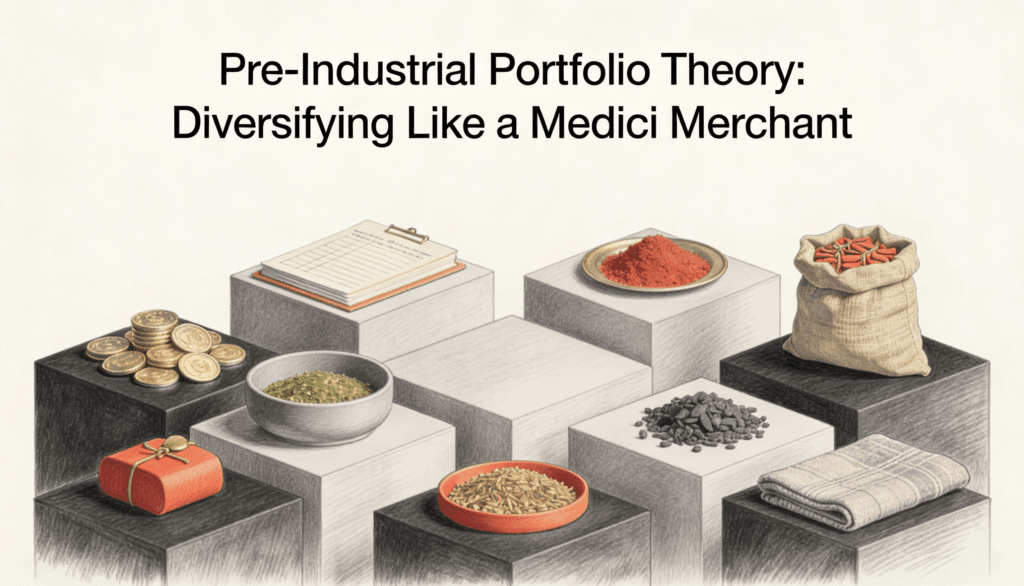
The Medici family is remembered as bankers, but that label undersells the operation. Their portfolio, if we can call it that, included wool manufacturing, silk trading, mining interests, agricultural land, church financing, and political influence so deep it functioned as its own asset class. They did not just diversify across industries. They diversified across the very categories of power.
This is the part that modern investors tend to miss. We think of diversification as spreading money across stocks, bonds, and maybe some real estate. The Medici understood something more fundamental. Wealth is not just financial. It is social, political, and reputational. A loan to the Pope was not simply a financial instrument. It was an insurance policy against political ruin, a marketing campaign, and a power play all wrapped into one transaction.
The genius was not in any single investment. It was in how the pieces connected. When the wool business suffered, the bank carried the family. When banking hit trouble during a credit crisis, the agricultural holdings kept producing. And when everything economic went sideways, the political capital bought time to recover. This is portfolio theory in its most ambitious form, applied not just to money but to the entire architecture of survival.
Grain Storage as the Original Savings Account
Thousands of years before the Medici, Mesopotamian farmers had their own version of diversification. They stored grain. This sounds unremarkable until you consider what grain storage actually represented in a world without currency as we know it.
Grain was money. It was also food. It was also a tradeable commodity, a unit of account, and a store of value. In economic terms, it performed nearly every function we now spread across multiple financial instruments. A farmer with a full granary was simultaneously holding a savings account, a commodity position, and an emergency fund.
But here is where it gets interesting. Grain spoils. Rats eat it. Floods destroy it. So Mesopotamian communities developed temple systems where grain could be pooled, recorded, and redistributed. The temple was not just a religious institution. It was a proto-bank, a warehouse receipt system, and arguably the first clearinghouse in human history. The priests were portfolio managers in robes.
This arrangement reveals something counterintuitive about early economies. We assume that financial sophistication requires financial instruments. But these societies achieved remarkable complexity using physical goods and social trust. The instruments were different. The logic was the same.
Ships and the Birth of Venture Capital
Medieval maritime trade might be the clearest pre-industrial example of modern portfolio thinking. A merchant in Venice or Genoa faced a brutal reality. Ships sank. Pirates existed. Storms did not check the cargo manifest before striking. Any single voyage could mean total ruin.
The solution was elegant. Instead of funding one ship entirely, a merchant would buy shares in multiple voyages. Different ships, different routes, different captains. Sound familiar? It should. This is exactly the logic behind a diversified equity portfolio. Except the assets were made of wood and the dividends were paid in spices.
The commenda contract, widely used across Mediterranean trade, formalized this arrangement. One partner supplied the capital. Another supplied the labor and expertise. Profits were split according to a predetermined ratio. Losses were absorbed primarily by the capital provider, while the traveling merchant risked life and limb but not personal savings.
This structure is strikingly similar to modern limited partnership agreements in venture capital and private equity. The silent money partner takes financial risk. The active partner takes operational risk. Both share the upside. The medieval Italians did not invent venture capital in name, but they absolutely invented it in substance.
What makes this especially instructive is the risk awareness baked into the system. These merchants did not need spreadsheets to understand correlation. They knew intuitively that a storm in the Adriatic probably would not also destroy a ship in the North Sea. Geographic diversification was not a theory they read about. It was a pattern they lived.
Land: The Asset That Never Logged Off
Across nearly every pre-industrial society, land held a special place in the wealth portfolio. Not because people had read anything about real assets or inflation hedges, but because land had a quality that nothing else could match. It did not disappear.
Ships sank. Coins were debased. Trade routes shifted. Political alliances collapsed. But the field outside town was still there in the morning. This permanence gave land an almost gravitational pull in pre-industrial wealth strategies. Successful merchants in medieval England, Ming Dynasty China, and Mughal India all followed the same playbook. Make money in trade, then convert it into land as quickly as respectability would allow.
This was not just financial strategy. It was social strategy. In most pre-industrial societies, land ownership conferred status that mercantile wealth simply could not buy. A rich trader was tolerated. A landowner was respected. Converting commercial profits into acreage was the medieval equivalent of a tech founder buying a ranch in Montana. The asset itself mattered, but what it signaled mattered more.
There is a lesson here that modern portfolio theory tends to overlook. Assets carry meaning beyond their financial characteristics. A government bond and a rental property might offer similar returns, but they say very different things about who you are and how you relate to the world around you. Pre-industrial investors understood this instinctively. Every allocation was also a statement.
Diversifying Across Time: The Long Game
One of the most sophisticated strategies in pre-industrial finance was diversifying across time itself. This took many forms, but the most interesting was the widespread practice of extending credit across generations.
Jewish banking families in medieval Europe, for example, operated lending networks that spanned decades and continents. A loan made in one generation might not be fully repaid until the next. Family reputation served as the collateral, and the family name was the brand. The time horizon was not quarterly earnings. It was dynastic continuity.
This multigenerational thinking produced a kind of diversification that modern investors rarely practice. When your investment horizon is measured in lifetimes rather than fiscal years, you make fundamentally different decisions. You tolerate illiquidity. You invest in relationships that may not pay off for decades. You plant trees whose shade you will never sit in, as the proverb goes.
The Japanese concept of shinise – businesses that have operated for centuries – reflects a similar philosophy. Some Japanese firms have survived for over a thousand years, not by chasing growth but by prioritizing resilience. They diversified across time by choosing stability over expansion, modest returns over spectacular ones. In a world obsessed with disruption, these are the businesses that refused to be disrupted.
The Social Portfolio: Trust as an Asset Class
Perhaps the most underappreciated form of pre-industrial diversification was social. In economies where contracts were hard to enforce and legal systems were unreliable at best, personal relationships were not just nice to have. They were load-bearing infrastructure.
A merchant in the Islamic Golden Age did not just diversify goods and routes. He diversified relationships. Business partnerships, family alliances, religious community ties, and patron-client networks all functioned as distinct positions in a social portfolio. Each relationship carried different risks and offered different protections. A business partner might help during a trade dispute. A religious community might provide shelter during political upheaval. A well placed patron might intervene when the law turned hostile.
The implication for modern investors is provocative. We have largely replaced social trust with institutional trust. We rely on courts, regulations, and standardized contracts instead of personal relationships. This is efficient, but it also means we have lost a form of diversification that our ancestors considered essential. When institutions fail, as they occasionally do, the people with deep social networks recover faster than those with merely deep pockets.
What the Old World Still Teaches
The temptation when studying pre-industrial finance is to treat it as a charming prologue to the real story. Interesting but irrelevant. Colorful but obsolete. This is a mistake.
The core insight of pre-industrial diversification is that wealth is multidimensional. It is not just money. It is land, relationships, reputation, knowledge, political access, and stored grain. Modern portfolio theory narrowed this expansive view into a mathematical framework focused almost entirely on financial assets. That narrowing was powerful. It gave us tools and precision. But it also made us forget that the original diversifiers were playing a much bigger game.
When a Medici banker bought farmland, he was not just hedging his bond portfolio. He was buying food security, social status, political leverage, and a legacy for his grandchildren. When a Venetian merchant split his investment across five ships, he was not calculating correlation coefficients. He was refusing to let one bad storm end his family.
The math came later. The wisdom came first.
Modern investors with their apps and algorithms have access to more instruments, more data, and more markets than any Medici could have imagined. But the question worth asking is whether all that access has actually made us better at the fundamental task. Spreading risk, building resilience, and thinking about wealth as something bigger than a number on a screen.
The merchants of the pre-industrial world had fewer tools. But they might have had a clearer view of what diversification actually means. Not just owning different things, but building a life that can survive whatever comes next.
That, more than any efficient frontier or Sharpe ratio, is the point.