Table of Contents
Money in Pre-Industrial Societies
You would think that a group of monks who took vows of poverty would be the last people to invent banking. But history has a sense of humor, and the Knights Templar are the punchline.
In the 12th century, a small order of warrior monks set out to protect Christian pilgrims traveling to Jerusalem. Within a few decades, they were running what was arguably the most sophisticated financial network in the medieval world. They did not plan it. They stumbled into it because they were solving a very practical problem: how do you move money across a continent without getting robbed?
The answer they came up with would shape finance for the next nine hundred years.
The Problem That Created the Solution
To understand what the Templars built, you first need to understand what moving wealth looked like in the 12th century. There were no wire transfers. No checks. No central banks. If you were a French lord heading to the Holy Land on crusade, you had to physically carry your gold and silver with you. Across mountains. Across seas. Through territories crawling with bandits who knew exactly what crusaders were carrying.
This was not just inconvenient. It was suicidal. The roads of medieval Europe were essentially open air robbery corridors. Carrying your wealth on your person was an invitation to lose both the wealth and the person.
The Templars recognized something that most people around them did not. The problem was not money itself. The problem was that money and the person holding it had to be in the same place at the same time. If you could separate the value from the physical object, you could move wealth without moving anything at all.
This is, stripped to its essence, the founding insight of modern banking.
Letters of Credit and the Birth of Abstract Money
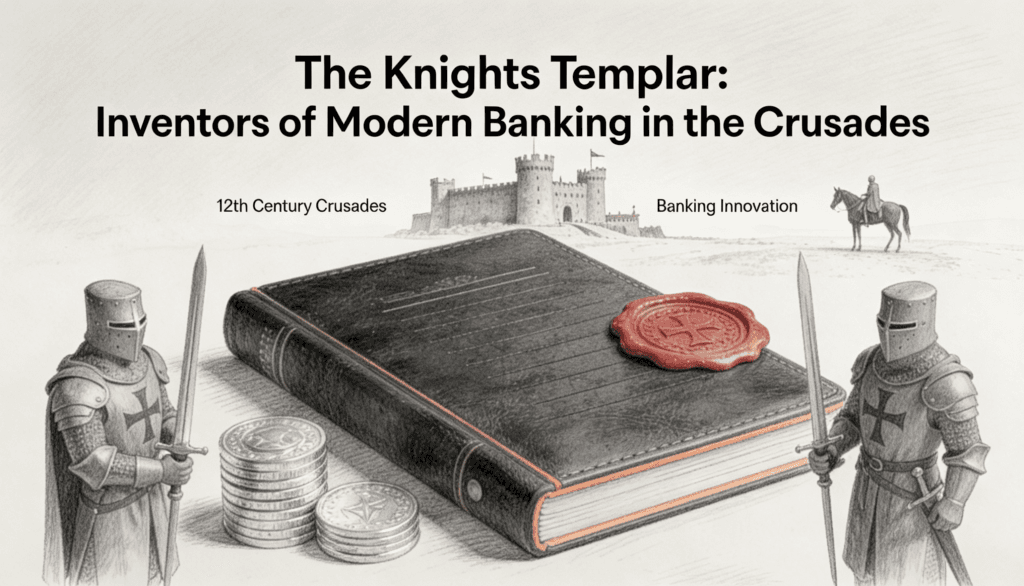
Here is how it worked. A pilgrim or crusader would visit a Templar preceptory in, say, Paris. He would deposit his gold and receive a letter of credit. This was a coded document that recorded the value of his deposit. He could then travel to Jerusalem carrying nothing but a piece of paper. Upon arrival, he would visit the Templar house there, present his letter, and withdraw funds in local currency.
Read that again. A warrior monk in a stone fortress just invented the traveler’s check. In the 1100s.
What makes this extraordinary is not just the mechanical innovation. It is the conceptual leap. The Templars understood, whether consciously or not, that money is not really a thing. It is information. A gold coin is just a way of encoding information about value. If you can encode that same information on a piece of parchment and create a trusted system for decoding it on the other end, the gold becomes unnecessary for the transaction itself.
This is the same principle behind every digital payment you make today. Your bank balance is not a pile of cash sitting in a vault. It is a number in a database. The Templars figured out the abstraction. They just used wax seals instead of encryption software.
Trust as Infrastructure
But the letter of credit only works if both parties trust the system. And this is where the Templars had an advantage that no secular institution could match.
They were a religious order. They answered to the Pope. They operated across national borders with a level of institutional consistency that no kingdom could achieve. A Templar preceptory in London operated under the same rules as one in Acre. The same hierarchy. The same accountability. The same brand, if you want to think of it that way.
In a world where trust between strangers was almost nonexistent, the Templars were the closest thing to a universally recognized institution. Kings could not always trust other kings. Merchants could not always trust other merchants. But almost everyone could trust a monk who had sworn an oath before God and who belonged to an order with a reputation to protect across an entire continent.
This is a point that modern finance still has not fully internalized. We tend to think of banking as a mechanical process. Deposits, withdrawals, interest rates, leverage. But underneath all of it is trust. Every financial system in history has been built on the willingness of people to believe that the system will honor its commitments. The Templars did not just create financial instruments. They created the institutional credibility that made those instruments work.
It is worth noting that this is exactly what collapses first when a financial system fails. Not the mechanics. The trust.
Lending to Kings and the Invention of Sovereign Debt
The Templars did not stop at letters of credit. Once they had built a network of deposits across Europe and the Middle East, they found themselves sitting on enormous pools of capital. And they did what anyone sitting on a pool of capital eventually does. They started lending it out.
Their clients were not peasants or small merchants. They were kings.
The English Crown borrowed from the Templars. So did the French Crown. The Templars financed wars, infrastructure, and the general operating expenses of medieval governance. They charged interest, though they were careful to structure it in ways that technically complied with the Church’s prohibition on usury. The fees were framed as service charges or penalties for late repayment rather than interest in the explicit sense.
If this sounds familiar, it should. The creative repackaging of interest payments to satisfy regulatory or moral constraints is a tradition that has survived into the 21st century with remarkable vitality. Every era finds its own euphemisms.
But the deeper point here is structural. When a private institution lends money to a sovereign government, it creates a relationship of mutual dependency that is inherently unstable. The government needs the lender’s capital. The lender needs the government’s protection. As long as both sides honor the arrangement, it works beautifully. But the moment one side decides the cost of honoring it exceeds the cost of breaking it, the system collapses.
The Templars would learn this lesson in the most brutal way imaginable.
A Diversified Medieval Conglomerate
By the 13th century, the Templars were not just bankers. They owned farms, vineyards, mills, and entire villages. They had a fleet of ships. They manufactured goods. They managed real estate portfolios across multiple countries.
If you squint, this looks remarkably like a modern diversified holding company. Revenue streams from agriculture, manufacturing, logistics, real estate, and financial services. The Templars had, without using the vocabulary, built something resembling a vertically integrated conglomerate with a financial services arm at its center.
And this is where an interesting parallel with modern finance emerges. The most powerful financial institutions today are not just banks. They are ecosystems. They combine lending, asset management, insurance, real estate, and technology into interconnected structures where each part supports and depends on the others. The Templars arrived at this model not through business school theory but through the practical logic of running an international organization that needed to feed soldiers, move money, build castles, and maintain political relationships simultaneously.
The structure emerged from the needs. The theory came centuries later.
The Fall and Its Lesson
On Friday, October 13, 1307, King Philip IV of France ordered the arrest of every Templar in the country. The charges included heresy, corruption, and various other accusations that were almost certainly fabricated. The real motive was simpler. Philip was deeply in debt to the Templars, and destroying the order was more convenient than repaying the loans.
This is the part of the story that reads like a parable, because it essentially is one.
The Templars had made a classic error. They had become so financially powerful that they posed an existential threat to their largest borrower. They had leverage over the king but no mechanism to enforce it. In modern terms, they had massive credit exposure to a single counterparty who also happened to control the army.
There is a saying in banking that goes something like this: if you owe the bank a thousand dollars, the bank owns you. If you owe the bank hundred million dollars, you own the bank. Philip IV understood this principle intuitively. The Templars, for all their financial sophistication, did not.
The order was dissolved by papal decree in 1312. Its assets were transferred to other organizations. Its leaders were burned at the stake. The most advanced financial institution of the medieval world was destroyed not by market forces or mismanagement but by the political power of a debtor who found it cheaper to kill his creditor than to pay his bills.
What Survived
The Templars vanished, but their innovations did not. The letter of credit evolved into the bill of exchange, which evolved into the check, which evolved into the electronic transfer. The principle of separating the representation of value from its physical form continued to develop through the Italian banking houses of the Renaissance, through the joint stock companies of the 17th century, through the central banks of the 18th and 19th centuries, all the way to the digital financial infrastructure of today.
The Templars also demonstrated something about money that remains counterintuitive to most people. Money is not wealth. Money is a technology for moving wealth. Gold sitting in a chest does nothing. Gold encoded as information and transmitted across a network creates economic activity, enables trade, and multiplies the productive capacity of everyone in the system.
The monks who swore vows of poverty understood this better than most of the wealthy people they served. Perhaps that is the most ironic part of the whole story. The people who renounced personal wealth ended up understanding the nature of money more deeply than anyone else in their century.
The Bigger Picture
When we look at the history of finance, we tend to focus on instruments and institutions. Interest rates, bond markets, central banks, regulations. But the Templar story suggests that the real history of finance is a history of ideas about trust, information, and power.
Every major financial innovation has been, at its core, a new way of encoding trust. The letter of credit trusted that the Templars would honor their commitments across borders. A banknote trusts that the issuing government will maintain its value. A stock certificate trusts that the company will operate honestly. A blockchain trusts that the mathematics will hold.
The Templars did not set out to invent banking. They set out to protect pilgrims. But in solving the practical problems of their mission, they stumbled onto principles that turned out to be universal. Money is information. Trust is infrastructure. And the most dangerous position in finance is being owed more than your debtor can afford to repay.
Nine centuries later, we are still learning the same lessons. We just have better spreadsheets.