Table of Contents
Why Recency Bias Tricks Your Brain Into Confusing the Last 12 Months for the Next 30 Years
There is a particular kind of confidence that comes from looking at a chart that only goes back one year. It feels like knowledge. It looks like research. In reality, it is a very expensive form of nostalgia dressed up as analysis. This is recency bias in investing, the mental habit that convinces otherwise intelligent people that whatever just happened is whatever will keep happening.
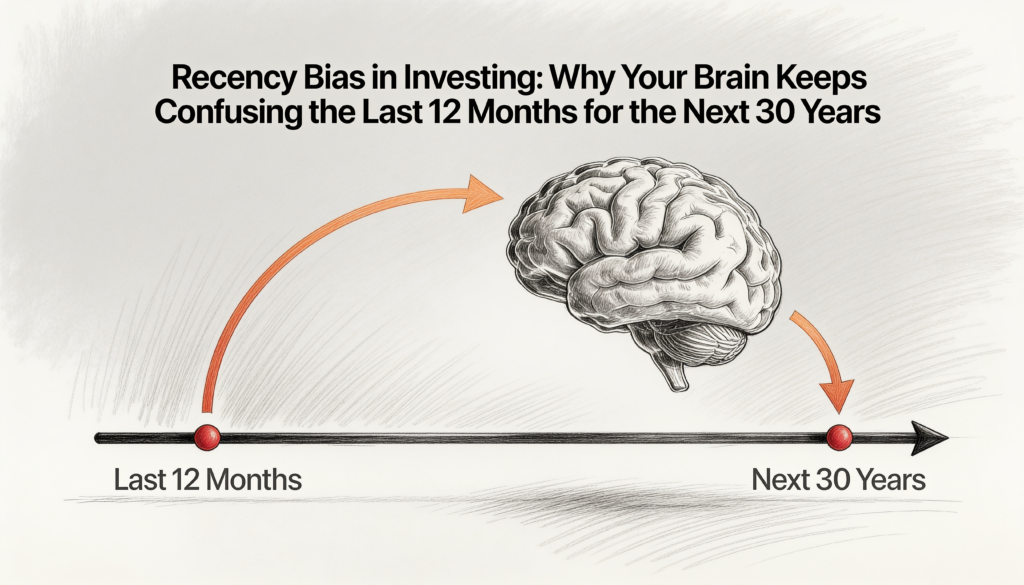
Recency bias is the reason people pile into technology stocks after a bull run, flee to cash after a correction, and treat the last four quarters as though they were a prophecy carved into stone. It is pattern matching with a tragically small sample size. And if you believe you are immune to it, you are very likely the most vulnerable person in the room. The entire premise of long term investing assumes a 30 year horizon, yet your brain keeps grabbing the most recent 12 months and treating that sliver as the whole story.
The Mind Was Not Built for Markets
To understand why recency bias is so persistent, it helps to understand what your brain was actually designed to do. The short answer is that it was built to keep you alive, not to build you a portfolio.
Tens of thousands of years ago, if you saw a lion at the watering hole 3 days in a row, the intelligent move was to assume there would be a lion at the watering hole on day 4. The penalty for ignoring recent data was death. The penalty for overweighting recent data was, at worst, walking a little further to find water. Evolution did not optimize human beings for asset allocation. It optimized us for not getting eaten.
This is the root of the entire problem. The same mental shortcut that kept your ancestors alive is the one that makes you look at last year’s best performing fund and think, “that is where my money belongs.” Your brain is doing exactly what it evolved to do. It is also doing exactly the wrong thing.
Financial markets are not watering holes. The lion does not keep showing up on schedule. The moment everyone assumes the lion will appear is precisely when it has moved on, and a completely different threat is approaching from a direction nobody was watching.
The instincts that served us on the savanna actively sabotage us in capital markets, because markets are adversarial systems where the obvious pattern is often already exhausted by the time you notice it.
The Twelve Month Window Is a Peculiar Drug
There is something almost narcotic about trailing 12 month returns. They are recent enough to feel relevant, long enough to seem like a genuine trend, and short enough to hide almost everything that actually matters.
Consider how strange the 12 month frame really is. It represents roughly 252 trading days. In the context of a 30 year investing horizon, that is less than 4 percent of the total timeline. Yet people routinely use this thin slice to make decisions about the other 96 percent. It is like reading a single chapter of a novel and then writing a full review with complete confidence.
Why the Industry Loves the One Year Number
The financial industry, to both its credit and its shame, understands this perfectly. Fund advertisements display trailing returns with the precision of a Swiss watchmaker. The one year figure is always there, bright and prominent, because it is the number most likely to provoke action. Nobody panic sells because of a 5 year chart. Nobody panic buys because of a 20 year trend. Show someone a 12 month rocket ship, however, and the wallet opens almost involuntarily.
What makes this especially dangerous is that recency bias does not feel like a bias at all. It feels like being well informed. You read the news. You checked the numbers. You saw the trend. The problem was never a lack of information. It was a surplus of the wrong kind.
The Rearview Mirror Problem
Here is a thought experiment borrowed from driving, because the analogy is almost too perfect. Imagine someone who drives entirely by looking in the rearview mirror. They can see every turn they have already made with perfect clarity. They know exactly where they have been. And they are absolutely convinced that this backward looking data will tell them what is around the next corner.
This is how many people invest. They look at what has already performed, assume it will keep performing, and drive forward while staring backward. The results are predictable in the statistical sense and shocking in the personal sense, because the crash always seems to arrive out of nowhere, even though the method guaranteed it would arrive eventually.
Momentum Is Not the Same as Recency Bias
The tricky part is that the rearview mirror is sometimes right. Markets do trend. Momentum is real. But momentum and recency bias are not the same thing, even though they feel identical from the inside.
Momentum is a quantifiable factor with decades of rigorous academic research behind it. It is measured, tested, and bounded by rules. Recency bias, by contrast, is a cognitive distortion wearing momentum’s clothes. It borrows the credibility of a real phenomenon while skipping all of the discipline. The difference between them is the difference between a pilot using instruments and a passenger guessing the altitude by how their stomach feels.
What History Actually Shows
If you zoom out far enough, the data on recency bias becomes almost comically clear. The sectors and asset classes that dominate one period rarely dominate the next. There are tables that track annual asset class performance, sometimes called quilt charts, and they look like patchwork designed by someone with no interest in patterns whatsoever.
What was on top falls to the bottom. What was at the bottom rises to the top. The sequence resists prediction with an almost deliberate stubbornness. Yet every single year, money chases last year’s winners. Investors collectively behave as though the quilt will finally stop rearranging itself. This time, the winning streak will hold. This time is different.
Those 3 words, “this time is different,” might be the most expensive sentence in the entire history of capital markets.
The danger is not that things never change. They do change. The danger is that the people saying it are almost never basing the claim on structural analysis. They are basing it on the fact that their recent experience has been pleasant, and they would very much like it to continue. A pleasant feeling is not a forecast, even though it can masquerade as one with remarkable conviction.
The Emotional Architecture of Bad Decisions
Recency bias does not operate alone. It brings friends, and together they form something far more dangerous than any single distortion.
- Confirmation bias makes you notice information that supports your recent experience while quietly ignoring information that contradicts it.
- Availability bias makes vivid recent events feel more probable than they actually are, simply because they are easy to recall.
- Herding applies the social pressure to do whatever everyone around you is doing, which is almost always whatever worked most recently.
Together these biases create something like an emotional architecture. A structure that feels solid, that feels like reason itself, but that is built entirely on the foundation of “this is what just happened, so this is what will happen next.”
Why Knowing About the Bias Is Not Enough
The psychologist Daniel Kahneman spent a career documenting how this architecture operates. His central insight was that humans run on 2 systems of thinking. One is fast, intuitive, and emotional. The other is slow, deliberate, and analytical.
Recency bias lives in the fast system. It arrives before you have time to think. By the moment the slow system finally catches up, the trade is already placed, the allocation has already shifted, and the damage is already in motion. This is precisely why simply knowing about recency bias does not fix the problem. You cannot out think a process that happens before thinking begins. What you need instead are systems, rules, and structures that operate independently of how you feel about last quarter.
The Graveyard of Obvious Bets
One of the most counterintuitive aspects of investing is that the most obvious bets tend to produce the most disappointing results. Not always, but often enough to deserve your attention.
When an investment feels obvious, when everyone agrees it is the correct move, when recent returns have made it the talk of every dinner party and financial podcast, that consensus is usually already reflected in the price. You are not discovering an opportunity. You are arriving at a party that started hours ago, and the best conversations have already happened.
The investments that produce outsized returns over long periods tend to be the ones that felt uncomfortable at the point of purchase. They were unloved, ignored, or actively feared. This is not a universal law, and contrarianism for its own sake is just as foolish as trend following for its own sake. But it is worth noticing that the most recent past is almost always where comfort lives, and comfort in investing is frequently an expense disguised as a feeling.
Shifting Baselines: Recency Bias on a Longer Timescale
There is a concept in ecology called shifting baseline syndrome. It describes how each generation of scientists accepts the environmental conditions they first encountered as normal, even when those conditions represent a badly degraded state compared to earlier periods.
A marine biologist studying fish populations today might treat current depleted levels as the baseline, entirely unaware that the same stocks were 10 times larger 50 years earlier. The reference point quietly resets, and the loss becomes invisible.
The Era You Happened to Inherit
Investors suffer from exactly the same syndrome. Whatever conditions you entered the market in become your baseline for normal. If you started investing during a decade of low interest rates, near zero rates feel ordinary and any increase feels extreme. If you started during a period of high volatility, calm markets begin to feel suspicious, almost ominous.
Your personal starting point becomes the invisible frame through which you interpret everything that follows. The most dangerous part is that you cannot see the frame, because you are standing inside it.
This is recency bias stretched across a longer timescale. It is not merely the last 12 months shaping your decisions. It is the entire era you happen to inhabit, mistaken for permanent reality.
What Actually Works Against Recency Bias
If the diagnosis is clear, the prescription is frustratingly simple. That simplicity is probably why so few people actually follow it.
Extend Your Time Horizon Operationally
First, extend your time horizon, not as an abstract principle but as an operational reality. If you are making decisions based on trailing one year data, force yourself to look at 3 years, 5 years, and 10 years instead. The longer the lookback period, the weaker the grip of recency bias. This works not because long term data is always correct, but because it dilutes the distortion of the recent past until it loses its power to panic you.
Automate the Decision Out of Existence
Second, automate wherever possible. Regular, systematic investing removes the human element at the exact point of decision. You do not have to overcome your biases if the money moves before your biases ever activate. This is not a sophisticated strategy. It is almost embarrassingly simple, and that simplicity is precisely why it works so reliably.
Study the History You Are Ignoring
Third, study the history you keep ignoring. Not the last 12 months. The last 100 years. Read about the panics, the manias, and the cycles that felt permanent and were not. Not because history repeats itself exactly, but because the emotional patterns repeat with remarkable fidelity. The technology changes. The asset class changes. The human reaction stays almost identical from one generation to the next.
Build In Deliberate Friction
Fourth, build in friction. Make it slightly harder to change your allocation. Add a waiting period before you act on a strong feeling. Write down your reasoning and revisit it a week later. Most recency driven impulses lose their intensity within days. The ones that survive the waiting period might actually be worth acting on, and you will be glad you filtered out the rest.
The Question Worth Asking Yourself
The honest truth is that you are probably both an investor and a historian of the last 12 months. Everyone is. The question is not whether recency bias affects you, because it absolutely does. The real question is whether you have built a process that accounts for it.
The most dangerous investor is not the one who lacks information. It is the one who has plenty of information, all of it recent, and mistakes that narrow slice for the entire picture. They are informed, confident, and wrong in a way that feels indistinguishable from being right.
Real investing is not about predicting what comes next. It is about acknowledging that you cannot predict what comes next and then structuring your decisions accordingly. It is less thrilling than trading on the latest trend. It makes for worse stories at dinner parties. And across the span of a lifetime, it is the only approach that reliably works.
So the next time you feel certain about where the market is heading, ask yourself a single question: is this conviction based on analysis or on memory? Because your memory, as vivid and persuasive as it feels, only covers about 4 percent of the timeline that actually matters. And 4 percent is not a strategy. It is the starting point for a very expensive mistake.