Table of Contents
The Same Trick, Played at Two Different Speeds
There are two ways to use other people’s money to get rich. One takes thirty years. The other takes thirty minutes. Both are forms of leverage, both can make you wealthy, and both can ruin you completely. The only real difference between them is the speed at which the consequences arrive.
Picture the real estate investor who borrows from a bank, buys a property, and waits patiently for decades. Now picture the WallStreetBets trader who borrows from a brokerage, buys options, and refreshes the screen every ninety seconds. Same principle. Wildly different vibes. One community celebrates patience, cash flow, and getting a fair deal on a duplex. The other celebrates screenshots of six figure gains earned during a lunch break.
And yet the underlying mechanics sit far closer together than either tribe would ever want to admit. This article introduces a single idea that ties them together: leverage velocity, the rate at which borrowed money translates into outcomes. Once you understand velocity, you stop arguing about whether leverage is good or bad and start asking the only question that actually matters, which is how fast the consequences of your debt arrive.
What Leverage Velocity Actually Means
Leverage is one of the few financial concepts that does not require a textbook. You borrow money, you invest it, and if the investment rises you gain more than you would have with your own cash alone. If it falls, you lose more. That is the entire mechanism. Everything else is decoration.
Real estate investors have practiced this for generations. You put a fraction of the purchase price down, a bank covers the remainder, and you control an asset worth far more than the cash you actually committed. A property worth five times your initial investment only needs to appreciate modestly for you to double your money. This is not a secret. It is how a surprising number of the quietly wealthy people in your neighborhood arrived at their position.
WallStreetBets discovered the identical math and asked a reasonable question. Why wait decades when options contracts allow you to achieve the same magnification in days? It is a fair question. It also happens to be one of the most dangerous questions in all of finance.
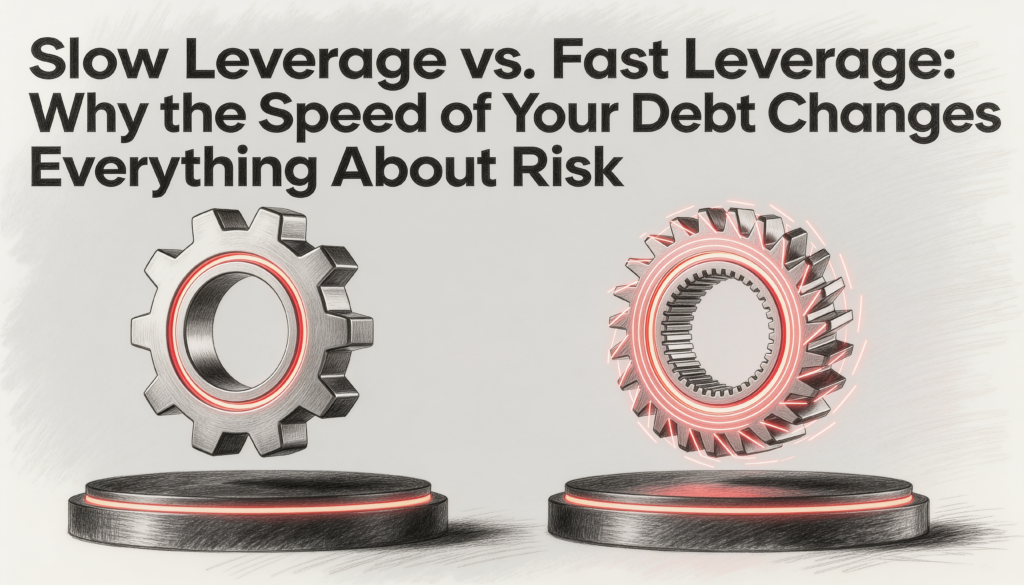
Here is where the framework earns its keep. Imagine a spectrum. At one extreme sits the thirty year fixed mortgage, where leverage unfolds across an entire generation. At the other extreme sits the zero days to expiration option, the now infamous 0DTE contract that lives and dies inside a single trading session. Every leveraged instrument in existence falls somewhere along this line.
Leverage velocity is the speed at which borrowed money converts into a final outcome. Low velocity gives you time to be wrong and recover. High velocity removes that mercy entirely.
The magnitude of the leverage matters, of course. But velocity is the variable almost everyone ignores, and it is the variable that decides who survives. A thirty year mortgage and a 0DTE call option can both grant you five to one exposure. The mortgage measures its feedback in years. The option measures its feedback in minutes. The numbers may rhyme, but the experience of holding them lives in entirely different universes.
The Mortgage End of the Spectrum
At the slow end, time behaves as a cushion. When a landlord makes a poor purchase, the clock is generous. Property values dip, rents stagnate, the roof needs replacing, and none of this feels pleasant. Yet the timeline grants room to recover, to raise rents, to refinance, to wait for a cycle to turn. The feedback loop between a decision and its consequence stretches across years. You have the luxury of being wrong and still finishing fine.
The 0DTE End of the Spectrum
At the fast end, that same time cushion disappears. A zero days to expiration option compresses the entire timeline into hours. The feedback arrives instantly. There is no refinancing a contract that expires worthless on Friday afternoon. The margin desk does not wait for you to formulate a recovery plan. The very clock that protects the landlord becomes the clock that destroys the trader.
Why Speed Changes the Nature of the Risk
Something counterintuitive happens when you increase leverage velocity. You do not merely raise the quantity of risk. You change its character entirely.
A real estate investor carrying a mortgage faces a risk that is, strangely, collaborative. The bank does not want you to fail. They issued a thirty year loan precisely because they expect repayment. The incentives sit roughly aligned. Your lender behaves like a reluctant and slightly annoying partner, but a partner nonetheless. They would genuinely prefer that you succeed.
A brokerage extending margin to an options trader holds no such relationship. If your position moves against you, they will liquidate it without a courtesy call. There is no restructuring a margin call. There is no phoning the desk to explain that the market will rebound next quarter. The relationship is transactional in the purest possible sense. You are not a partner. You are a position.
The slow leverage user plays a game where the other participants would prefer everyone to win. The fast leverage user plays a game where the other participants are completely indifferent to the outcome.
This distinction matters more than any difference in raw returns. As velocity rises, the people on the other side of your debt grow colder. The slow investor enjoys a partner. The fast trader faces a counterparty. The leverage is identical, yet the game is profoundly different.
The Margin of Error Collapses
Velocity also dictates how precise you have to be. The slow real estate investor can afford to be mediocre. Overpay slightly, underestimate the repairs, make a marginally weak deal, and still emerge ahead over twenty years. Time forgives sloppiness.
The high velocity options trader enjoys no such grace. They must be correct about direction, magnitude, and timing simultaneously. Being right about two of those three frequently produces the exact same result as being wrong about all three. As velocity increases, the demand for precision increases with it, and human beings are not wired to be precise about three independent variables at once.
The Psychology Built Into the Clock
There is a concept in behavioral psychology called intermittent reinforcement. It explains why slot machines are more addictive than vending machines. If a reward arrived every single time, the experience would be satisfying but forgettable. When the reward arrives at unpredictable intervals, walking away becomes almost impossible.
Slow leverage operates like a vending machine. You apply the effort, you collect the rent, and the process is predictable, steady, and psychologically unremarkable. Nobody has ever lost sleep from sheer excitement over a rental payment landing in their account.
Fast leverage operates like a slot machine. The gains are spectacular and random. The losses are equally spectacular and equally random. The screenshots of someone converting a few thousand dollars into a few hundred thousand are the reason new people keep arriving. The screenshots of someone converting a few hundred thousand into nothing are the reason the forum stays entertaining.
This reinforcement pattern shapes behavior in ways the participants rarely notice. The slow investor is trained by the market to be patient. The fast trader is trained by the market to keep pulling the lever. One system quietly builds wealth. The other generates stories. Stories are far more shareable than spreadsheets, which explains precisely why WallStreetBets commands millions of followers while your local landlord association does not.
The Dinner Party Theory of Wealth
There is a theory that people judge wealth not by its size but by its story. How you earned the money determines how others react to it, and leverage velocity sits at the center of that judgment.
Tell someone at a dinner party that you own rental properties and they will nod with approval. You are a landlord. You are building something. You are serious. Tell that same person you earned an identical sum trading options on meme stocks and watch their expression shift. You got lucky. You were gambling. You are not serious.
The money is the same. The social reception is not. We forgive slow leverage because it wraps itself in something tangible. A building feels like an investment. A derivative contract feels like a wager. The mathematics does not care about this distinction, yet people do, and since people create markets, their feelings eventually become a kind of mathematics all their own.
What Each End of the Spectrum Gets Right
It would be tempting to frame this as responsible adults on one side and reckless gamblers on the other. That framing is popular because it is simple, and it is wrong because it is simple.
The slow leverage community carries genuine blind spots. They undercount the cost of their own time. They describe managing properties as passive income when it frequently behaves like a second job with worse hours. They dismiss liquidity as though the inability to sell quickly were a feature rather than a limitation. And they possess a remarkable talent for ignoring how much less impressive their returns look once you subtract every hour of unpaid labor they personally contributed.
The high velocity crowd, for all its chaos, understands something the slow camp refuses to acknowledge. Capital efficiency matters. Tying up hundreds of thousands of dollars inside a single asset in a single neighborhood is a form of concentration risk that would horrify any competent portfolio manager. The notion that you can obtain leveraged exposure to markets without signing a thirty year contract, without managing tenants, without geographic concentration, is not a foolish notion. The execution is often catastrophic, but the underlying logic carries real merit.
The slow leverage investor is correct that low velocity is safer. The fast leverage trader is correct that high velocity is more capital efficient. They are both wrong to believe the other approach is simply stupid.
Choosing Your Position on the Spectrum
The framework becomes practical the moment you stop treating it as two warring tribes and start treating it as a dial you can deliberately set. Most people never make this choice consciously. They absorb a culture, adopt its instruments, and then defend the resulting velocity as though it were a personality trait.
A smarter approach asks three questions before taking on any leveraged position. First, how long is the feedback loop between the decision and its consequence? Second, does my counterparty want me to succeed, or are they indifferent? Third, how precise do I have to be, and am I honestly capable of that precision under pressure?
Answer those three questions and you can place any instrument on the spectrum. A fifteen year rental mortgage sits near the patient end. A leveraged exchange traded fund sits closer to the middle, magnifying daily moves while still allowing you to exit. A weekly options spread sits further along. A zero days to expiration contract sits at the violent edge. The instrument is far less important than the velocity it imposes on your life.
Where the Two Tribes Secretly Agree
Strip away the aesthetics, the Reddit posts, the property tours, the gain and loss screenshots, the landlord meetups, and you are left with two groups who share one core belief. Ordinary income from a job is not enough. Both have concluded that capital, rather than labor, is the genuine route to financial freedom. Both have selected leverage as the tool to arrive there sooner.
The true difference has nothing to do with intelligence or discipline. It comes down to which variety of uncertainty a person can actually tolerate. Some people can watch a property sit vacant for three months and remain calm. Other people can watch an options contract lose half its value in a single afternoon and remain calm. Both demand serious emotional control. Neither is easy. They are simply different flavors of the same difficult thing.
This is why leverage velocity deserves a place in your thinking right alongside the amount you borrow and the interest you pay. The slow investor’s edge is time. The fast trader’s edge is speed. One forgives mistakes, the other does not, and in a world where every single person makes mistakes, that forgiveness frequently decides who keeps their money and who hands it back to the market.
The Practical Takeaway
If you remember one thing from this piece, remember that risk is not a single number. It is a number multiplied by a speed. A modest amount of leverage moving at extreme velocity can wipe you out faster than an enormous amount of leverage moving slowly. When you evaluate any opportunity that involves borrowed money, measure the velocity before you measure anything else.
Ask how quickly the position can be forced to a conclusion against your will. Ask whether time stands on your side or against it. Ask whether your lender is a partner or a counterparty. The answers will tell you far more about your actual exposure than the headline return ever could.
Neither tribe will convince the other to change. The landlord will keep collecting rent. The trader will keep buying calls. And somewhere between them sits the lesson both sides overlook. Leverage is a tool, and tools do not care who holds them. The speed at which they operate determines whether the person holding one builds something lasting or simply hands their capital to someone faster, calmer, and more honest about velocity than they were.