Table of Contents
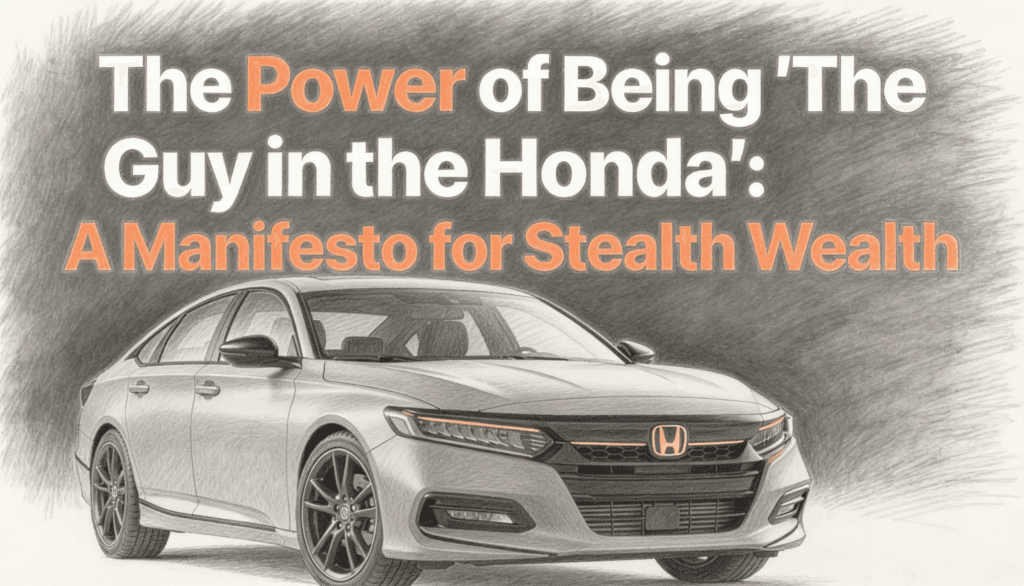
There is a particular kind of person who pulls into a parking lot in a ten year old Honda Accord, walks into a building wearing clothes that do not announce anything, and sits quietly while everyone else performs their wealth like a Broadway audition nobody asked for.
This person is often the richest one in the room.
That is not a motivational poster. It is a pattern. And the pattern tells us something uncomfortable about money, status, and the strange theater we have built around both.
The Peacock Problem
Nature gives us a useful starting point. The male peacock carries an absurd tail. It is heavy, it slows him down, and it makes him easier for predators to catch. But he displays it anyway because the tail signals genetic fitness to potential mates. Biologists call this costly signaling. The message is simple: I can afford to be this wasteful and still survive.
Luxury consumption works the same way. The designer watch, the German sedan, the shoes that cost more than some people’s rent. These are human peacock tails. They say: I have so much excess that I can light money on fire and still be fine.
But here is where the analogy breaks down. The peacock’s tail is real. It genuinely proves something about the bird carrying it. A leased Mercedes proves nothing about the person driving it except that they qualified for a monthly payment.
We are running peacock software on a system that no longer requires it. The signal has been completely divorced from the substance. And the people who understand this are the ones quietly driving Hondas.
The Visibility Tax
Every dollar you spend on looking wealthy is a dollar that is not building actual wealth. This is obvious when you say it out loud, yet entire industries exist to help people ignore it.
Think of visible spending as a tax. Not a government tax. A social one. You pay it to maintain a certain image, to keep up a performance, to make sure nobody at dinner suspects you might be ordinary. Call it the visibility tax.
The thing about taxes is that they compound in reverse. Every dollar sent toward the visibility tax is a dollar that does not compound forward. Over twenty or thirty years, the difference between the person who paid the visibility tax and the person who did not is staggering. Not because of one purchase, but because of the thousands of small performances that add up to a lifestyle built on exhibition rather than accumulation.
The guy in the Honda is not cheap. He just refuses to pay a tax that buys him nothing he actually wants.
What Wealth Actually Looks Like
We have a cultural image of wealth that is almost perfectly inverted from reality. Movies, social media, and advertising have trained us to associate wealth with consumption. The rich person has the big house, the fast car, the bottle service, the first class seat.
Some rich people do have these things. But the correlation between visible consumption and actual net worth is far weaker than most people assume. Studies on millionaires consistently find the same boring profile: they drive modest cars, live in houses below what they could afford, and spend less than they earn. Every year. For decades.
This is not because they are miserly. It is because they understand something that high earners who stay broke never figure out: wealth is what you do not see. It is the investments that sit quietly growing. The options that exist because capital exists. The freedom to say no to things that compromise your time or integrity.
You cannot photograph wealth. You can only photograph spending. And we have confused the two so thoroughly that most people are chasing the photograph instead of the thing it was never able to capture.
The Psychology of Enough
There is a concept in behavioral economics called the hedonic treadmill. You buy something nice. You feel great for a while. Then you adapt. The new baseline becomes normal, and now you need something even nicer to get the same feeling. Repeat until bankruptcy or exhaustion, whichever comes first.
The guy in the Honda stepped off the treadmill. Not because he does not enjoy nice things, but because he figured out that the treadmill does not go anywhere. It is a brilliant piece of engineering designed to convert money into momentary feelings at an increasingly terrible exchange rate.
Stepping off requires something that sounds simple but is psychologically brutal: you have to define enough. You have to draw a line and say, this is what I need to live well, and everything beyond it goes toward building something instead of displaying something.
Most people never draw that line. Not because they are greedy, but because the culture never asks them to. Every advertisement, every influencer, every “you deserve it” message is designed to make the line invisible. To keep you running.
Defining enough is not a financial act. It is a philosophical one. And it might be the single most profitable decision a person can make.
The Freedom Equation
Here is the part that rarely gets discussed. Stealth wealth is not really about money. It is about freedom.
When nobody knows what you have, nobody can leverage it against you. Your relatives do not show up with business proposals. Your friends do not keep a quiet ledger of who should be paying for dinner. Your employer does not assume you do not need a raise because you clearly have money.
Invisibility is a form of protection. It keeps your relationships honest. It keeps your negotiations clean. It lets you move through the world without the strange gravitational pull that visible wealth creates.
There is an old saying in poker: if you cannot spot the sucker at the table, you are the sucker. Visible wealth makes you easy to spot. Not as the sucker necessarily, but as the target. For salespeople, for opportunists, for anyone who sees your display and calculates what they might extract from it.
The guy in the Honda is playing a different game. He is not at the table to be seen. He is at the table to win. And winning, in the long game of building a life, usually looks a lot less interesting than people expect.
The Counterargument (And Why It Is Only Partly Right)
There is a legitimate criticism of stealth wealth culture. Sometimes appearance matters. If you are building a business, meeting investors, or operating in certain industries, looking the part is not vanity. It is strategy. A consultant who shows up in worn sneakers may lose a client not because the work would be worse, but because perception shapes trust in ways we cannot always override.
This is fair. Context matters. There are situations where strategic spending on appearance generates real returns.
But there is a meaningful difference between strategic presentation and lifestyle inflation disguised as necessity. The person who buys one good suit for client meetings is making a calculated investment. The person who fills a closet with designer labels for Instagram is paying the visibility tax and calling it a business expense.
The distinction is intent. Are you spending to build something? Or are you spending to be seen?
The Quiet Compound
The guy in the Honda often ends up with the ability to buy anything the peacock has, and more. He just does not want to.
That is the punchline. Stealth wealth is not about deprivation. It is about arriving at a place where the things that once seemed important simply are not anymore. The sports car does not disappear from the menu. It just stops looking appetizing.
We live in an age of maximum visibility. Everyone is broadcasting. Everyone is curating. Everyone is building a personal brand, which is really just a polite term for a permanent sales pitch aimed at people you do not know.
In this environment, invisibility is the real luxury. The ability to exist without performing. To have without displaying. To be wealthy in the way that matters, which is to say, in the way that nobody needs to verify.
The guy in the Honda understands something the rest of the parking lot does not. The car is not the point. The house is not the point. The clothes are not the point. The point is the life you can build when you stop spending energy on the performance and start directing it toward the thing itself.
He is not hiding his wealth. He is using it.
And that, more than any balance sheet or portfolio statement, is what makes him rich.