Table of Contents
Most people think money is a thing. A dollar bill. A number on a screen. Something you earn, spend, save, or lose.
But money is not a thing. Money is a verb disguised as a noun. It is an action pretending to be an object. And once you see it that way, everything about finance, investing, and even democracy starts to look different.
Let us start with what should be an unsettling question: what is money, really?
The Ontology Problem
Ontology is just a fancy way of saying “the study of what something actually is.” We do not usually bother with this question for money because the answer seems obvious. Money is currency. Money is value. Money is what sits in your bank account.
But try to pin it down and it slips away from you.
A dollar bill is not money. It is paper with ink on it. The number in your bank account is not money either. It is an entry in a database. Bitcoin is not money in any physical sense. It is a mathematical agreement between strangers.
Every Dollar Is a Ballot
Here is where it gets interesting.
Benjamin Graham, the father of value investing, once said the market is a voting machine in the short run and a weighing machine in the long run. He meant that prices reflect popularity in the moment but reality over time.
But Graham did not take his own metaphor far enough.
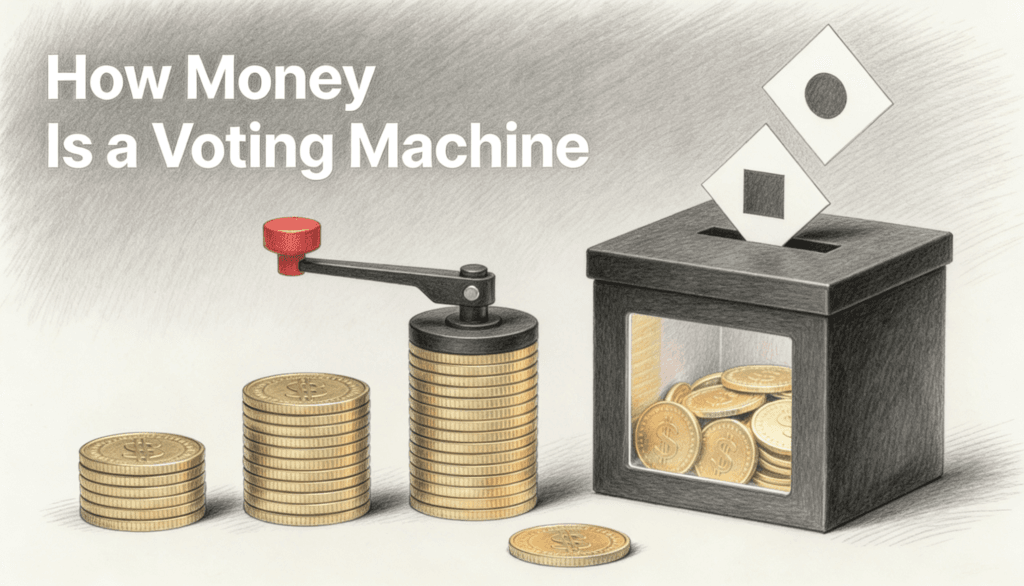
It is not just the stock market that works like a voting machine. Money itself is one. Every time you spend a dollar, you are casting a vote. Every time you invest, you are casting a vote. Every time you choose not to spend, you are still casting a vote.
Think about what happens when you buy coffee from a local shop instead of a chain. You just voted for that shop to continue existing. You voted for its employees to keep their jobs. You voted for its landlord to keep leasing the space. You voted for its coffee supplier to keep farming.
Now multiply that by every transaction happening on the planet right now. Trillions of tiny elections, running constantly, with no central authority tallying the results. The economy is not a machine. It is an ongoing referendum.
And unlike political elections, you do not get one vote. You get as many votes as you have dollars. Which brings us to the part nobody likes to say out loud.
The Democracy That Is Not One
Money as a voting system has a brutal flaw: the votes are not distributed equally.
In a political democracy, at least in theory, every person gets one vote. In the financial democracy, someone with ten million dollars gets ten million votes while someone with ten dollars gets ten. The market does not care about fairness. It cares about signal strength.
This is not a moral judgment. It is a structural observation. And it explains a lot of things that otherwise seem mysterious.
Why does the economy sometimes produce outcomes that most people do not want? Because most people do not have most of the votes. The market responds to money, not to preferences. If you prefer something but cannot pay for it, the market does not hear you. You are a voter without a ballot.
This is the part where money stops being a neutral tool and starts being a political instrument. Not political in the partisan sense. Political in the original Greek sense, meaning it shapes how the community organizes itself.
Price Is Not Value (And Never Was)
Once you accept that money is a voting mechanism, something else clicks into place. Price and value are not the same thing.
Price is what the voting machine says right now. Value is what the weighing machine says eventually. The gap between these two is where all the interesting things in finance happen.
A stock trading at fifty dollars is not worth fifty dollars. It is simply receiving fifty dollars worth of votes at this moment. Tomorrow, the voters might change their minds. The company behind the stock did not change. The voters did.
This is why markets can be rational and irrational at the same time. They are rational in the sense that they accurately reflect what people are voting for. They are irrational in the sense that what people vote for is often driven by fear, greed, narrative, and herd behavior rather than careful analysis.
The 2021 meme stock phenomenon was a perfect example. GameStop did not suddenly become a great company. What happened is that a large group of new voters showed up and started casting ballots. The voting machine registered their input faithfully. It was doing its job. Whether those votes reflected reality was a separate question entirely.
What Inflation Really Tells You
Inflation is usually described as prices going up. But that framing hides something important.
Inflation is what happens when the voting system gets flooded with new ballots. When central banks print money, they are not creating value. They are printing new votes. More votes chasing the same goods means each vote counts for less.
Think of it this way. If a school election allowed some students to photocopy their ballots, the winning candidate would not be the most popular one. It would be the one supported by whoever had access to the copier.
This is not a perfect analogy, but it captures something that dry economic language misses. Inflation is not just a price phenomenon. It is a dilution of financial voice. The people who receive the new money first get to vote before prices adjust. Everyone else shows up to find that their ballots buy less than they used to.
Economists call this the Cantillon Effect, named after Richard Cantillon, who noticed it in the 1700s. Three centuries later, it is still the most underappreciated concept in finance.
Saving Is Silence, Debt Is Borrowed Speech
If spending is voting, then saving is choosing not to vote. It is abstention.
This sounds passive, but it is not. When you save, you are withdrawing your votes from the current economy. You are saying: nothing available right now deserves my ballot. I will wait.
In aggregate, this is powerful. When an entire population starts saving aggressively, it sends a signal that the current menu of goods and services is not compelling enough. Businesses notice. They adapt, innovate, or fail. The silent vote is still a vote.
Debt, on the other hand, is borrowed votes. When you take out a loan, you are casting ballots with someone else’s money. You are voting for things today using your future self’s voice. This is fine when the thing you vote for generates enough value to pay back the loan. It is catastrophic when it does not.
The 2008 financial crisis was, at its core, a crisis of borrowed votes. Millions of people were casting ballots for houses they could not afford, using voices they had borrowed from the future. When the future arrived and demanded its voice back, the whole system collapsed.
The Strange Loop of Investing
Investing adds another layer to this. When you buy a stock or a bond, you are not just voting for a company. You are voting for a version of the future.
Every investment is a prediction wrapped in a transaction. You are saying: I believe this company, this sector, this country will matter more tomorrow than the market thinks it does today. If you are right, you get more votes. If you are wrong, you lose them.
This creates a strange loop. The act of investing changes the thing you are investing in. When enough people buy a stock, the company gets more attention, more capital, more talent, more momentum. The prophecy starts to fulfill itself. The voters create the outcome they voted for.
Money as Language
There is one more connection worth drawing. Money behaves a lot like language.
Both are systems of shared meaning that only work because everyone agrees to participate. Both evolve over time. Both can be used to tell the truth or to lie. Both are tools for coordination that no single person controls.
And just like language, money shapes thought. The way a financial system is structured determines what kinds of economic ideas are even thinkable. A society with no concept of credit cannot imagine entrepreneurship the same way. A society with no equity markets cannot distribute ownership the same way.
The linguist Benjamin Lee Whorf argued that the language you speak shapes the thoughts you can have. The same may be true of the monetary system you live in. Your financial vocabulary determines your financial imagination.
So What Do You Do With This?
Understanding money as a voting machine does not make you rich. But it does change how you see every financial decision you make.
When you spend, ask yourself: what am I voting for? When you save, ask yourself: what am I refusing to vote for? When you invest, ask yourself: what future am I trying to elect?
These are not abstract questions. They are practical ones. Every dollar you allocate is a statement about what you think should exist in the world. The market will tally your vote alongside billions of others and produce a result that nobody individually chose but everybody collectively created.
Money is not a thing you have. It is a voice you use. The question is whether you are using it deliberately or just making noise.
And if that sounds like too much responsibility for a Tuesday afternoon purchase, well, that is the cost of living inside a permanent, unending, global election where your wallet is your ballot box and the polls never close.